

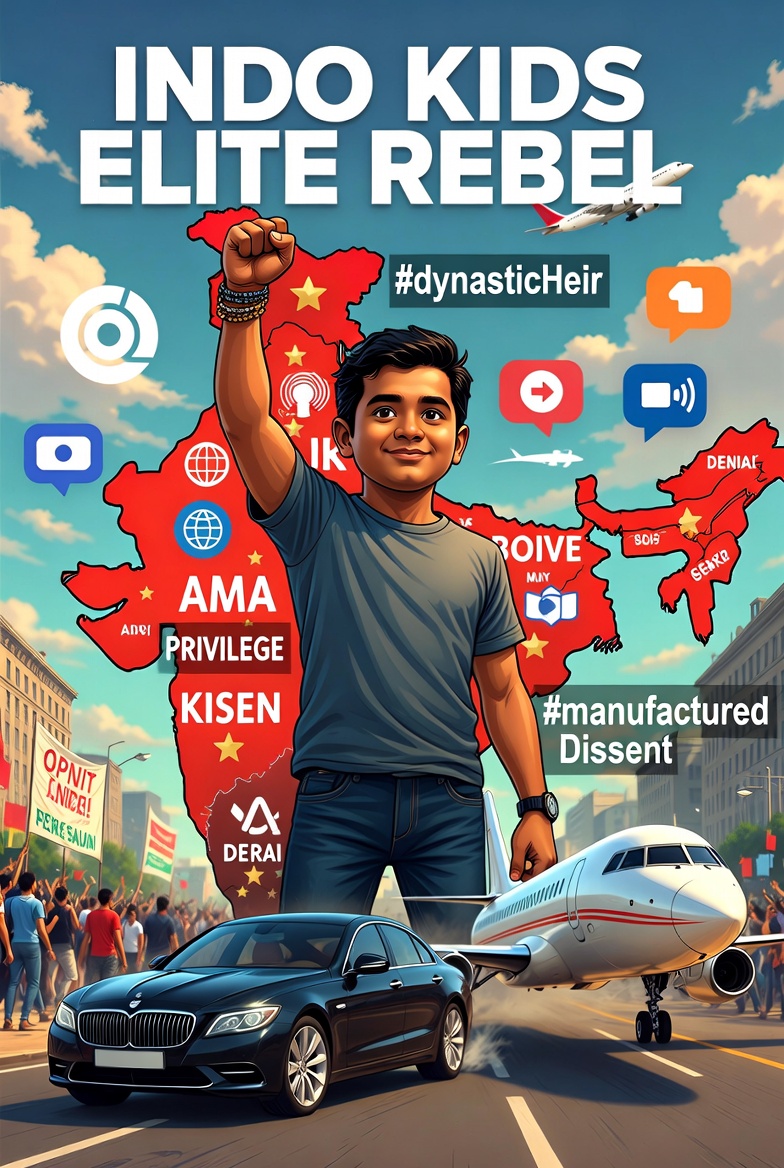
Indo Kids Elite Rebels: When Power’s Children Lead the Revolt Against Power
भारत/BG
Part 2: Nepo Kids vs Indo Kids: The Designer Revolution Series
The Paradox That History Keeps Repeating
Continuing with the analysis started in our previous blog — where we documented how India’s political heirs rebranded themselves after NDA’s rise shattered dynastic monopoly — we now examine the Indo Kids elite rebels phenomenon itself. Not who they are, but how the paradox actually works.
Nepal’s Nepo Kids were exposed and was forced to resign by a popular uprising. India’s Indo Kids elite rebels operate the opposite mechanism — they lead the uprising. The question is: how do children of privilege convince millions they represent the dispossessed?
Destabilization Doctrine Series
Uncover how America’s foreign policy tools—arming proxies and funding color revolutions—are boomeranging back, targeting India through encirclement and internal chaos. From Pakistan’s self-inflicted terror wounds to elite grooming of opposition figures, this series exposes the playbook behind manufactured unrest and regime change operations. Ties directly to how Indo Kids rebels are positioned in engineered movements.
Explore now:
- Destabilization Doctrine: How America’s Foreign Policy Boomerang Is Striking Home
- Activation of Destabilization Doctrine: The India Deployment Begins
- Rahul’s Gen Z Call: Activation of Destabilization Doctrine
- Target India Action Phase: Doctrine in Motion
- Regime Change Playbook: A Manual for Color Revolution Operations
Zero-Risk Activism: The Defining Feature
The most revealing characteristic of Indo Kids elite rebels is the complete absence of personal risk. Nepal’s Gen Z protesters faced live ammunition, rubber bullets, and mass arrests — at least 22 killed, over 1,000 injured. Bangladesh’s 2024 student uprising cost dozens of lives before Sheikh Hasina fled the country. Sri Lanka’s Aragalaya movement endured teargas and water cannons before Rajapaksa resigned.
In each case, genuine rebellion demanded genuine sacrifice.
India’s Indo Kids elite rebels operate under a fundamentally different risk calculus. Institutional protection — legal teams, media allies, international advocacy networks, diplomatic contacts — ensures that consequences remain theatrical rather than existential. Arrest becomes a photo opportunity. Detention generates international solidarity campaigns. Court cases stretch across decades while building personal brands. The rebellion is real enough to photograph, safe enough to survive.
This is not accidental. It is the product of careful design.
The Architecture of Manufactured Dissent
Indo Kids elite rebels do not emerge organically. They are manufactured through a pipeline that rivals any corporate talent development program.
Stage 1 — Credential Laundering: Western elite education transforms a political heir into an independent intellectual. Oxford, Harvard, Columbia — the institution’s prestige substitutes for the personal credibility that genuine activism would have earned. The heir returns not as a dynast but as an “internationally trained policy expert.” [hinduinfopedia.com — Great Deception series]
Stage 2 — Cause Adoption: The heir adopts globally resonant causes — climate justice, gender equity, minority rights, freedom of expression — that carry automatic moral weight in international media. These causes may or may not be real, but their adoption is strategic. The heir becomes the face of something larger than dynastic politics.
Stage 3 — Aesthetic Construction: The visual language of grassroots activism is meticulously curated. Handwritten placards, candlelight vigils, humble wardrobes for camera-facing moments, slum visits documented on professional-grade equipment. Every image communicates: “I chose to be here.” The privilege that enabled the choice remains invisible.
Stage 4 — Victim Narrative: The most critical stage. The heir must transform from beneficiary of power into victim of power. Legal cases help — even frivolous ones generate the necessary persecution narrative. Media interviews frame every setback as evidence of state oppression rather than political competition.
Stage 5 — Global Strategic Backing covering NED, USAID, Ford Foundation, Open Society networks, the Serbia-to-Arab-Spring playbook pattern, and the key concept of convergent assets — not recruited agents, but domestic ambitions that align with Washington’s strategic interests. The fellowship circuits, op-ed placements, and HRW citations framed as nodes in a documented network, not random journalism.
Manufacturing Defect Series
When humans stopped “making” humans through discipline and authority, society birthed defects like arrogance and unchecked freedom—evident in modern parenting and education. This series contrasts the crisis with RSS’s character-building model, emphasizing guru-shishya traditions for humble, capable citizens. Essential for understanding how elite rebels exploit these human flaws in their manufactured dissent.
Explore now:
Why It Works: The Psychology of Misdirection
Three psychological mechanisms make Indo Kids elite rebels effective where simple dynasty politics fails:
The Competence Halo: Now covers two tracks — English-speaking India (Oxford/Harvard credential laundering) AND vernacular India (caste networks, inherited organizational machinery repackaged as personal charisma). International education and articulate English-language communication create an assumption of merit that shields against nepotism charges. When a political heir speaks fluently about constitutional values at international forums, audiences assign competence regardless of how the platform was obtained. The degree becomes the credential. The credential replaces the track record. The track record was never required. A leader of Uttar Pradesh inherits a state apparatus and presents it as generational change, and the one from Bihar rides institutional backing and presents it as ideological conviction. Same function, different mechanism.
Sacrifice Illusion — London comfort vs. dusty village campaign trail. Both versions hide the same thing: the inherited machinery (security, media crew, pre-arranged crowds) that made the gesture possible. The comfort was never given up, only repackaged as campaign material.
Binary Trap — Named specific binaries for each track: Akhilesh critic = BJP apologist, Tejasvi critic = anti-Hindu. The enemy is chosen for you. Skepticism becomes complicity, nuance becomes betrayal.
Hindu Haq Series
Why are Hindu rights systematically denied? This series exposes the theological foundations normalizing discrimination—classifying Hindus as “kafir” without equal humanity—leading to daily asymmetries in law, education, and festivals. Reclaim Hindu Haq through recognition and constitutional equality, connecting to how elite narratives ignore these injustices.
Explore now:
The Nepal Contrast: Why Genuine Revolt Looks Different
Place Nepal’s Nepo Kids revolt alongside India’s Indo Kids phenomenon and the structural differences become unmissable.
Nepal’s movement was bottom-up: viral TikTok videos from ordinary citizens exposed politicians’ children flaunting luxury — designer clothes, Dubai vacations, palatial homes — while youth unemployment touched 20.8%. Per capita income hovered at $1,300. The contrast was documented, not manufactured. The anger was economic, not ideological. The movement had no celebrity faces because the celebrities were the target. When the government banned 26 social media platforms to silence the criticism, the streets erupted harder. Censorship confirmed what the videos showed.
India’s movement is top-down: media-visible heirs adopt the language of revolt, position themselves as champions of the dispossessed, and build campaigns that flow downward from institutional platforms into social media, not upward from social media into institutions. The machinery of amplification — think tanks, foreign media correspondences, international fellowships — precedes the movement rather than following it. The infrastructure exists before the cause is selected.
Nepal’s Gen Z demanded: “Explain where your money comes from.” India’s Indo Kids respond: “I’m fighting for your rights.” One question exposes power. The other performs service to it.
Sacred Boundaries Series
Protecting Hindu sacred spaces isn’t exclusion—it’s essential defense against infiltration and legal asymmetries enabled by “secularism.” From Salafist Trojan tactics using Muslim girls in festivals to doctrinal histories of dominance, this series documents erosion costs and calls for boundaries. Relevant to how manufactured rebels often blur these lines for political gain.
Explore now:
- Principle of Sacred Exclusion: Dharma’s Right to Boundaries
- Islamic Texts and Polytheist Verdict on Hindu-Muslim Interactions
- Islamic Doctrinal History: From Ridda Wars to Love Jihad
- Legal Asymmetry Against Hindus: How “Secularism” Enables Islamic Dominance
- Salafists Trojan Technique: Use of Muslim Girls in Hindu Festival Infiltration
Media Amplification: The Force Multiplier
No Indo Kids elite rebels operation succeeds without media infrastructure. The amplification follows a precise sequence:
Domestic Launch: A curated action — a provocative statement, a strategic arrest, a humanitarian visit — generates initial coverage in sympathetic domestic outlets.
International Pickup: Foreign correspondents based in Delhi, already networked with the same NGO ecosystem, amplify the story to global audiences. The heir transitions from “Indian politician’s child” to “young democracy activist facing persecution.”
Fellowship Circuit: International platforms — universities, think tanks, human rights organizations — provide speaking invitations that validate the narrative. Each appearance generates further coverage. The cycle becomes self-sustaining.
Social Media Conversion: International legitimacy flows back into Indian social media. Screenshots of foreign newspaper coverage, clips from international TV, awards from global organizations — these become domestic campaign material. “Even the world recognizes what I’m fighting for.”
This pipeline exists. It has identifiable nodes, funding patterns, and recurring personnel. We will examine its specific architecture in Blog 3.
Critiques and Common Objections
Here are the most frequent counterarguments to the analysis of Indo Kids elite rebels, along with concise rebuttals that strengthen the core thesis without denying observable effort.
1. Counterpoint: Some heirs show genuine commitment through sustained effort and personal risk
Rebuttal / Strengthening:
While effort exists, the nature and scale of risk differ fundamentally. Ordinary activists often face prolonged pre-trial detention without bail, torture allegations, or indefinite incarceration with minimal institutional protection. Elite heirs, by contrast, benefit from high-profile legal teams, international advocacy (Amnesty, foreign media campaigns), rapid bail, and interim relief. Privilege converts potential existential threats into manageable, brand-enhancing episodes. Genuine sacrifice requires vulnerability without safety nets; here the nets are inherited networks and global alliances.
2. Counterpoint: Dynastic politics has inclusive or democratizing effects in unequal societies
Rebuttal / Strengthening:
This “inclusion” is selective and family-based, not merit-based or systemic. It funnels representation through bloodlines rather than grassroots merit or broad movements. True democratization would lower entry barriers for everyone (campaign finance reform, party internal democracy), not replace them with inherited monopolies that correlate with poorer delivery (inherited voter loyalty reduces accountability). The result is not deeper democracy but captured representation — elite heirs mimic revolt to maintain control, not to empower the dispossessed.
3. Counterpoint: Intra-dynastic competition or family feuds prove accountability exists
Rebuttal / Strengthening:
These are contained competitions inside the elite family bubble. Power shifts between relatives, never to outsiders or grassroots challengers. Such intra-elite struggles enable adaptation (one heir adopts rebel aesthetics, another defends tradition) while preserving the family’s overall hold on resources and networks. This is not democratic accountability; it is dynastic Darwinism — the fittest performer survives to rebrand the lineage.
4. Counterpoint: Performative activism and privilege exist everywhere, not just among dynasts
Rebuttal / Strengthening:
Privilege and performance appear across the spectrum, but the Indo Kids phenomenon is distinct: it emerges specifically from the disruption of hereditary monopoly by non-dynastic governance. When merit-based challengers threaten family legacies, heirs pivot to “outsider” rebellion — adopting internationally resonant causes while leveraging inherited platforms. This is not generic elitism; it is targeted elite adaptation to democratic pressure, where the rebel costume safeguards the throne.
Nehru Series
Nehru’s historiography glorified Islamic invaders as “vigorous and virile” bringers of vitality, while omitting temple massacres, forced conversions, and Hindu resistance—shaping a narrative that delegitimizes grievances. This series dissects the linguistic reframing that sustains secular myths and elite rebranding today. Uncover the roots of distorted Indian history.
Explore now:
The Civilizational Pattern: Elite Adaptation
The Indo Kids elite rebels phenomenon is not unique to India. It represents a civilizational pattern visible across post-colonial societies wherever genuine democratic forces threaten entrenched elites.
In Latin America, elite families often adopt leftist or progressive looks while keeping their economic power and influence intact—like the Kirchner family in Argentina and the Turbay family in Colombia.
In Southeast Asia, military families create “democracy advocates” who challenge certain governments but protect the system. In the Middle East, royal-linked figures fund “reform movements” to keep dissent under control.
The pattern is the same everywhere: when real democratic pressure threatens elites, they don’t fight democracy—they take it over. They create their own critics, reformers, and revolutionaries. The revolution is captured before it even starts.
This is exactly what we see with Indo Kids Elite Rebels in India: using privilege to stage rebellion while preserving power. Read Destabilization Doctrine series to understand the full concept
Great Deception Series
Expose global deceptions in civilizational warfare—from Europe’s rapid Palestine recognitions to UN’s anti-Israel bias and the two-state delusion shattered by votes. This series reveals how illusions sustain power imbalances, with Palestine as a laboratory tested across continents. Parallels the manufactured narratives enabling elite rebel facades in India.
Explore now:
- September 2025: Europe’s 48-Hour Surrender Explained
- Two-State Delusion Exposed: Netanyahu’s 99-9 Vote That Shattered Consensus
- When Dictatorships Vote on Democracy: UN’s Legitimacy Crisis
- Anti-Israel Obsession: UN’s Statistical Evidence of Institutional Bias
- Palestine as Global Laboratory: Civilizational Warfare Strategy Tested Across Continents
What Comes Next
We established in Blog 1 how Indo Kids narrative shaping operates as a strategic response to NDA’s disruption of dynastic politics. In this blog, we have dissected the paradox itself — how privilege performs rebellion, why zero-risk activism succeeds, and how the Nepal contrast exposes the manufacturing process. The four-stage pipeline — credential laundering, cause adoption, aesthetic construction, victim narrative — is not a conspiracy theory. It is observable infrastructure with identifiable outputs.
Next in series: “Indo Kids NDA Effect: Why Dynasties Needed Rebranding”
Feature Image: Click here to view the image.
Videos
Glossary of Terms
- Indo Kids elite rebels — Elite political heirs in India (often from dynastic families) who rebrand as activists or rebels through manufactured dissent, international credentials, and zero-risk activism to preserve power after dynastic disruption.
- Nepo Kids — Children of entrenched political elites who inherit influence through family lineage rather than merit; term popularized in Nepal’s 2025 uprising against nepotism and luxury flaunting amid poverty.
- Credential Laundering — Process where Western elite education (e.g., Oxford, Harvard) transforms a dynastic heir into an “independent intellectual” or policy expert, substituting institutional prestige for genuine activist credibility.
- Zero-Risk Activism — Form of rebellion where privileged participants face theatrical consequences (photo-op arrests, international campaigns) shielded by legal, media, and diplomatic networks, unlike genuine grassroots sacrifice.
- Competence Halo — Psychological effect where international education and fluent English create perceived merit, shielding dynasts from nepotism criticism despite lacking independent track records.
- Sacrifice Illusion — Disproportionate perception of commitment when a privileged person “chooses” activism over comfort, ignoring that it’s often a strategic family career move.
- Binary Trap — Framing dissent as “support the rebel or support authoritarianism,” eliminating nuance and positioning critics as system defenders.
- Manufacturing Defect — Crisis in human character formation due to lack of discipline and authority, producing arrogant, uncontrolled individuals exploitable by elite manufactured dissent.
- Hindu Haq — Hindu civilizational and constitutional rights systematically denied through theological discrimination (e.g., “kafir” classification) and legal asymmetries.
- Sacred Boundaries — Dharmic right to protect Hindu sacred spaces and rituals from infiltration, contrasting with imposed secular asymmetries enabling dominance.
#IndoKids #NepoKids #DynasticPolitics #EliteRebels #इंडोकिड्स #नेपोकिड्स #वंशानुगतराजनीति #कुलीनविद्रोही #IndoKids #DynasticPolitics #NarrativeControl #PoliticalActivism #NepoKids #DynasticPolitics #PoliticalNarrative #HinduinfoPedia #इंडोकिड्सकथानिर्माण #IndoKidsNarrativeShaping
Read Earlier Blogs
- https://hinduinfopedia.org/rss-character-manufacturing-system-global-export-possibility/ https://hinduinfopedia.in/?p=24973
Leave a Reply