
Category: Bharat

Home » Bharat
Yoga Sutra 1.19, Bhava Pratyaya, Videha Yogis, Prakriti Laya, Samadhi, Viveka Khyati, Spiritual Discernment, Yoga Philosophy, Kaivalya, Patanjali Yoga, Meditation States, Non Attachment, Sankhya Philosophy, Cosmic Consciousness, Spiritual Liberation, Bhava Pratyaya Videha
Post

Bhava Pratyaya Videha Yogis: Spiritual Privilege And Rebirth (Yoga Sutra 1.19)

Bhava Pratyaya Videha Yogis represent inherited meditative capacity carried across lifetimes, granting effortless access to profound samadhi. Patanjali warns that such absorption—whether bliss-based or cosmic—remains within nature unless completed by viveka-khyāti. True liberation arises not from experience alone, but from discriminative wisdom that dissolves even subtle bondage.

sahool, plumb bob, symbolism, construction metaphor, moral decay, imbalance, dusty atmosphere, glowing brass, scaffold, brick wall, cinematic lighting, sepia tones, ethics, traditional tools, philosophy, societal collapse, introspection, KBC and the Plumb Line
Post

KBC and the Plumb Line: When a Society Loses Its Moral Measure

This article explores how modern society abandoned its moral plumb line, leading to collapsing discipline, confused rights, and fractured families. Through Hindu principles of dharma, balanced reward–correction, and compassionate firmness, the piece explains why early guidance forms character and why false kindness creates long-term harm. A call to restore structure and rebuild human formation.

fire deity, sacred fire, Vedic imagery, cosmic battlefield, warriors, golden flames, martial symbolism, divine commander, spiritual energy, epic illustration, glowing altar, disciplined troops, fiery aura, mythic atmosphere, strategic power, Rigvedic Fire-General
Post

Rigvedic Fire-General: Agni as Army Commander – Rigveda 1.66

Rigveda 1.66.5-8 reveals Agni as strategic commander—eternal will incarnate, brilliant as golden chariots in battle, commanding like an army rushing to attack, operating with twin-force across present and future. These verses establish Vedic doctrine of organized defense under righteous leadership, completing the canonical triad with Indra's fortress-breaking and Maruts' shock-troops for civilizational protection.

Maruts, Vedic storm warriors, Rigveda imagery, celestial war host, storm vortex, elemental warriors, mythic defense, Vedic aesthetics, digital illustration, storm energy, divine protection, martial symbolism, swirling clouds, lightning warriors
Post

Rigvedic War-Host: The Maruts as Divine Shock Troops

The Rigvedic hymn 1.64 presents the Maruts as a unified storm-host embodying the protective power of ṛta. Far from mere poetic embellishment, traditional and modern commentaries show the Maruts functioning as guardians of order who remove obstacles, strengthen communities, support rightful authority, and provide the inner resilience needed for civilizational continuity and collective defense.

British colonialism, Indian education, Macaulay, Gurukul, cultural genocide, HinduinfoPedia, history
Post

Cultural Genocide by British: India’s Civilizational Soul Destroyed

British rule in India was more than economic exploitation—it was cultural genocide. Through Macaulay’s education policy, caste codification, missionary propaganda, and historical distortion, the British dismantled India’s civilizational memory. This blog uncovers how they replaced Gurukuls with colonial schools, suppressed Ayurveda, and divided society—leaving a legacy of mental colonization that still lingers.

India, Britain, Industrial Revolution, colonialism, wealth drain, East India Company, history, economics, HinduinfoPedia, deindustrialization, British loot
Post

British Loot and Industrialize: How India Funded Britain’s Rise

Britain’s Industrial Revolution didn’t emerge from innovation alone—it was bankrolled by India’s wealth. From Bengal’s Diwani revenues to opium trade and cotton extraction, British industry rose on Indian poverty. This blog exposes the $45 trillion drain that built modern Britain while deindustrializing Bharat—an economic heist masked as civilization.

India, RSS, global vision, HinduinfoPedia, unity, leadership, future, century, progress, spirituality, Sankalp Patra, nationalism
Post

Future Vision: Path of the Coming Century

The RSS Centenary Sankalp Patra outlines a Future Vision for the next century, balancing tradition and modernity. From institutional growth and social transformation to global leadership, diaspora roles, AI ethics, education, Ayurveda, and cultural revival, the roadmap emphasizes dharma-based life, harmony, and world welfare. It envisions India as a moral, cultural, and spiritual guide.

RSS, Planning, Reality, Implementation, Rashtriya Swaimsewak Sangha
Post

Vasudhaiva Kutumbakam: Indian Vision for Global Welfare

The RSS centenary Sankalp Patra reaffirms Vasudhaiva Kutumbakam: the whole world as one family. From spiritual roots in Sanatana Dharma to practical visions for peace, justice, environment, economy, and culture, this vision contrasts with Western globalization by emphasizing harmony, cooperation, and universal brotherhood. It is not dominance, but India’s civilizational duty of sharing.

Odisha Famine, 1866 famine, British Raj, starvation, colonial history, Indian famines, humanitarian crisis, historical photo, famine victims, British exploitation, Odisha history, HinduinfoPedia
Post

Bengal Famine and British Genocides: How Colonial Policies Killed Millions

Between 1765 and 1947, British rule caused twelve major famines that killed an estimated 30–60 million Indians. These were not natural calamities but deliberate policy outcomes—tax rigidity, grain exports, and racist governance that turned droughts into genocides. The blog exposes how colonial profit replaced compassion, making famine Britain’s deadliest legacy in India.

English, feature image, RSS, Planning, Reality, Implementation, Rashtriya Swaimsewak Sangha
Post

From Planning to Reality: RSS’ Practical Implementation

The blog From Planning to Reality: Practical Implementation explores how the Rashtriya Swayamsevak Sangh translates resolutions into action. It covers branch expansion, training, leadership development, institutional building, harmony, and technology, showing how clarity, discipline, and evaluation transform vision into tangible social change. This journey reflects the Sangh’s century-long experience of turning commitments into reality.

Kohinoor diamond, British Crown Jewels, colonial plunder, Tipu Sultan sword, Amaravati sculptures, Indian heritage, stolen artifacts, British Museum, HinduinfoPedia, cultural genocide
Post

British Stole Indian Treasures: Colonial Plunder and Cultural Genocide

Britain’s colonial conquest of India was not only political but civilizational. Millions in wealth, sacred art, and knowledge were stripped from Bharat—Tipu Sultan’s treasures, Amaravati Marbles, Kohinoor Diamond, and ancient manuscripts now fill British museums. This plunder erased India’s cultural memory and redefined its heritage as imperial trophies—a crime whose echoes still resonate today.

RSS, Struggle to Solution, Modern Challenges, Practical Pathways, Centenary Sankalp, HinduinfoPedia, India, Social Change, National Unity, Blog
Post

From Struggle to Solution: Facing Modern Challenges

Modern challenges span from information wars and judicial bias to environmental crises and cultural disintegration. The RSS centenary declaration reaffirms that solutions must rest on dharmic strength and national unity. By combining adaptation, innovation, and cooperation, Bharat can move from struggle to solution while offering the world a vision of harmony and resilience.

East India Company, Divide and Rule, British Raj, Colonial India, Indian History, Partition, Bharat, Colonial Strategy, British Empire, HinduinfoPedia
Post

Divide and Rule by East India Company

The British didn’t conquer India by force alone—they conquered it through division. Divide and Rule by East India Company reveals how religion, caste, region, and class were systematically weaponized to keep Bharat fragmented. From Plassey to Partition, it exposes how a civilizational mosaic was turned into a map of conflict and dependency.

Swayamsevak in service during crisis — embodying discipline, compassion, and selfless duty for society.
Post

Spiritual Foundation: Power of Sarve Bhavantu Sukhinah

The centenary declaration of RSS makes clear that every program—shakha expansion, leadership, social change—rests on a deeper spiritual foundation. Expressed in the timeless prayer Sarve Bhavantu Sukhinah, this foundation guides individuals from self-discipline to world peace. It is not limited to ritual but extends into families, society, and Bharat’s global responsibility.

Panch Parivartan, Hindu philosophy, transformation, spiritual growth, RSS vision, Indian culture, five dimensions, family values, societal harmony, national unity, global peace, Sanskrit quote, Indian spirituality
Post

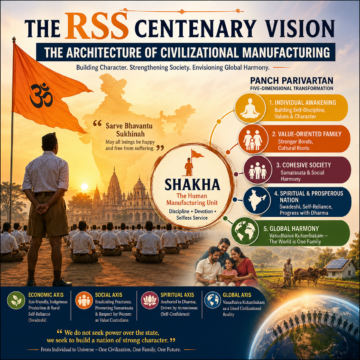
Panch Parivartan: The Five-Dimensional Transformation

Panch Parivartan represents the most comprehensive goal of the RSS Centenary Declaration—five layers of transformation from the self to the world. It begins with individual discipline, extends into family values, social harmony, and national strength, and culminates in global welfare. This five-dimensional model weaves unity, prosperity, and spirituality into one continuous process of renewal.

RSS, swayamsevak, cleanliness drive, social service, environment, community, discipline, unity, transformation, volunteerism, Social Metamorphosis
Post

Social Metamorphosis: From Values to Culture

Social Metamorphosis: From Values to Culture is not just about reform, but a holistic transformation of society. It begins with individuals shaped by values, extends into families, education, and communities, and balances economic strength with cultural revival. Women, youth, technology, and even the global Hindu diaspora together create a living model of harmony and collective progress.

Organizing Noble People, community, gathering, family, meal, togetherness, harmony, society, HinduinfoPedia
Post

Organizing Noble People: Power of Social Transformation

The RSS centenary declaration emphasizes that progress cannot rest on numbers alone. The third goal, Organizing Noble People, calls for uniting value-driven individuals from education, culture, industry, and public life. By nurturing confidence, civic duty, and leadership, this organization builds harmony in society, strength in the nation, and a vision of global peace.

Morning shakha discipline: RSS swayamsevaks embodying unity and character training—the living foundation of गुणात्मक सुधार, Striving for Character Excellence
Post

Striving for Character Excellence: Enhancing Shakha Quality

Striving for Character Excellence is not a matter of numbers but of depth—discipline, dharma, and duty. The RSS centenary resolution emphasizes that shakhas must nurture confidence, values, and responsibility through training, prayer, and collective living. From individuals to families and society, this pursuit builds the foundation of a harmonious Hindu society for global peace.

truck, Malayalam text, Hindi text, Seva Bharati, RSS, Kerala, social service, banner, yellow truck, blue truck
Post

Centenary Resolution: From Shakha Expansion to Social Transformation

Centenary Resolution: From Shakha Expansion to Social Transformation Part 3: RSS Centenary Sankalp Blog Series Centenary Resolution And Role of Shakha Among the five goals established at the historic Centenary Resolution gathering in Bengaluru, the first and most fundamental objective is “Shakha Expansion.” This represents the transformation of Dr. Hedgewar’s 1925 vision into the reality...

Pledge for the World: The Vision of a Harmonious and Organized Hindu Society
Post

Pledge for the World: The Vision of a Harmonious and Organized Hindu Society

Samras and Sangathan are more than words; they form the blueprint for civilizational renewal. Harmony ensures dissolution of caste, regional, and economic divides, while organization channels collective energy toward dharmic goals. The resolution insists that such a society, guided by sajjan shakti, can offer the world a practical path to enduring peace and cooperation.