

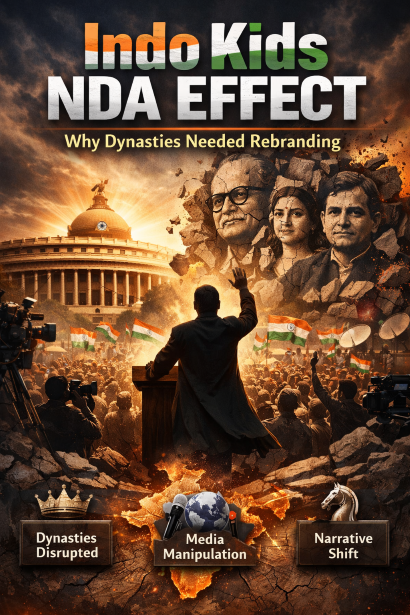
Indo Kids NDA Effect: Why Dynasties Needed Rebranding
भारत/BG
Part 3 of “Nepo Kids vs Indo Kids: The Designer Revolution Series”
The Trigger That Changed Everything
Every civilization’s political calculus shifts when an outsider breaks the monopoly. Rome’s patrician order fractured when plebeians demanded the consulship. Britain’s aristocratic Parliament transformed when the Reform Acts let commoners in. In India, a 5,000-year-old civilizational democracy — the world’s largest — witnessed its own tectonic disruption when the 2014 general election delivered power to a leader with no dynasty, no inherited party apparatus, and no establishment credentials. Continuing from our previous analysis where we dissected how Indo Kids elite rebels manufacture dissent through zero-risk activism and institutional protection — we now trace the Indo Kids NDA effect to its origin: the moment when India’s political dynasties realized that inherited power was no longer a guaranteed path to governance.
The Indo Kids NDA effect is not about ideology. It is about survival. When the National Democratic Alliance demonstrated that a chai-wala could defeat a dynasty, every political heir in India confronted an existential question: reinvent or perish.
Intel Brief: The Destabilization Doctrine
Is the chaos organic, or is it a blueprint? Explore the Regime Change Playbook and the mechanics of the “India Deployment.”
Indo Kids NDA Effect: Formula Broke of 2014
For six decades after independence, Indian democracy operated on a predictable formula. Political families — Congress’s Nehru-Gandhis foremost, but also regional dynasties across every state — controlled party tickets, campaign funding, media access, and institutional networks. The formula was simple: bloodline guaranteed candidacy, party machinery guaranteed votes, and government machinery guaranteed returns.
2014 shattered this formula with unprecedented electoral force. A party that had won 44% of all post-independence elections was reduced to 44 seats — its worst result in history. The NDA secured 336 seats. The margin was not competitive defeat — it was existential humiliation.
What made this result devastating for dynasties was not just the numbers. It was the mechanism. Narendra Modi’s campaign demonstrated that mass democratic mobilization could bypass every traditional gatekeeping structure that dynasties controlled. Direct voter outreach through rallies and social media replaced the intermediary networks — caste brokers, local strongmen, party fixers — that dynastic politics depended upon. The Indo Kids NDA effect began the moment those intermediate structures became optional.
The Cascade: State by State
The 2014 disruption was not a one-time event; it was a foundational shift. The 2019 General Election acted as the definitive consolidation of this trend, where the NDA increased its tally to 353 seats, proving that the rejection of dynastic entitlement was not a fleeting protest but a permanent realignment of the Indian voter. This momentum cascaded through India’s political geography, dismantling dynastic strongholds in sequence.
Uttar Pradesh (2017): The Samajwadi Party-Congress alliance — a dynastic merger designed to combine two inherited vote banks — was obliterated. BJP won 312 of 403 seats. Akhilesh Yadav’s experiment of presenting inherited machinery as generational change failed its first major electoral test.
Rajasthan, Madhya Pradesh, Chhattisgarh (2023): Three states where Congress had built recent comeback narratives were swept by BJP, proving that even successful governance by dynasty-linked leaders could not withstand the NDA organizational machinery.
Karnataka (2023): The exception that proved the rule — Congress won, but through a meticulously de-dynasted campaign that foregrounded Siddaramaiah over family names.
Each loss intensified the Indo Kids NDA effect. Each loss forced another cohort of political heirs to accept that the old formula — surname equals candidacy equals power — was permanently broken. The question was no longer whether to adapt, but how.
Indo Kids NDA effect: The Three Survival Strategies
Facing the NDA disruption, India’s dynastic heirs split into three distinct survival strategies. Each strategy produced a different variant of the Indo Kids phenomenon.
Strategy 1 — The Policy Intellectual:
Transform from political heir into independent thinker. Adopt a portfolio of globally resonant policy positions — data privacy, climate action, parliamentary reform — that signal competence independent of surname. The Oxford thesis becomes the credential. The TED talk becomes the campaign speech. The heir doesn’t campaign for votes — they campaign for relevance, trusting that media platforms will convert intellectual capital into political capital. This is the Rahul Gandhi pivot from reluctant prince to “institutional voice.”
Strategy 2 — Tactical Asceticism:
The heir performs a ritualistic abandonment of privilege. They walk long distances, sleep in villages, and wear khadi conspicuously as a form of “Grassroots Cosplay.” Document every humble moment on social media. This strategy converts the perceived sacrifice of comfort into evidence of authenticity. The heir doesn’t deny the dynasty — they perform its transcendence.
Strategy 3 — The Permanent Dissident:
This is the most structurally important strategy for the Indo Kids NDA effect. When electoral victory becomes improbable, the heir pivots from contesting power to contesting legitimacy. Every government action becomes evidence of authoritarianism. Every institutional response becomes persecution. The heir transforms from a losing candidate into a “freedom fighter” — a role that requires no electoral mandate, no governance track record, and no accountability to constituents. International media provides the audience that domestic voters denied, effectively outsourcing the “opposition” role to global institutions when local mandates fail. This creates a bridge to the media networks analyzed below.
HINDU HAQ: THE DENIED REALITY
“The daily drumbeat that denies Hindu rights through theological normalization.”
Controlled Dissent: The Comeback Mechanism
The Indo Kids NDA effect produced its most sophisticated output in the mechanism of controlled dissent. Unlike genuine protest movements — which emerge from grievance, operate without institutional backing, and face real consequences — controlled dissent is designed from inception to serve dynastic recovery.
The architecture is precise, pivoting away from the local voter toward a Global PR offensive. An issue with genuine emotional resonance is identified — agricultural distress, unemployment, communal tension, judicial independence. Dynastic heirs position themselves as champions of that issue, not to win over the Indian hinterland, but to trigger “democracy in danger” alerts across Western editorial boards. The framing ensures that any resolution of the issue credits the heir, while any continuation of the issue indicts the government. Media allies convert this positioning into a continuous narrative of courageous opposition.
The key feature of controlled dissent is that it never threatens the structure of elite power. Farm protests challenge specific policies but never land ownership patterns. Unemployment agitations demand government jobs but never question the private sector networks that dynastic families control. Communal harmony campaigns target majoritarian politics but never examine the minority vote-bank structures that dynasty parties built.
Genuine dissent asks uncomfortable questions of everyone. Controlled dissent asks uncomfortable questions only of the current government — and offers dynasty restoration as the answer.
SACRED EXCLUSION & DHARMA
Analyzing the right to boundaries and the legal asymmetry enabled by secularism.
Indo Kids NDA effect: Amplifying and Rebrand By Media Networks
No dynastic rebrand succeeds without media infrastructure, and the Indo Kids NDA effect activated media networks that had been dormant during the decades when dynasties simply held power.
The transformation was visible in real-time. Outlets that had spent decades as government-adjacent during Congress rule repositioned themselves as “independent watchdogs” the moment NDA took power. The editorial shift was not ideological — it was structural.
The UPA era had institutionalized a culture of mass media bribery, where journalists enjoyed a “free ride” on the taxpayer’s dime—complete with free luxury lodging, boarding, and the finest wines on state-sponsored foreign junkets. This entitlement was choked off the day Modi landed in Delhi. When the luxury suites and overseas bars were closed to them, the “independent watchdog” was born out of withdrawal symptoms.
Media organizations whose ownership, advertising revenue, and regulatory access depended on these Congress-era relationships found their leverage disappearing under a government that operated outside traditional elite networks.
International media played a complementary role. The coverage pattern was consistent: dynastic heirs framed as democratic champions, NDA governance framed as authoritarian drift, every opposition setback narrated as persecution rather than political competition. This was not conspiracy — it was convergence. The same NGO networks, the same think tank circuits, the same foreign correspondent relationships that dynastic families had cultivated during decades in power naturally amplified narratives favorable to their restoration.
The Indo Kids NDA effect thus created a feedback loop: electoral loss increased media visibility, media visibility increased international support, international support increased domestic narrative power, and domestic narrative power partially compensated for electoral weakness.
ROOT ANALYSIS: THE NEHRUVIAN HISTORIOGRAPHY
How 70 years of “whitewashing” created the vacuum for today’s Indo-Kids.
Indo Kids NDA effect: The Civilizational Stakes
What makes the Indo Kids NDA effect historically significant is not the dynastic adaptation itself — elites have adapted to democratic pressures for centuries. What is significant is what the adaptation reveals about Indian democracy.
The NDA disruption proved that India’s democracy is functional enough to remove entrenched power through the ballot box — something Nepal, Bangladesh, and Sri Lanka could only achieve through street revolution or military intervention.
The Indo Kids phenomenon proves that India’s elite networks are sophisticated enough to survive that removal through narrative capture — something that failed in every other South Asian country where anti-dynasty movements succeeded.
India thus presents a unique civilizational paradox: its democracy is strong enough to produce genuine transfer of power, and its elite infrastructure is resilient enough to contest that transfer continuously. The battle is not between democracy and authoritarianism, as international media frames it. The battle is between democratic mandate and elite narrative — between the authority of 600 million votes and the influence of networks that span Delhi, London, Washington, and Geneva.
This is the deeper pattern that the Indo Kids series has been building toward. Blog 1 documented the narrative shaping. Blog 2 dissected the elite rebel mechanism. This blog has traced the political trigger — the Indo Kids NDA effect that made all of it necessary.
PILLAR: THE GREAT DECEPTION
Deconstructing the UN’s institutional bias and the “New York Declaration” theater.
What Blog 4 Reveals
In Blog 4 — “Manufacturing the Revolutionary” — we move from causes to mechanics. The specific playbook: how an heir becomes a revolutionary, who funds the transformation, which organizations provide the platforms, and what the promotional pipeline looks like from the inside. The names, the networks, and the money trails.
The Indo Kids NDA effect created the demand. Blog 4 examines the supply.
Next in series: “Indo Kids Revolutionary Playbook: Manufacturing the Revolutionary”
Feature Image: Click here to view the image.
Leave a Reply