

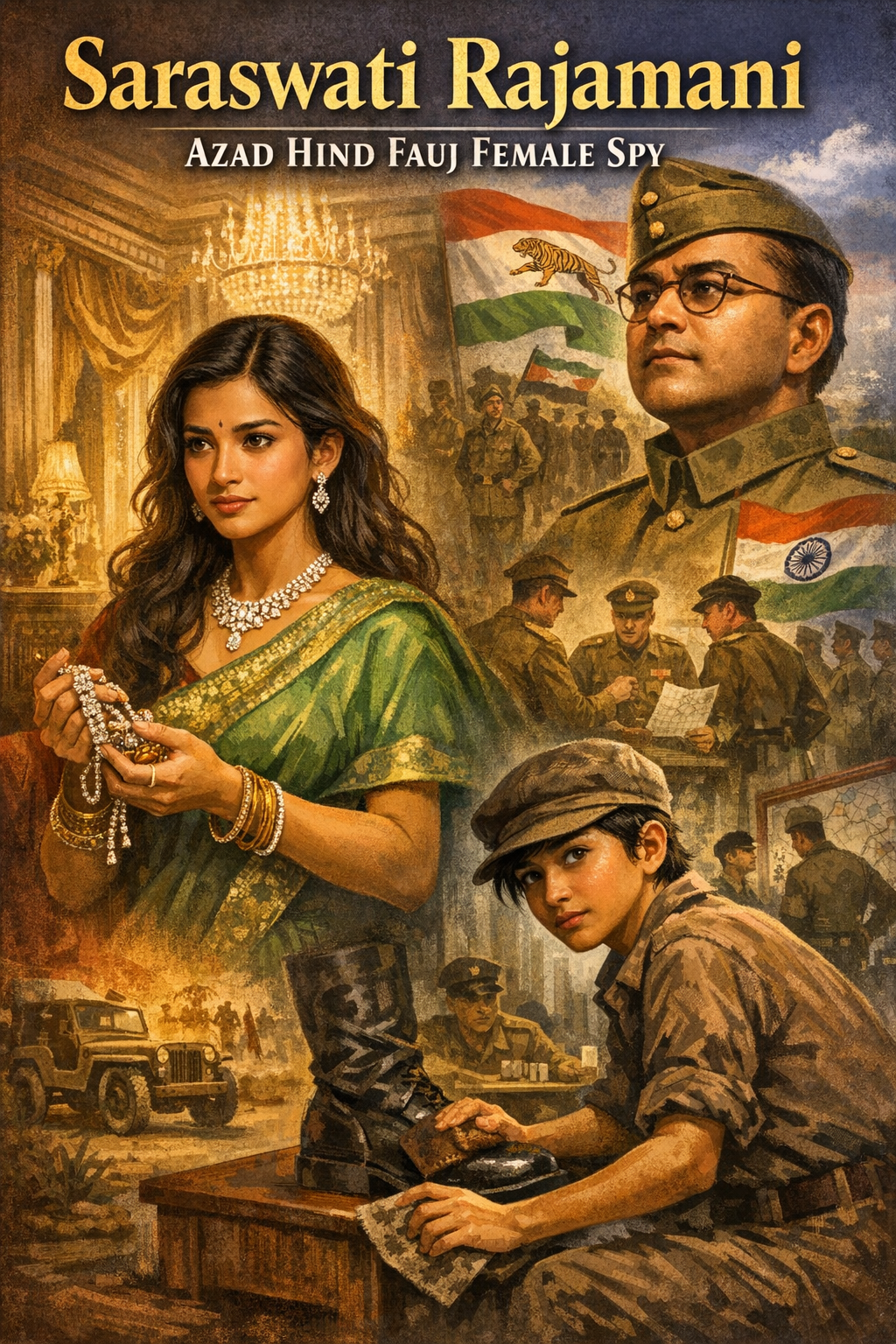
Saraswati Rajamani: Azad Hind Fauj Female Spies
Saraswati Rajamani The Philanthropist Teen
On the birth anniversary of one of India’s rare war heroines, Saraswati Rajamani, observed on the eleventh of January, we present a brief tale of her life. Year 1942. Rangoon, present-day Myanmar. In one of the wealthiest neighborhoods, stood a teenage girl, at her bedroom windows adorned with glittering diamonds round her throat and silk dress that kissed the marble floors.
She was from royal lineage who never knew what hunger was , never walked on unpaved roads and always attire in the finest fabrics imported from the British Empire.
She was the 15 year old maiden named Saraswati Rajamani.
Within weeks, she would be disguised as a boy , polishing British officers’ boots and memorizing battle plans that would determine the fate of India’s freedom struggle.
This gave birth to one of ” Azad Hind Fauj’s female spies — not out of desperation or poverty but a conscious choice to abandon all comforts for a much greater cause.
The Thunder That Changed Everything
The news spread through Rangoon’s Indian community like wildfire: Netaji Subhas Chandra Bose had arrived. The man who had escaped house arrest, crossed continents, and challenged Gandhi’s monopoly on India’s freedom strategy was now in Burma, building an army that would march on India itself.
Young Rajamani insisted on attending the rally. Her father—a gold mine owner whose wealth rivaled minor royalty—reluctantly agreed. After all, what harm could come from a political speech?
When Netaji mounted the platform before thousands of Indians in Rangoon, his voice cut through the humid air like a blade:
“Give me blood, and I will give you freedom.”
Not petitions. Not negotiations. Not the passive resistance that had defined the Indian National Congress under Gandhi’s leadership for decades. Blood. Immediate sacrifice. Total commitment.
Rajamani felt something ignite in her chest—a fire that no amount of wealth could extinguish.
Without hesitation, standing in that crowd, she removed her diamond necklace. Then her gold bangles. Then her emerald earrings. Every piece of jewelry adorning her body—gifts accumulated over fifteen years of privilege—she placed in the collection box for the Azad Hind Fauj fund.
Her family was horrified. These weren’t trinkets. These were heirlooms worth a small fortune, enough to fund a battalion.
When Netaji Came to Her Door
The next morning, an army jeep stopped outside the Rajamani mansion.
Netaji Subhas Chandra Bose himself stepped out.
He had come to return the jewelry. He assumed—reasonably—that a teenage girl had donated such expensive items in a moment of emotional fervor. She was young, from a sheltered background, perhaps didn’t understand the permanence of her decision. He would return them quietly, save her family the embarrassment.
But when Netaji stood before her in that grand parlor, surrounded by all the wealth her family had accumulated, young Rajamani looked him straight in the eye:
“Netaji, I did not give them by mistake. They were my offering to my country. And I do not take back what I have given.”
Netaji stared. He had recruited soldiers, trained commandos, negotiated with Japanese generals and German officials. He had seen courage in many forms. But this—a sixteen-year-old girl from unimaginable privilege, speaking with the certainty of a seasoned warrior—this stopped him cold.
No fear. No doubt. Only steel-like determination.
He smiled. A real smile, not the diplomatic expressions he offered to politicians and bureaucrats.
“I want you in my team,” he said. “But not with a gun. Your work will be even harder.”
He gave her a new name that day: Saraswati. A goddess’s name for a girl who would need divine courage for what was coming.
The Transformation: From Heiress to Azad Hind Fauj Female Spies
What Netaji understood—and what made him a strategic genius—was that the British would never suspect teenage girls. While other revolutionaries conducted armed raids and dramatic attacks, Netaji was building an intelligence network that could operate inside the enemy’s most secure facilities.
He needed Azad Hind Fauj female spies. Not combatants. Not propagandists. Invisible intelligence operatives who could disappear into the background of colonial society.
Under Netaji’s direct orders, Saraswati Rajamani’s transformation began.
Her long hair—the pride of wealthy Indian families, maintained with expensive oils and braided by servants—was cut short. Hacked off with military scissors until she could pass as a boy.
The silk dresses were replaced with loose cotton shirts and trousers, the kind worn by local Burmese youth who worked menial jobs.
Her name changed again. “Saraswati” was too formal, too memorable. She became “Mani”—common, forgettable, perfect for espionage.
She was paired with another recruit: Durga, a girl of similar age and equally fierce commitment. Together, they would form one of the most effective intelligence cells operating behind British lines.
Their mission was brutally simple: infiltrate British military facilities and steal their secrets.
Inside the Belly of the Beast: Azad Hind Fauj Spy Operations Begin
Imagine it.
A girl who had never cleaned her own room now scrubbed floors in British military mess halls.
A teenager who had servants bring her meals now served tea to the officers planning to bomb the very army she belonged to.
A young woman who spoke fluent English—her family’s pride—now pretended to be an illiterate local boy who understood nothing.
Mani and Durga were placed as domestic workers inside British military compounds in Rangoon. The cover was perfect: teenage Burmese boys doing menial labor, invisible to the white officers who barely acknowledged their existence.
The British generals assumed these “boys” understood no English. So right in front of them—while Mani polished their boots, while Durga swept their floors—they held war council meetings.
“We’ll bomb the INA positions at these coordinates.”
“Supply convoys will move through this route on Tuesday.”
“Intelligence suggests Bose’s troops are concentrated here—we’ll shell the area at dawn.”
Every word was recorded. Every map memorized. Every code analyzed.
Mani’s mind became a filing cabinet of military intelligence. After finishing her work, she would retreat to the bathroom, write everything on tiny slips of paper, and hide them inside hollowed bread loaves or the soles of shoes. These messages would then be smuggled to Netaji’s headquarters.
Day after day, this deadly hide-and-seek with death continued.
While Gandhi’s followers courted arrest through civil disobedience, the Azad Hind Fauj female spies played a different game—one where capture meant torture and execution, not just imprisonment.
The intelligence Mani and Durga provided saved countless INA lives. Ambushes were avoided. Supply lines were protected. Counter-attacks were planned with precision.
But espionage is a profession with a short life expectancy. Everyone in the intelligence networks knew the mathematics: eventually, you get caught. The only question was whether you could escape—or whether you’d die with your secrets intact.
The Price of Privilege Abandoned
Saraswati Rajamani’s family back in Rangoon had no idea where she was. Her father—who had built his fortune with careful calculation—could not comprehend why his daughter had vanished into Netaji’s army.
She could have lived her entire life in comfort. When India eventually gained independence, she could have celebrated from her mansion, sipping tea while others sacrificed.
Instead, she chose to become one of the Azad Hind Fauj female spies—arguably the most dangerous role in the entire independence movement.
Male soldiers could die with honor on battlefields. Azad Hind Fauj spy operations offered no such dignity. If caught, female operatives faced torture designed specifically to break women. The British had no Geneva Convention obligations toward “terrorists”—which is what they called all INA members.
Yet every morning, Mani woke up, disguised herself, and walked back into British military compounds.
The Rule That Haunted Every Spy
The Azad Hind Fauj had one absolute rule for its intelligence operatives:
If captured, end yourself. Do not be captured alive.
Every spy carried a cyanide capsule. If cornered with no escape, they were expected to bite down and die within seconds. This wasn’t cruelty—it was mercy. British interrogators had techniques that made death preferable.
Mani and Durga both knew this rule. They had accepted it the day they joined the intelligence wing.
But rules are easier to accept in theory than in practice.
Because one night, in the darkness of a Rangoon military prison, that rule would be tested.
And the girl who gave Netaji her gold would face a choice that would define the rest of her life.
The Woman History Forgot
Today, when we search for Azad Hind Fauj female spies in our history textbooks, we find almost nothing. A footnote, perhaps. A single paragraph if we’re lucky.
While male freedom fighters received statues and streets named after them, the women who risked torture and death in intelligence operations remain largely anonymous.
Saraswati Rajamani chose to abandon everything—wealth, security, family, her very identity—for India’s freedom. She transformed from a teenage heiress into one of the most effective intelligence operatives in the entire independence movement.
But her story doesn’t end with espionage triumphs.
It ends with a night of blood and bullets, three days hiding in a tree with a gunshot wound, and a life of poverty in independent India that would shame every citizen who enjoys the freedom she paid for.
Why This Story Matters Now
The sacrifice of Azad Hind Fauj female spies like Saraswati Rajamani reveals an uncomfortable truth about India’s independence narrative: we remember the speeches and the famous names, but we forget the invisible soldiers who bled in silence.
Netaji Subhas Chandra Bose understood what many leaders didn’t: freedom cannot be won with symbolism alone. While others courted arrest and sought martyrdom in public squares, the Azad Hind Fauj built a professional military and intelligence apparatus.
Azad Hind Fauj spy operations succeeded because they recruited people willing to sacrifice everything—including recognition, including memory, including the very possibility that future generations would know their names.
Saraswati Rajamani gave her jewelry, her identity, her youth, and nearly her life.
India gave her nothing in return.
On her birthday—January 11—we remember not just what she did, but what we owe her.
Coming January 13, 2025: The second part of this series reveals how Saraswati Rajamani rescued her captured partner from a British military prison, took a bullet while escaping, and survived three days in a tree while bleeding and hunted by British soldiers with dogs. Then we’ll see how independent India rewarded her sacrifice—with poverty, neglect, and a lonely death at age 91 that no television channel covered.
The girl who gave Netaji her gold deserves better than our silence.
Feature Image: Click here to view the image.
Related Videos
Related Reading:
- Subhash Chandra Bose: Contrasting Strategies with Gandhi
- Lesser Known Freedom Fighters: Bravery Beyond Boundaries
- Chittagong Armoury Raid: Women Revolutionaries Who Chose Death Over Capture
- India’s Freedom Struggle: Beyond Gandhi’s Non-Violence
Glossary of Terms
- Azad Hind Fauj (Indian National Army): A liberation army formed during World War II under the leadership of Subhas Chandra Bose to militarily overthrow British colonial rule in India.
- Female Intelligence Operatives (INA): Young women recruited by the Azad Hind Fauj to conduct covert espionage, surveillance, and intelligence transfer inside British military installations.
- Rangoon (1940s): Present-day Yangon in Myanmar, a strategic British military hub during World War II and a key base for INA intelligence operations.
- British Military Compounds: Secured colonial installations in Southeast Asia used by British forces for planning air raids, troop movement, and logistics during the war.
- Espionage Cell: A small, compartmentalized intelligence unit designed to gather and transmit classified military information while minimizing exposure and detection.
- Cyanide Capsule Protocol: A mandatory rule for INA spies requiring self-termination if capture was imminent, to prevent torture-based intelligence extraction.
- Colonial Interrogation Methods: Psychological and physical torture techniques employed by British forces against captured revolutionaries and intelligence operatives.
- Disguised Identity Operations: The practice of altering gender, appearance, language behavior, and social status to infiltrate enemy environments undetected.
- Intelligence Smuggling Techniques: Methods such as hiding written data in food, footwear, or clothing to secretly transport military intelligence to INA headquarters.
- Invisible Soldiers of Independence: Freedom fighters whose contributions were critical yet deliberately concealed and later excluded from mainstream historical recognition.
#AzadHindFauj #NetajiBose #FreedomFighters #WomenInHistory #HinduinfoPedia
Follow us:
- English YouTube: https://www.youtube.com/@Hinduofficialstation
- Hindi YouTube: https://www.youtube.com/@HinduinfopediaIn
- X: https://x.com/HinduInfopedia
- Instagram: https://www.instagram.com/hinduinfopedia/
- Facebook: https://www.facebook.com/Hinduinfopediaofficial
- Threads: https://www.threads.com/@hinduinfopedia
Leave a Reply