

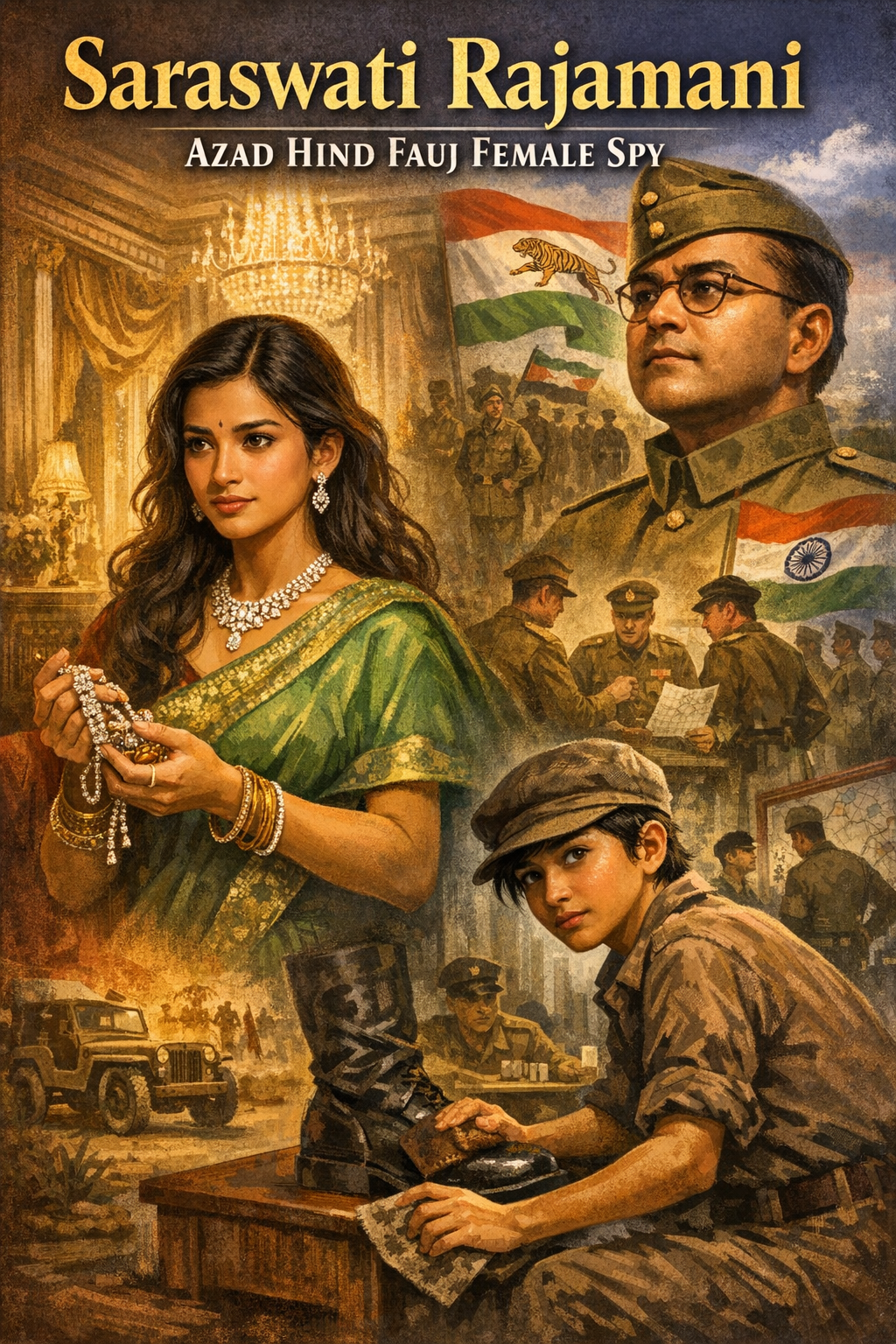
Spy Saraswati Rajamani: Azad Hind Fauj Female Spies-II
Netaji’s Spy Saraswati Rajamani
We present the second installment on the little-known spy Saraswati Rajamani, who devoted her youth to the cause of India’s freedom. Every spy knows the mathematics of their profession: eventually, you get caught. The only questions are whether you can escape, and whether you’ll die with your secrets intact.
Author’s Note: Some contextual statements in this account reflect documented patterns of colonial interrogation practices and post-independence neglect of INA veterans. Where direct archival records for Saraswati Rajamani are unavailable, such observations are presented as historically grounded interpretation rather than personal attribution.
For Azad Hind Fauj spy operations, the stakes were even higher. Male soldiers captured by the British faced interrogation and execution. Female operatives faced something worse—torture designed specifically to break women, sexual violence as a weapon, and deaths so brutal that the Azad Hind Fauj issued its absolute rule:
If captured, end yourself. Do not be captured alive.
Every intelligence operative carried a cyanide capsule. Bite down, and death came in seconds. Better than what the British had planned.
Saraswati Rajamani—the teenage heiress who gave Netaji her gold and became one of the Azad Hind Fauj’s most effective female spies—carried that capsule every day. She had accepted that rule when she joined the intelligence wing.
But rules are easier to accept in theory than in practice.
Because one night in 1943, in the darkness of a Rangoon military prison, that rule would be tested. And the girl who polished British officers’ boots while memorizing their battle plans would make a choice that defined courage itself.
The Nightmare Becomes Real: Azad Hind Fauj Spy Operations Under Siege
The intelligence network operating in Rangoon had been remarkably successful. While Gandhi’s followers courted arrest through symbolic civil disobedience, Azad Hind Fauj spy operations delivered actionable military intelligence that saved lives.
Mani (Saraswati Rajamani) and Durga had established a perfect routine. Disguised as local Burmese boys working menial jobs, they moved invisibly through British military compounds. Officers discussed troop movements, bombing targets, and supply routes right in front of them—assuming these “boys” understood no English.
Every secret was memorized, written on tiny slips of paper, hidden inside bread loaves or shoe soles, and smuggled to Netaji’s headquarters. The intelligence prevented ambushes, protected supply lines, and gave the Indian National Army tactical advantages that confounded British commanders.
But espionage networks have a limited lifespan. Someone talks. Someone gets careless. Someone gets betrayed.
One evening in late 1943, Durga didn’t return from her shift at the British mess hall.
The Choice: Run or Rescue
When the news reached Mani—Durga had been captured and was locked in a British military prison—the other intelligence operatives were unanimous:
“Run. If you go there, you’ll die too.”
They were right. The standing order for Azad Hind Fauj spy operations was explicit: if one operative is captured, the others scatter. Preserve the network. Don’t compound the loss.
British interrogators were systematic. They would torture Durga for information about the intelligence network. Every name, every safe house, every contact. And when they were finished extracting information, they would execute her as a terrorist.
The smart play—the strategic play—was for Mani to disappear into the Burmese countryside, report back to INA headquarters, and rebuild the intelligence network with new operatives.
But Saraswati Rajamani hadn’t given up her wealth, her identity, and her safety to make smart plays.
She looked at the men telling her to run and said:
“My friend has been caught, and I will run away? I will not allow that.”
Inside the British Fortress: Azad Hind Fauj Spy Operations at Maximum Risk
What Mani planned was suicide dressed as a rescue mission.
The British military prison where Durga was held wasn’t some colonial outpost—it was a heavily fortified compound in central Rangoon, designed to hold captured insurgents and political prisoners. Guards patrolled 24/7. Searchlights swept the perimeter. The walls were high, the gates were thick, and escape was considered impossible.
Mani studied the facility for days, watching guard rotations, timing shift changes, identifying vulnerabilities. She knew the guards’ weakness from her time working in British messes: opium and alcohol.
While revolutionary women like Pritilata Waddedar had attacked British clubs head-on, Mani’s approach was different. Azad Hind Fauj spy operations succeeded through invisibility, not confrontation.
On the chosen night, disguised once again as a local boy delivering supplies, she entered the prison compound carrying food and tea. The guards knew her face—she’d been bringing deliveries for weeks, building familiarity, becoming part of the background.
But this time, the tea and food were laced with strong opium.
Within an hour, the guards on night shift began nodding off. Their eyelids grew heavy. Their vigilance evaporated.
When the last guard slumped over his desk, Mani moved.
She stole the keys from his belt, navigated the dark corridors, and found Durga’s cell. The lock clicked open. Two teenage girls who had given up everything for India’s freedom stood face to face in a British military prison.
They had minutes at best.
The Escape: When Azad Hind Fauj Spy Operations Turn into Combat
The plan was simple: climb the prison wall before the guards woke, disappear into Rangoon’s streets, and vanish.
They almost made it.
Mani and Durga were halfway up the outer wall when the alarm siren screamed into the night. Someone—a guard who hadn’t drunk enough opium, or a patrol rotation they’d miscalculated—discovered the escape.
Searchlights swept across the compound. Soldiers poured out of barracks. Rifles were raised.
“HALT OR WE FIRE!”
They didn’t halt.
Dropping from the wall’s exterior, they ran into the darkness. Behind them, chaos erupted—officers shouting orders, dogs barking, boots pounding pavement.
And then the shooting started.
Bullets cracked through the night air, slamming into walls, ricocheting off stone. Mani felt something hit her right leg—not like pain, but like a ball of fire tearing through her flesh. The bullet entered below her knee and exited through her calf, leaving a channel of destroyed tissue.
Blood soaked through her clothes immediately. The pain twisted her body. Every step became agony.
But stopping meant death. Not just for her—for Durga too.
Bleeding heavily, they ran.
Three Days in Hell: The Price of Azad Hind Fauj Spy Operations
They made it to a dense forest on Rangoon’s outskirts before Mani collapsed from blood loss. British soldiers with trained tracking dogs were minutes behind them.
Durga looked at her wounded friend, looked at the approaching searchlights, and made a decision that would haunt both of them.
She dragged Mani to a massive tree with thick foliage and helped her climb into its upper branches.
And there they stayed.
For seventy-two hours.
Think about what that means:
- A bullet wound in Mani’s leg, the hole open and bleeding, with no medical treatment
- Fever burning through her body as infection set in
- No water. No food.
- British patrols directly below them with dogs
- One sound—one movement—and it was over
The dogs circled the tree multiple times. Soldiers searched the area repeatedly. At one point, a British officer stood directly beneath their branch, smoking a cigarette while talking about where the “terrorists” might have gone.
Mani, barely conscious with pain and fever, had to remain absolutely silent. One groan, one shift of weight on a branch, one sound of fabric against bark—and both girls would be captured, tortured, and executed.
For three days and three nights, they clung to those branches.
The wound in Mani’s leg festered. Blood soaked into the bark. Fever made her delirious. Durga had to physically hold her friend to prevent her from falling or crying out in pain.
When British patrols finally gave up the search on the third day, assuming the fugitives had escaped the area or died in the forest, the two girls climbed down.
Mani could barely walk. The bullet wound had become infected, swollen to twice its size, leaking pus and blood. Every step was torture.
But they limped back to the Azad Hind Fauj camp.
Netaji’s Salute: Recognition of Azad Hind Fauj Spy Operations Excellence
When Mani and Durga stumbled into the INA encampment, Mani was nearly unconscious from sepsis and blood loss. Soldiers carried her to the medical tent where field doctors worked to remove the bullet fragments and clean the wound.
Netaji Subhas Chandra Bose came to see her.
This man—who had escaped British house arrest, crossed continents, negotiated with Axis powers, and built an army from scratch—stood before a teenage girl who had risked everything to save her comrade.
As the doctors extracted metal fragments from her leg without anesthesia, Netaji saluted the sixteen-year-old warrior and said:
“I did not know our army had such powerful explosives hidden within it. You are India’s first woman spy. You are my Rani of Jhansi.”
Comparing her to Rani Lakshmibai—the queen who died fighting the British in 1857—was the highest honor Netaji could give.
He wanted to gift her his personal pistol, given to him by the Emperor of Japan. But Rajamani wanted only one thing: India’s freedom.
The Final Irony: What Independent India Gave Her in Return
India became independent on August 15, 1947.
The British left. The Congress took power. Nehru became Prime Minister. The country celebrated.
And Saraswati Rajamani—who had given her youth, her blood, her father’s fortune, and nearly her life for that freedom—watched from the margins.
Her name never appeared in history textbooks. No statues were erected. No streets were named after her. While male freedom fighters received pensions and recognition, the woman who conducted Azad Hind Fauj spy operations behind enemy lines was forgotten.
The girl who once slept on golden beds in a Rangoon mansion spent her final decades in a decaying one-room rented house in Royapettah, Chennai. Not poverty—extreme poverty.
The government of independent India delayed giving her the freedom fighter’s pension for years. Bureaucrats shuffled papers while the woman who bled for three days in a tree couldn’t afford medicine.
Yet she never complained.
The 2004 Tsunami: When She Gave Again
In December 2004, when the Indian Ocean tsunami devastated coastal communities, relief funds were established for victims. The entire country mobilized to help.
Among the donors was an elderly woman from Chennai who gave her entire saved pension to the relief fund.
When journalists asked why she donated money she desperately needed for her own medicine, Saraswati Rajamani smiled and said:
“Giving is in my blood. In childhood, I gave everything for my country’s freedom. Today I gave for my country’s people.”
The woman who had given Netaji her diamonds at age fifteen was still giving at age eighty.
The Death No One Noticed
On January 13, 2018, Saraswati Rajamani died of a heart attack at age ninety-one.
No national mourning was declared. No breaking news on television. No statements from politicians. No front-page obituaries.
India’s first woman spy—one of the most effective intelligence operatives in Azad Hind Fauj spy operations—died as she had lived in independent India: forgotten.
Why This Matters More Than Ever
The story of Azad Hind Fauj spy operations reveals an uncomfortable truth about India’s independence narrative: we remember the speeches but forget the soldiers. We celebrate the symbolic gestures but ignore the bleeding.
While Gandhi’s non-violent movement received international attention, Azad Hind Fauj spy operations succeeded because they recruited people willing to sacrifice everything—including recognition, including memory, including the very possibility that future generations would know their names.
Saraswati Rajamani represents thousands of forgotten warriors:
- The women who conducted espionage behind enemy lines
- The soldiers who died in Burma fighting for Indian freedom
- The revolutionaries who chose armed resistance when others chose symbolism
- The intelligence operatives who saved lives through information that never made headlines
Their sacrifice wasn’t symbolic. It was blood, bullets, and three days clinging to a tree branch while British soldiers searched below.
The Debt We Cannot Repay
Today, when we search for information about Azad Hind Fauj female spies or Azad Hind Fauj spy operations, we find almost nothing. The institutional amnesia is complete.
But consider what Saraswati Rajamani gave:
- At fifteen, she donated her family’s wealth—diamonds, gold, emeralds—to fund the INA
- At sixteen, she abandoned her identity to become “Mani,” an invisible spy
- She risked torture and execution daily while gathering intelligence in British compounds
- She rescued her captured comrade from a military prison despite orders to flee
- She took a bullet during the escape and survived three days in a tree with untreated wounds
- She lived the rest of her life in poverty, never complaining about independent India’s neglect
- At eighty, she donated her pension to tsunami victims despite having nothing herself
What does India owe her?
At minimum: memory.
At best: a rewriting of our independence narrative to include the soldiers who bled while others made speeches.
Breaking the Silence
On this anniversary of her death—January 13—we face a choice:
Continue the institutional amnesia that allowed her to die forgotten, or finally acknowledge that India’s freedom was purchased not just with symbolism but with blood.
The Azad Hind Fauj spy operations succeeded because young people like Saraswati Rajamani chose sacrifice over safety. They operated in the shadows so that future generations could live in the light.
The question for independent India is simple: Will we honor that sacrifice, or will we continue pretending that freedom came through non-violence alone?
Netaji called her his “Rani of Jhansi.” He recognized her courage.
Independent India let her die in poverty and silence.
Her True Legacy
The most powerful aspect of Saraswati Rajamani’s story isn’t the dramatic prison rescue or the three days bleeding in a tree—it’s what she did after independence.
She never demanded recognition. Never complained about neglect. Never turned bitter about the country that forgot her. And when the 2004 tsunami struck, she gave again.
That’s not just patriotism. That’s a level of character that shames every politician who claims to represent Indian values while ignoring the warriors who built the foundation they stand on.
Her legacy isn’t just about Azad Hind Fauj spy operations or intelligence work or military history. It’s about what it means to serve without expecting reward, to sacrifice without demanding recognition, to give when you have nothing left to give.
What We Owe Her Now
We cannot repay Saraswati Rajamani. She’s gone.
But we can:
- Remember her name. Share her story. Teach our children that India’s freedom struggle included intelligence operatives, not just protesters.
- Document the others. She wasn’t the only one. Hundreds of Azad Hind Fauj female spies and male operatives died without recognition. Their stories deserve excavation from historical silence.
- Challenge the narrative. The Gandhi-centric independence story is incomplete. Armed resistance, military strategy, and intelligence operations were equally crucial.
- Honor forgotten warriors. Every freedom fighter deserves recognition, not just those whose methods aligned with post-independence political narratives.
- Demand better. When governments ignore the warriors who built the nation, citizens must demand accountability.
The Final Word
When Saraswati Rajamani climbed that tree in 1943 with a bullet wound in her leg, British soldiers below her, fever burning through her body, and no certainty she’d survive the next hour—she wasn’t thinking about history books or recognition.
She was thinking about Durga. About their mission. About keeping her secrets even if it killed her. About the freedom she might never live to see.
That’s the definition of courage: sacrificing everything for a cause greater than yourself, knowing you might never witness the victory.
India became free.
Saraswati Rajamani died poor and forgotten.
The least we can do—the absolute minimum—is remember her name.
Today, January 13, 2025, marks seven years since her death.
No government commemorations. No official ceremonies. No politicians laying wreaths.
Just a teenage girl who gave Netaji her gold, became India’s first woman spy, bled in a tree for three days, lived in poverty, donated her last money to tsunami victims, and died alone.
If this story makes you angry, it should.
If it makes you question our national narrative, it should.
If it makes you want to excavate more forgotten stories from India’s independence struggle, it should.
Because somewhere in Chennai, there’s a unmarked grave containing the body of a woman who deserved better than our silence.
Her name was Saraswati Rajamani.
And she was one of the most extraordinary warriors India ever produced.
Remember her.
Feature Image: Click here to view the image.
Videos
Glossary of Terms
- Azad Hind Fauj: The Indian National Army formed under Subhas Chandra Bose to fight British rule through armed struggle during World War Two.
- Indian National Army Intelligence Network: A covert system of couriers, spies, and informants operating behind enemy lines in Southeast Asia to gather British military information.
- Saraswati Rajamani: A teenage female intelligence operative of the Azad Hind Fauj who worked undercover in Rangoon during the nineteen forties.
- Mani: The operational alias used by Saraswati Rajamani during her intelligence missions inside British military establishments.
- Durga: A fellow teenage Azad Hind Fauj intelligence operative and close associate of Saraswati Rajamani during Rangoon operations.
- Rangoon: The capital city of British Burma, now Yangon in Myanmar, where several INA intelligence activities took place.
- Cyanide Capsule: A poison capsule carried by revolutionary operatives to avoid capture, interrogation, and torture by colonial authorities.
- British Military Prison, Rangoon: A fortified detention facility used by British authorities to hold captured insurgents and political prisoners during World War Two.
- Rani of Jhansi Regiment: The women’s regiment of the Azad Hind Fauj established under Subhas Chandra Bose to encourage female participation in armed resistance.
- Indian Ocean Tsunami Two Thousand Four: A massive natural disaster during which Saraswati Rajamani donated her entire pension for relief efforts.
- Freedom Fighter Pension: Financial assistance provided by the Government of India to recognized participants of the independence movement.
- Institutional Amnesia: The systematic neglect or erasure of certain contributors to history, particularly armed revolutionaries and intelligence operatives, from official narratives.
#AzadHindFauj #IndianFreedom #WomenFreedomFighters #Netaji #HinduinfoPedia
Related Reading:
- Chittagong Armoury Raid: Women Who Chose Death Over Capture
- Lesser Known Freedom Fighters: Bravery Beyond Boundaries
- Subhash Chandra Bose: Contrasting Strategies with Gandhi
- Gandhi’s Controversial Leadership in the Indian Freedom Struggle
- Martyrs of Indian Independence and Gandhi’s Influence
- Nehru’s Policy Analysis: Its Impact on Independent India
- Indian Rebellion of 1857: Key Battles and Heroes
- Bhagat Singh: A Revolutionary’s Legacy
Follow us:
- English YouTube: https://www.youtube.com/@Hinduofficialstation
- Hindi YouTube: https://www.youtube.com/@HinduinfopediaIn
- X: https://x.com/HinduInfopedia
- Instagram: https://www.instagram.com/hinduinfopedia/
- Facebook: https://www.facebook.com/Hinduinfopediaofficial
- Threads: https://www.threads.com/@hinduinfopedia
Leave a Reply