
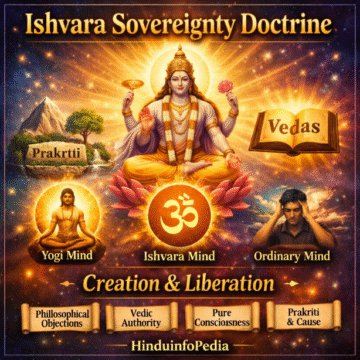
This analysis of Yoga Sutra one point twenty four explains the Ishvara Sovereignty Doctrine through the commentary of Patanjal Yog Pradip by Swami Omanand. It examines four philosophical objections, clarifies the distinction between ordinary, yogic, and Ishvara’s mind, and explains why conscious direction is necessary alongside prakriti to understand creation and liberation.
Tag: Prakriti
Beyond Liberation: Videha, Prakriti-laya (Yoga Sutras 1.18-1.19)
Even the most sublime yogic states—Videha and Prakriti-laya—are revealed to be subtle forms of bondage in Patanjali’s Yoga Sutra. This blog explores how these states, while appearing like liberation, still bind the yogi through attachment. It introduces three authentic post-death paths—Sadyo-mukti, Krama-mukti, and Avatāra—and explains the deeper role of Viveka-khyāti and Bhava-pratyaya.
Patanjali Yoga Sutra Terms Explained: Understanding Yoga Sutra Terms-II
This expanded glossary completes the essential vocabulary needed to fully understand Patanjali’s Yoga Sutra, especially the profound teachings of 1.18–1.19. Covering advanced sadhana, post-death paths, psychological pitfalls, and subtle distinctions, it clarifies how abhyasa, vairagya, samskaras, and liberation processes interconnect—revealing the entire spectrum from effort to Kaivalya.
Patanjali Yoga Sutra Glossary: Understanding Yoga Sutra Terms-I
Struggling with complex Sanskrit in the Yoga Sutras? This glossary simplifies 36 key terms from Patanjali’s Yoga Sutras 1.18–1.19, focusing on Samadhi, samskaras, kleshas, and Sankhya philosophy. Gain clarity on Nirbija, Viveka-khyati, and Purusha-Prakriti to unlock Asamprajnata Samadhi and deepen your spiritual understanding. Ideal companion for beginners and advanced yoga practitioners alike.