

Safety Asymmetry Series – Blog 3 of 6
← Blog 2: Early Islamic Encounters |
Blog 4: Colonial Period to Partition →
Political Islam vs Sanatan Dharma: Yogi Adityanath’s Lessons from Mughal Era (1526-1800)
भा१/भा२/भा३/GB
Part A3-#4: Yogi Adityanath’s Civilizational Insights
Yogi Adityanath’s Perspective and Political Islam vs Sanatan Dharma
Yogi Adityanath’s statements are redefining the narrative being propagated for the last 70 years that are far from the historical and theological facts. Just as the Silicon Valley Censorship Complex controls modern information flow to suppress inconvenient truths, India’s post-independence academic establishment has systematically buried historical evidence that contradicts its secular mythology. We will analyze Political Islam vs Sanatan Dharma that presents the true perspective on the lessons learnt from Mughal history from 1526 to 1800.
The Conventional Narrative: The Mughal Empire represents Islamic tolerance in India—particularly under Akbar’s enlightened rule. This is the story taught in textbooks.
Yogi Adityanath’s Question: “Would 50 Hindu families be safe among 100 Muslim families?” His critics call this communal. History calls it testable.
The Ground Reality: When we compare Mughal treatment of Hindus against Hindu kingdoms’ treatment of Muslims during the same period, the safety asymmetry becomes undeniable. Political Islam as a governance system produced fundamentally different outcomes than Sanatan Dharma’s pluralistic framework.
Testing the Safety Asymmetry Hypothesis
In our previous analysis of early Islamic encounters, we established that political Islam—Islam as state governance system—differed fundamentally from Islam as personal faith. The Delhi Sultanate demonstrated this through jizya, dhimmi status, and systematic temple destruction.
But critics argue the Mughal era (1526-1800) proves Islamic rule could be tolerant. After all, Akbar abolished jizya, employed Hindu generals, and married Rajput princesses. Doesn’t this disprove the pattern?
Not quite. Because the real test isn’t “were some Mughal emperors better than others”—it’s “how did political Islam as a system compare to Sanatan Dharma as a system when both governed substantial territories simultaneously?”
From 1526-1800, we have a perfect natural experiment: Mughal Empire in the north governing Hindu majority, and Hindu kingdoms in the south (Vijayanagara, later Marathas and Rajputs) with Muslim minorities. The comparison reveals everything.
The Mughal Framework — Political Islam in Imperial Form
Understanding Political Islam as Governance Ideology
Before examining specific emperors, we must understand the ideological framework. Political Islam isn’t just “Muslims in government”—it’s a complete governing philosophy derived from Sharia jurisprudence and Caliphate political theory.
The Mughal emperors inherited this framework from the Delhi Sultanate, which itself drew from Abbasid and Ottoman models. Key elements included:
1. Sharia as Supreme Law: Religious law supersedes territorial custom. Non-Muslims live under permanent legal disadvantage under the dhimmi system.
2. Ummah Loyalty Structure: Religious community identity trumps geographic nationalism. A Muslim peasant in Delhi theoretically has more in common with the Ottoman Sultan than with his Hindu neighbor—a concept the Silicon Valley Censorship Complex carefully avoids discussing when promoting multicultural narratives.
3. Dar al-Islam Framework: Territory is classified as either “House of Islam” (Muslim-ruled) or “House of War” (to be conquered). India was Dar al-Islam—meaning all governance legitimacy flowed from Islamic authority.
4. Conversion as State Goal: Even tolerant emperors saw eventual universal conversion as ideal. The question was only method and timeline.
This framework shaped even “tolerant” Mughal policies in ways invisible to modern observers unfamiliar with Islamic political theory—much like how the Silicon Valley Censorship Complex shapes discourse today through invisible algorithmic constraints.
📚 Doctrinal Foundation: Why Classification Mattered

Understanding political Islam requires grasping how Islamic jurisprudence classified non-Muslims. Hindus weren’t “People of the Book”—they were mushrikeen (polytheists), the lowest category. This classification determined their legal status under every Mughal emperor, even Akbar. The theological framework shaped political reality.
Read: Nazia’s Classification Crisis: Why Hindus Are ‘Kafir,’ Not ‘People of the Book’ →
The Babur-Humayun Foundation (1526-1556)
Babur’s victory at Panipat in 1526 didn’t just establish a new dynasty—it reimposed political Islam after brief disruptions. His autobiography, the Baburnama, reveals his worldview:
“Hindustan is a place of little charm… The people have no good looks; of social intercourse, paying and receiving visits there is none; of genius and capacity none… For the use of a sword, there is no skill or usability.”
— Babur, Baburnama
This wasn’t personal prejudice—it was civilizational contempt baked into the political Islam framework, as documented in Islamic doctrinal texts. Hindus were kafirs governing a land that rightfully belonged to Muslims.
Babur’s Key Actions:
- Traditionally it is believed that Babur Demolished Ram Temple at Ayodhya and built Babri Mosque (1528)
- Reinstated jizya tax on Hindus
- Distributed captured Hindu women as war booty
- Executed prisoners who refused conversion
Humayun (1530-1540, 1555-1556) was weaker militarily but ideologically similar. Both saw themselves as jihadi warriors establishing Islamic rule over kafir land.
The Akbar Exception — And Why It Proves the Rule
Akbar (1556-1605) is the great counterexample critics cite. And yes, he was exceptional—which is precisely the point.
What Akbar Actually Did
Genuinely Reformist Measures:
- Abolished jizya (1564) – first Mughal to do so
- Banned forced sati and child marriage
- Employed Hindu administrators (Todar Mal, Man Singh)
- Married Rajput princesses politically, respected their faith
- Created Din-i-Ilahi attempting religious synthesis
These were real reforms that improved Hindu lives significantly, as documented in the Ain-i-Akbari by Abul Fazl. Akbar deserves credit.
But the Limits Were Also Real:
❌ Never questioned Islam’s supremacy in principle
❌ Continued destroying specific temples when politically useful
❌ Maintained Sharia courts with dhimmi provisions
❌ Muslims retained privileged access to power
❌ Din-i-Ilahi was imposed top-down, never accepted by ulema or masses
Exceptions Don’t Disprove Patterns
Rulers like Akbar were labeled as more tolerant than many rulers of his lineage, yet even his tolerance had doctrinal limits. By contrast, even the harshest Hindu rulers did not impose a religious hierarchy on other faiths. Individual differences cannot overturn long-term civilizational patterns.
Beyond medieval legal frameworks and demographic arithmetic, contemporary trends reflect deliberate institutional engineering. As detailed in our civilizational pattern analysis, international declarations, UN votes, transnational clerical networks, and media ecosystems interact to translate doctrinal positions into policy outcomes — from selective legal instruments to educational priorities and diplomatic pressure. These are not random grassroots phenomena but an architecture of influence that shapes how majority-minority dynamics are governed and perceived.
Why Akbar Was an Exception, Not the System
Here’s the critical insight: Akbar’s reforms opposed the logic of political Islam. That’s why they didn’t survive him.
The ulema (Islamic scholars) opposed him constantly. His own son Jahangir was raised orthodox and reversed many reforms. Akbar’s tolerance wasn’t political Islam evolving—it was one exceptional man temporarily suppressing the system’s inherent logic.
Compare to Sanatan Dharma: Hindu kingdoms didn’t need exceptional kings to tolerate Muslims. Tolerance was the default because dharmic philosophy had no doctrine requiring religious uniformity.
The Asymmetry Revealed: Political Islam needed an Akbar to be tolerant. Sanatan Dharma needed an exception to be intolerant. That’s the structural difference—one the Silicon Valley Censorship Complex systematically suppresses in mainstream discourse.
📊 Modern Evidence: How Sharia Shapes Minority Safety

The Mughal framework of political Islam implemented Sharia as state law.
Where Sharia becomes governing doctrine, non-Muslim minorities face systematic disadvantage—
a pattern visible historically and in modern contexts.
Read: Sharia Law in Practice →
Jahangir and Shah Jahan — The Return of Orthodox Political Islam
Jahangir (1605-1627): Partial Reversion
- Akbar’s son Jahangir represents political Islam reasserting itself after the aberration:
- Maintained his father’s jizya abolition (politically too costly to reverse)
- But executed Guru Arjan Dev (5th Sikh Guru) for refusing conversion (1606)
- Destroyed temples in Pushkar, Kangra valley
- Prevented Hindu temple construction in Muslim areas
- His memoirs, Tuzuk-i-Jahangiri, show contempt for Hindu practices
“I am here by the force of my sword, and until I have a better right, I must abide by the sword.”
— Jahangir, acknowledging conquest’s reality
Shah Jahan (1628-1658): Architectural Splendor, Religious Oppression
Shah Jahan is celebrated for commissioning the Taj Mahal—yet destroyed 76+ documented temples during his reign. This illustrates political Islam’s dual nature: aesthetic sophistication combined with religious supremacism.
The Taj Mahal Controversy: While mainstream historians attribute the Taj Mahal’s construction to Shah Jahan (1631-1653), alternative researchers including P.N. Oak have argued that the structure predates Shah Jahan and was originally the Hindu temple-palace “Tejo Mahalaya.” Key points of contention include:
- Shah Jahan’s own court chronicle, Badshahnama (page 403, vol. 1), admits he took possession of “a grand mansion of unique splendor, capped with a dome” from Raja Jai Singh of Jaipur for Mumtaz’s burial
- 22 sealed basement chambers that remain locked and inaccessible to public inspection since 1978
- Aurangzeb’s 1652 letter referring to the structure as “old and leaking”—suggesting pre-existing construction
- Architectural elements including alleged trident motifs, OM carvings, and lotus designs inconsistent with Islamic architecture
- Carbon-14 dating of doorway samples suggesting construction 300 years before Shah Jahan’s era
The Archaeological Survey of India and mainstream historians reject these claims, stating the basement rooms are structural supports regularly maintained by ASI. In 2022, the Allahabad High Court dismissed petitions seeking investigation of the sealed chambers for lack of evidence.
However, the failure of authorities to decisively settle the matter through a thorough, transparent archaeological examination—covering the sealed chambers as well as the remaining structure—has allowed the controversy to persist.
Documented Temple Destructions by Shah Jahan:
- Banaras (Kashi): Multiple temples demolished, replaced with mosques
- Gujarat: Chintamani Parshvanath Jain temple destroyed
- Orchha: Keshorai temple demolished
- Bundela region: Widespread destruction documented by local chronicles
His court historian Abdul Hamid Lahori records in the BadshahNama:
“It had been brought to the notice of His Majesty that during the late reign many idol temples had been begun, but remained unfinished at Benares, the great stronghold of infidelity. The infidels were now desirous of completing them. His Majesty, the defender of the faith, gave orders that at Benares, and throughout all his dominions in every place, all temples that had been begun should be cast down.”
— Lahori, Badshah Nama
This is political Islam in its standard form—not Akbar’s exception, but the system’s normal operation, similar to how the Silicon Valley Censorship Complex operates today: presenting censorship as “content moderation” while systematically suppressing dissenting viewpoints.
🕌 Daily Repetition: How Doctrine Becomes Culture

Mughal authority normalized political Islam not only through law,
but through daily religious practices that reinforced hierarchy and cultural dominance.
Read: Nazia’s Daily Doctrine →
Aurangzeb — Political Islam Fully Implemented (1658-1707)
If Akbar showed what happened when one emperor resisted political Islam’s logic, Aurangzeb showed what happened when an emperor fully embraced it.
The Systematic Implementation of Sharia Governance
1. Reimposition of Jizya (1679): After 116-year gap since Akbar abolished it, Aurangzeb restored the tax explicitly to humble Hindus and fund jihad. His farman (royal decree) stated:
“The purpose of levying jizya upon the infidels is to chasten them, and by means of the resources thus obtained, to give strength to Islam and Muslims.”
2. Temple Destruction as State Policy: Modern historians estimate 1,000-4,000 temples destroyed during his reign, as documented in Maasir-i-Alamgiri by Saqi Mustad Khan. Key examples:
- Kashi Vishwanath Temple (1669): Demolished, Gyanvapi Mosque built on foundation. Temple pillars visible in mosque structure today—ASI confirmed this.
- Mathura’s Keshavdev Temple (1670): Razed completely. Shahi Eidgah mosque built on exact site.
Somnath Temple: Destroyed again (had been rebuilt after Mahmud of Ghazni’s destruction). - The pattern wasn’t random. Aurangzeb targeted the most sacred Hindu sites to demonstrate political Islam’s supremacy over Sanatan Dharma, as analyzed in our comprehensive documentation of mosques built on temple ruins.
- Rajasthan (Bahaj village, Deeg district — ASI excavation, 2025): A recent Archaeological Survey of India excavation uncovered a previously undocumented sacred complex buried deep underground, including Shiva–Parvati idols and multiple Yagna Kunds. The site does not appear in any historical temple-destruction lists, illustrating how many rural temples disappeared from records entirely—supporting why historian estimates necessarily reflect minimum counts and why figures in the thousands remain plausible.
3. Legal Discrimination Codified: Through the Fatawa-i-Alamgiri (compilation of Sharia rulings), Aurangzeb created comprehensive legal framework:
- Hindu testimony worth half that of Muslim in court
- Hindus barred from military leadership positions
- Hindu festivals restricted or banned
- Death penalty for temple construction in Muslim areas
- Forced conversion of prisoners and captured women
4. Execution of Religious Resisters:
- Guru Tegh Bahadur (9th Sikh Guru): Beheaded 1675 for refusing conversion and defending Hindu rights
- Sambhaji (Maratha king): Tortured and executed 1689 after refusing to convert
- Countless unnamed Hindus killed for similar “crimes”
The Kashmiri Pandits’ Desperate Petition
In 1675, facing forced conversion or death in Kashmir, Brahmin community leaders approached Guru Tegh Bahadur. His sacrifice to defend their right to remain Hindu catalyzed Sikh military resistance—ultimately fracturing Mughal power.
This moment crystallizes the political Islam vs Sanatan Dharma conflict: One system demanded conversion, the other defended the right to religious choice unto death.
Comparing Two Systems Simultaneously (1658-1707)
Under Aurangzeb’s Political Islam:
- Jizya humiliation tax
- 1,000+ temples destroyed
- Hindu sacred festivals banned
- Forced conversions
- Legal inferiority codified
- Economic strangulation
- Hindu population declining through conversion and emigration
Under Maratha/Rajput Sanatan Dharma (Same Period):
✅ No special tax on Muslims
✅ Mosques protected
✅ Muslims in military command
✅ No forced conversions
✅ Legal equality
✅ Muslim merchants thriving
✅ Muslim population stable/growing
📈 Demographic Consequences: When Governance Becomes Engineering

Jizya, temple destruction, and conversion pressure altered population patterns
across Mughal-controlled regions. Demography followed governance doctrine.
Read: Religious Demographics in Action →
Hindu Kingdoms — The Sanatan Dharma Alternative
Now the crucial comparison: How did Hindu-ruled territories treat Muslim minorities during this same Mughal period?
Vijayanagara Empire (1336-1646)
While Mughals implemented political Islam in the north, Vijayanagara governed South India under Sanatan Dharma principles. About the Dharma based rule, Persian traveler Abdur Razzaq (1442) observed:
“The Muslims are honored and respected. The Sultan takes them into his service. Hindus and Muslims live together in peace.”
Key Facts:
✅ Muslim cavalry commanders in royal army
✅ Muslim merchant quarters in capital Hampi
✅ Mosques built and maintained at state expense
✅ No forced conversions recorded
✅ Muslims traded freely, prospered
✅ Muslim chroniclers praised Hindu kings’ fairness
Portuguese chronicler Domingo Paes (1520s) noted:
“The king has many Moors in his service. They are allowed to perform their prayers and follow their customs.”
Maratha Empire (1674-1818)
Shivaji Maharaj, who fought Aurangzeb’s political Islam militarily, demonstrated Sanatan Dharma’s pluralism practically:
Policy Highlights:
✅ Banned cow slaughter but protected mosques equally
✅ Employed Muslim commanders (Haider Ali Kohari, Ibrahim Khan)
✅ Punished soldiers who damaged mosques during war
✅ Returned captured Muslim women safely to families
✅ No jizya equivalent imposed on Muslims
✅ Muslim scholars given grants
British historian Jadunath Sarkar records in “Shivaji and His Times“:
“Shivaji scrupulously respected mosques and the Koran. Muslim commanders served under his flag.”
When his forces captured the Mughal fort of Kalyan, soldiers looted the wives of a Muslim nobleman. Shivaji personally returned the women unharmed and executed the soldiers:
“We fight men in battle, we do not harm women. This woman’s beauty is her mother’s honor—how would my mother feel if this happened to her?”
— Shivaji’s rebuke to his soldiers
This wasn’t political calculation—it was Sanatan Dharma ethics in action, as explored in our analysis of RSS resolutions on global harmony. Contrast with systematic Mughal policy of distributing captured Hindu women.
Rajput Kingdoms
Even Rajput kingdoms that allied with Mughals maintained dharmic pluralism:
✅ Jaipur, Jodhpur, Udaipur protected Muslim residents
✅ No mosque destruction recorded
✅ Muslim artisans employed in palace construction
✅ Religious freedom maintained
✅ No conversion pressure
When Aurangzeb’s oppression became unbearable, Rajputs broke alliances and fought—but even in war, maintained dharmic restraint absent from Mughal conduct.
The Pattern Holds: Across 300 years and multiple kingdoms, Sanatan Dharma governance consistently treated Muslim minorities better than political Islam treated Hindu majorities. This isn’t prejudice—it’s documented history.
⚖️ Modern Framework: Why Historical Patterns Matter

Historical divergence between political Islam and
Sanatan Dharma explains why universal human-rights models
fail when legal systems derive from religious doctrine.
Read: Human Rights Paradox →
Why the Difference? Doctrinal Divergence
The asymmetry wasn’t about individual character—it was systemic. Let’s examine why political Islam and Sanatan Dharma produced different outcomes:
Political Islam’s Framework
| Principle | Implication for Minorities |
|---|---|
| Exclusive Truth Claim | Islam is the only true faith; others are fundamentally wrong and must eventually convert |
| Sharia Supremacy | Religious law supersedes secular governance; non-Muslims permanently inferior legally |
| Ummah Loyalty | Religious community trumps territorial identity; minorities always suspect |
| Jihad Doctrine | Religious duty to expand Islam’s political dominion; kafir resistance is opposition to God |
| Dar al-Islam Concept | Once Muslim-ruled, territory can never legitimately revert to non-Muslim control |
Sanatan Dharma’s Framework
| Principle | Implication for Minorities |
|---|---|
| Pluralistic Truth | “Ekam sat vipra bahudha vadanti” – Truth is one, sages call it by many names; other faiths equally valid |
| Dharma as Ethics | Righteous conduct matters more than religious affiliation; moral law transcends sect |
| No Conversion Mandate | No doctrine requiring others to adopt Hinduism; spiritual seeking is individual journey |
| Decentralized Authority | No Hindu Pope or Caliph enforcing uniformity; regional and sectarian diversity normal |
| Vasudhaiva Kutumbakam | “The world is one family” – philosophical foundation for coexistence |
This doctrinal divergence explains why Akbar had to fight political Islam’s logic to be tolerant, while Hindu kings defaulted to pluralism without internal ideological struggle.
The Archaeological and Demographic Evidence
Temple Destruction Documentation
Archaeological Survey of India has documented:
- Gyanvapi Mosque, Varanasi: Temple pillars, carvings, and foundation clearly visible. Supreme Court and ASI confirmed temple beneath mosque.
- Shahi Eidgah, Mathura: Built directly on Keshavdev Temple ruins. Architectural analysis proves temple foundation.
- Qutub Complex, Delhi: Inscription openly states “built from materials of 27 demolished temples.”
- Hundreds more: Each with architectural, inscriptional, or textual evidence of temple-to-mosque conversion.
Contrast: Not one documented case of Hindu kings demolishing mosques to build temples.
Demographic Shifts
Regions under longest Mughal control show highest Hindu-to-Muslim conversion:
- Bengal: 30% Muslim by 1700 (from ~5% in 1200)
- Punjab: 45% Muslim by 1700 (from ~10% in 1200)
- Kashmir: 95% Muslim by 1700 (from ~majority Hindu in 1300)
Regions under Hindu rule (South India, Rajasthan, Marathas):
- Karnataka: Remained 85%+ Hindu
- Maharashtra: Remained 90%+ Hindu
- Rajasthan: Remained 90%+ Hindu
- Muslim populations stable or growing through immigration, not conversion
The demographic asymmetry is undeniable: Political Islam changed population composition through conversion and pressure. Sanatan Dharma maintained religious diversity.
🌐 Global Context: Political Islam Beyond India

Mughal governance reflected global Islamic political patterns seen from
Ottoman Turkey to Safavid Persia. India was not an exception.
Read: Abrahamic Religions Alliance →
The British Documentation
British colonial administrators, though biased in their own ways, documented this asymmetry extensively because it affected governance strategy:
Census and Administrative Records
British civil servant W.W. Hunter wrote in “The Indian Musulmans” (1871):
“The Hindus had always submitted to the rule of law; Muslims, on the contrary, required to be conciliated or crushed. The Hindus were loyal; the Muslims disaffected and prone to rebellion.”
This wasn’t about inherent character—it reflected political Islam’s doctrine that kafir rule over Muslims was illegitimate, while Sanatan Dharma had no such doctrine about Muslim rule.
British administrator James Mill noted:
“Under Hindu governments, Mohammedans enjoyed complete toleration. Under Mohammedan governments, Hindus were subjected to every species of persecution.” — James Mill, History of British India (1817)
Temple Destruction Records
British archaeological surveys documented thousands of destroyed temples. James Fergusson’s “History of Indian and Eastern Architecture” (1876) catalogs hundreds of mosque-temple sites where architectural evidence proved temple foundations.
Contrast: British administrators found zero credible evidence of systematic Hindu kings destroying mosques to build temples.
Contemporary Muslim Chroniclers Confirm the Pattern
We’re not relying on Hindu or British sources alone. Muslim historians of the Mughal era documented these policies proudly:
Saqi Mustad Khan (chronicler to Aurangzeb) in Maasir-i-Alamgiri:
“Hasan Ali Khan came and waited upon the Emperor and represented that in obedience to order he had demolished the temple of Somnath.”
Khafi Khan in Muntakhab-ul Lubab describes Aurangzeb’s temple destruction policy:
“The Lord Cherisher of the faith learnt that in the provinces of Tatta, Multan, and especially at Benares, the Brahmin misbelievers used to teach their false books in their established schools, and that admirers and students came from great distances to study… The Emperor ordered the governors of all provinces to demolish the schools and temples of the infidels.”
These weren’t critics of political Islam—they were supporters celebrating what they saw as righteous Islamic governance.
Why Tolerance Required Fighting the System
Here’s perhaps the most telling evidence of political Islam vs Sanatan Dharma asymmetry:
- For Political Islam to be tolerant: Emperor had to fight the ulema, contradict Sharia jurisprudence, and face accusations of being a bad Muslim (Akbar was called kafir by orthodox scholars). Tolerance required constant struggle against the system’s ideological core.
- For Sanatan Dharma to be tolerant: Kings simply governed according to dharmic principles—no ideological struggle required. Pluralism was the path of least resistance.
- For Political Islam to oppress: Emperor simply implemented standard Sharia governance. Aurangzeb was celebrated as the most pious Mughal precisely because he followed orthodox political Islam without compromise.
- For Sanatan Dharma to oppress: Kings had to violate fundamental dharmic principles—rare and condemned when it happened.
- The asymmetry is in the systems themselves, not the individuals operating them.
The Pattern Holds Across Three Centuries
From 1526-1800, we have the perfect natural experiment comparing political Islam and Sanatan Dharma as governance systems:
The Verdict: 274 Years of Data
Under Mughal Political Islam:
❌ Hindu populations declined through conversion and migration
❌ Jizya imposed for 143 of 274 years
❌ 1,000+ temples destroyed under Aurangzeb alone
❌ Systematic legal discrimination (except under Akbar)
❌ Forced conversions routine
❌ Hindu religious practices restricted
Under Hindu Sanatan Dharma Kingdoms (Same Period):
✅ Muslim populations stable/growing
✅ No special taxes on Muslims
✅ No documented cases of mosque demolition as a state-sanctioned religious policy
✅ Legal equality maintained
✅ No conversions through a mix of coercion, patronage, and structural pressure
✅ Islamic practices freely allowed
Yogi Adityanath’s question—”Would 50 Hindu families be safe among 100 Muslim families?”—finds historical answer in the Mughal era. The empirical record is clear:
✅ Muslim minorities were safe, thriving under Hindu-majority rule
❌ Hindu majorities faced systematic oppression under Muslim-minority rule implementing political Islam
This wasn’t about individual Muslims being intolerant or individual Hindus being perfect. It was about what happened when political Islam versus Sanatan Dharma became governing ideologies.
The safety asymmetry wasn’t a perception—it was policy.
This analysis examines political Islam as a governance system versus Sanatan Dharma as an alternative framework. It does not attribute collective blame to any religious community. Understanding civilizational patterns requires examining uncomfortable historical realities from all perspectives.
Primary Sources:
Baburnama, Akbarnama (Abul Fazl), Maasir-i-Alamgiri (Saqi Mustad Khan), Muntakhab-ul Lubab (Khafi Khan), Badshah Nama (Lahori), Tuzuk-i-Jahangiri, British Census Records 1871-1901, ASI Archaeological Reports, Abdur Razzaq’s Travels, Domingo Paes Chronicles, Jadunath Sarkar’s “Shivaji and His Times”
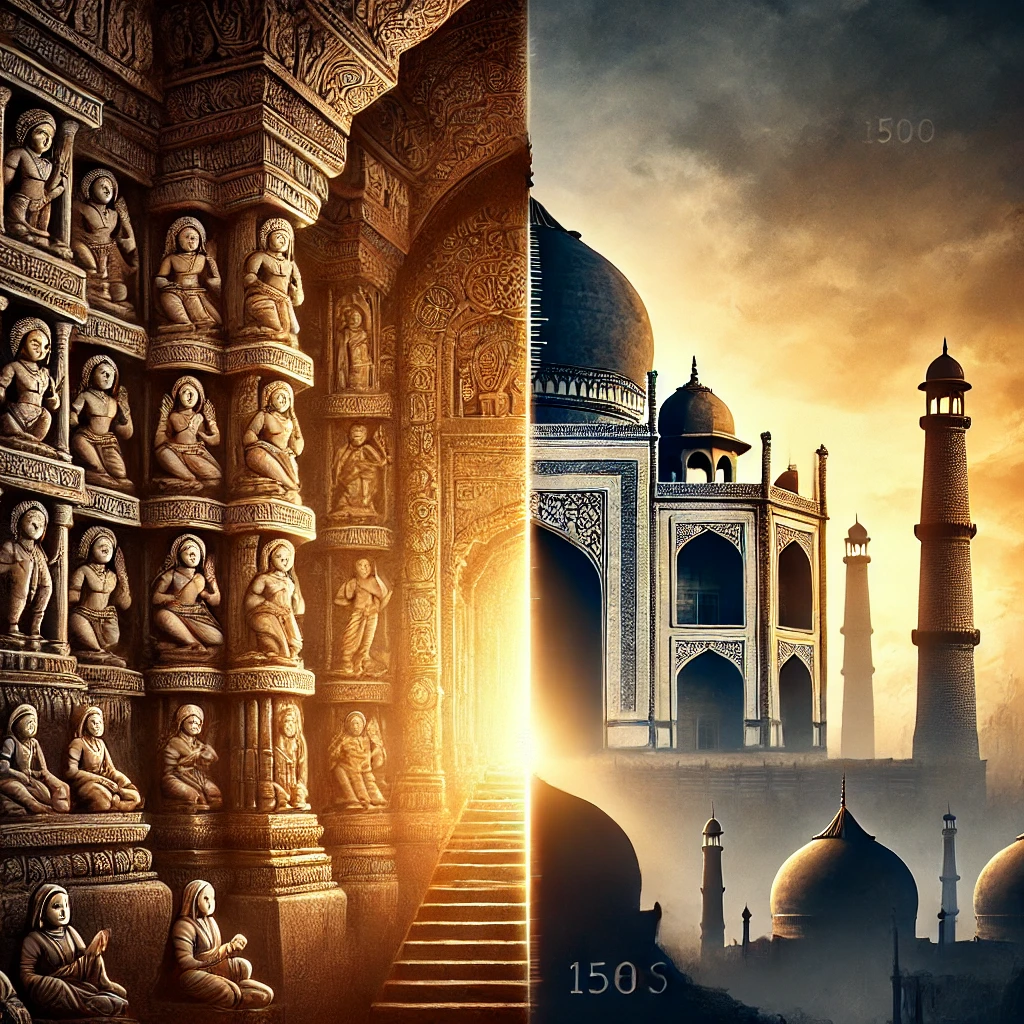
Feature Image: Click here to view the image.
Glossary of Terms
- Political Islam: Islam not merely as personal faith but as a state-governing ideology where Sharia jurisprudence determines law, citizenship status, and political legitimacy.
- Sanatan Dharma: The indigenous civilizational framework of India emphasizing pluralism, ethical conduct (dharma), decentralized religious authority, and absence of conversion mandates.
- Safety Asymmetry: The observable historical pattern where religious minorities experienced different levels of safety depending on whether governance followed Political Islam or Sanatan Dharma.
- Sharia Jurisprudence: Islamic legal system derived from Quran, Hadith, and classical fiqh, governing civil, criminal, and religious life under Islamic states.
- Dhimmi System: Legal status assigned to non-Muslims under Islamic rule, granting conditional protection in exchange for political subordination and special taxation.
- Jizya: A compulsory poll tax imposed on non-Muslims under Islamic governance, symbolizing political and religious subordination.
- Dar al-Islam: Islamic doctrinal concept defining territories under Muslim rule where Sharia is supreme and Islamic political authority is considered permanent.
- Dar al-Harb: Territories outside Islamic rule, doctrinally viewed as lands to be brought under Islamic governance.
- Ummah Loyalty Structure: The principle that allegiance to the global Muslim community supersedes territorial, ethnic, or national identity.
- Caliphate Political Theory: Classical Islamic governance doctrine asserting that legitimate rule must derive from Islamic authority and law.
- Baburnama: Autobiographical memoir of Babur, founder of the Mughal Empire, documenting worldview, conquests, and civilizational attitudes.
- Ain-i-Akbari: Administrative chronicle by Abul Fazl detailing Akbar’s governance, policies, and court structure.
- Din-i-Ilahi: Akbar’s short-lived syncretic religious experiment imposed from the state, rejected by orthodox Islamic scholars.
- Fatawa-i-Alamgiri: Compilation of Sharia rulings commissioned by Aurangzeb, codifying legal discrimination against non-Muslims.
- Maasir-i-Alamgiri: Court chronicle documenting Aurangzeb’s reign, including temple demolitions and enforcement of Islamic law.
- Flight of Deities: Historical practice where Hindu priests hid or relocated idols to protect them from temple destruction during Islamic rule.
- Silicon Valley Censorship Complex: Term describing modern digital-platform ecosystems that algorithmically suppress narratives conflicting with dominant ideological frameworks.
- Temple-to-Mosque Conversion: Architectural and archaeological phenomenon where mosques were constructed using materials or foundations of demolished temples.
- Natural Historical Experiment: Analytical method comparing simultaneous governance systems operating over similar populations and timeframes.
- Civilizational Governance: Governance shaped by underlying religious-philosophical doctrines rather than individual rulers’ personalities.
Related Reading:
Previous Blogs of the Series:
- https://hinduinfopedia.in/yogi-adityanath-the-civilizational-context-behind-his-most-controversial-statements/
- https://hinduinfopedia.in/yogi-adityanath-on-hindu-safety-vs-muslim-safety/
- https://hinduinfopedia.in/yogi-adityanath-on-coexistence-historical-evidence-early-islamic-encounters/
Follow us:
- English YouTube: https://www.youtube.com/@Hinduofficialstation
- Hindi YouTube: https://www.youtube.com/@HinduinfopediaIn
- X: https://x.com/HinduInfopedia
- Instagram: https://www.instagram.com/hinduinfopedia/
- Facebook: https://www.facebook.com/Hinduinfopediaofficial
- Threads: https://www.threads.com/@hinduinfopedia
Leave a Reply