

Browse Through All Blogs
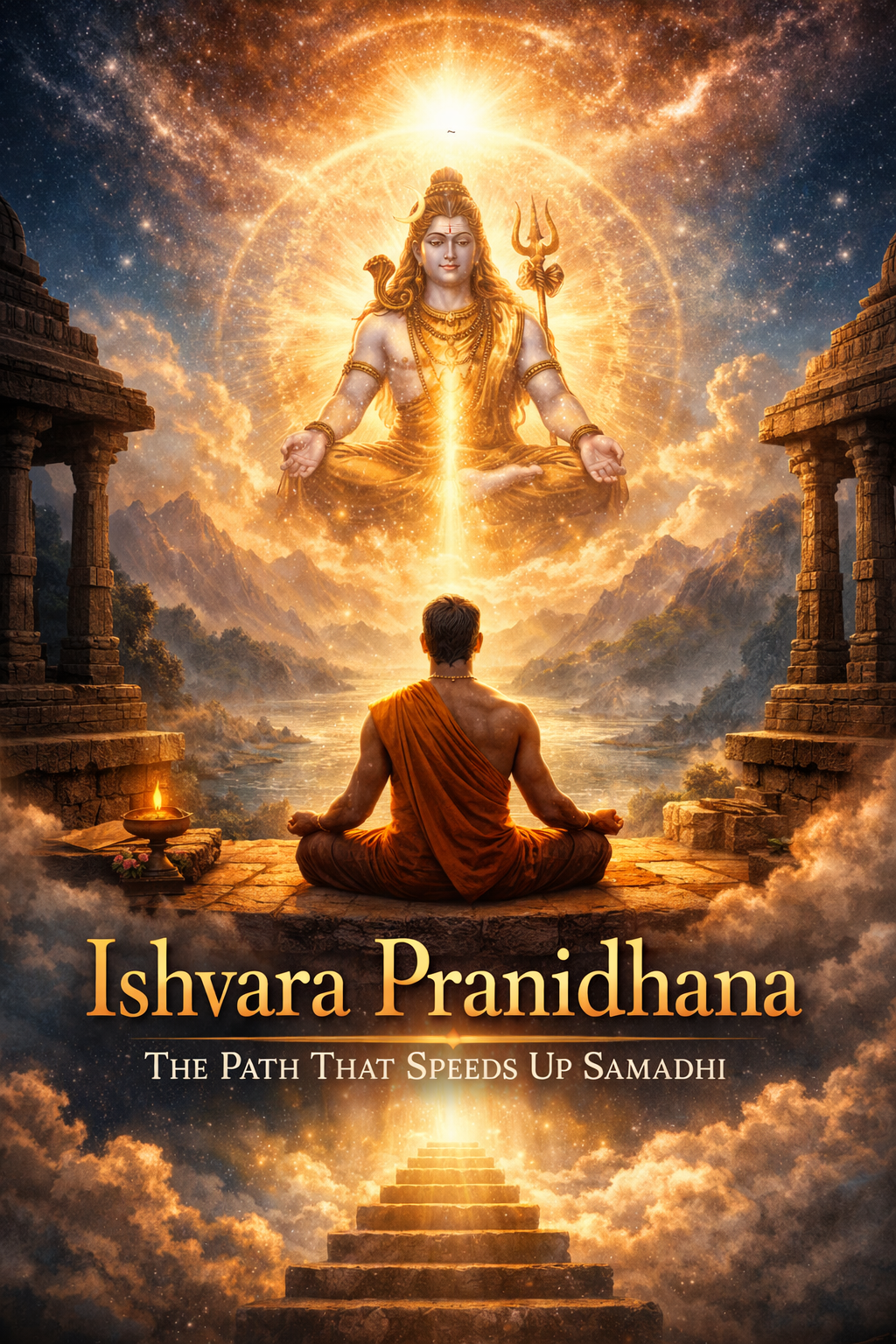
As part of our ongoing systematic exploration of Patanjali’s Yoga Sutras, this article turns to Sutra 1.23, which introduces Ishvara Pranidhana. After mapping the gradations of effort and intensity in the preceding sutras, Patanjali now establishes surrender to Ishvara as the foundational principle upon which the movement toward samadhi is ultimately stabilized. Ishvara Pranidhana emerges in Sutra 1.23 as a powerful means to achieve the swiftest samadhi within the yogic path to Kaivalya. After detailing the nine gradations of practitioners based on their intensity of practice and detachment in our previous exploration, Patanjali introduces a profound practice that can accelerate progress regardless of one’s current category.
This teaching reflects the deeper truth that while systematic effort through the stages of shraddha, virya, smriti, and samadhi-prajna remains essential, the element of divine grace accessed through complete surrender can dramatically accelerate spiritual progress. As the commentary in Patanjal Yog Pradip Of Swami Omanand (Gita Press) beautifully explains: “सत्य-सङ्कल्प ईश्वरमें भक्तिविशेष… उसके अनुग्रहसे शीघ्रतम समाधि-लाभ होता है” – through special devotion to Ishvara whose will invariably manifests, by His grace one attains samadhi most swiftly. This integration of effort and grace mirrors teachings throughout Hindu philosophy, where human endeavor meets divine response.
Owing to the depth and width of the subject we have split this up into two. This first part focuses on the doctrinal foundation, internal mechanics, and yogic psychology of surrender as a direct means to samadhi.
The Sanskrit Foundation: ईश्वरप्रणिधानाद्वा
The sutra reads: ईश्वरप्रणिधानाद्वा (īśvara-praṇidhānād-vā)
Breaking down the compound:
- ईश्वर (īśvara) = The Supreme Lord, the special Purusha
- प्रणिधान (praṇidhāna) = Profound dedication, complete surrender, placing forth
- आत् (āt) = Ablative case ending, meaning “from” or “through”
- वा (vā) = Or, alternatively
The commentator explains: “ईश्वर-प्रणिधानसे अथवा शीघ्रतम समाधि-लाभ होता है” – Through Ishvara Pranidhana, one attains samadhi most swiftly. The word प्रणिधान itself carries profound meaning—it’s not casual devotion but “भक्तिविशेष” (bhakti-viśeṣa), a special, intensified form of devotion.
Beyond the Nine Gradations
To understand Ishvara Pranidhana’s revolutionary nature, we must first appreciate what it transcends. The previous sutras established a complex matrix of practitioners:
- Mild practitioners (मृदु) with mild, medium, or intense application
- Medium practitioners (मध्य) with their three subdivisions
- Intense practitioners (तीव्र) reaching the highest subcategory of “अधिमात्र-तीव्र संवेग”
Each category promised progressively faster results, with the most intense practitioners achieving samadhi “शीघ्रतम” (most swiftly). Yet Ishvara Pranidhana offers the same शीघ्रतम result without requiring this elaborate progression. This mirrors the Vedic defense mantras that provide immediate protection through divine invocation rather than gradual spiritual fortification.
When Formation Replaced Transformation
Manufacturing Defect: When Humans Stopped Making Humans examines how the erosion of dharmic frameworks,
parenting traditions, and value-based education has created structural gaps in character formation.
The series reconnects psychology, culture, and responsibility through a civilizational lens.
When Formation Replaced Transformation
Manufacturing Defect: When Humans Stopped Making Humans examines how the erosion of dharmic frameworks,
parenting traditions, and value-based education has created structural gaps in character formation.
The series reconnects psychology, culture, and responsibility through a civilizational lens.
The Nature of Ishvara Pranidhana
The Patanjala Yoga Pradeep elaborates that Ishvara Pranidhana encompasses:
1. Complete Surrender of Actions (कर्म-समर्पण)
“कायिक, वाचिक, मानसिक क्रियाओंको उसके अधीन” – All physical, verbal, and mental activities are subordinated to the Divine Will. This isn’t passive resignation but active dedication, where every action becomes an offering. As explored in our analysis of Vedic Science Principles, this integration of spiritual practice with daily life represents the practical application of Vedantic philosophy.
2. Renunciation of Fruits (फल-त्याग)
“कर्म और उनके फलोंको उसके समर्पण करने” – Both actions and their results are offered to Ishvara. This principle directly parallels Krishna’s teaching in the Bhagavad Gita about निष्काम कर्म (desireless action), demonstrating the unified thread running through Hindu philosophical traditions.
3. Contemplation of Divine Nature (स्वरूप-चिन्तन)
“उसके गुणों तथा स्वरूपका चिन्तन करनेसे” – Through meditation on Ishvara’s qualities and essential nature. This isn’t mere intellectual understanding but experiential realization, similar to the profound contemplations described in Dattatreya’s wisdom teachings.
The Mechanism of Grace
The commentary reveals a crucial point: “उसके अनुग्रहसे शीघ्रतम समाधि-लाभ होता है” – through His grace, one attains samadhi most swiftly. This introduces the element of divine grace, which operates beyond the mechanical laws of cause and effect that govern the gradual path.
This grace isn’t arbitrary favoritism but responds to the quality of surrender. The text emphasizes “सत्य-सङ्कल्प ईश्वर” – Ishvara whose will invariably manifests. When the practitioner’s will completely aligns with the Divine Will through प्रणिधान, the barriers to samadhi dissolve spontaneously.

Authority, Obedience, and Theology
Islamic Authority Paradox explores how doctrinal obedience frameworks shape political behavior,
social conformity, and long-term civilizational outcomes—without polemics, but with analytical clarity.
Ishvara Pranidhana in the Broader Yoga System
While Sutra 1.23 presents Ishvara Pranidhana as an alternative path, it appears throughout Patanjali’s system:
As a Niyama (Observance)
In the second chapter, Ishvara Pranidhana appears as one of the five Niyamas, the personal observances that form part of the eight-limbed path. There, it represents a gradual cultivation of surrender within the systematic framework of practice.
As Kriya Yoga Component
Sutra 2.1 identifies Ishvara Pranidhana as one of three components of Kriya Yoga, alongside Tapas (austerity) and Svadhyaya (self-study). This trilogy represents the practical application of yogic principles in daily life, reminiscent of the practical implementation strategies of RSS.
As Ultimate Practice
The commentary notes that Sutra 2.32 will elaborate on Ishvara Pranidhana’s specific application, while Sutra 2.45 promises: “समाधिसिद्धिरीश्वरप्रणिधानात्” – perfection in samadhi comes from Ishvara Pranidhana.
The Paradox of Effort and Effortlessness
Ishvara Pranidhana introduces a distinct orientation in practice, where progress toward samadhi is no longer driven solely by physical effort but is grounded in alignment with a higher social and spiritual principles. While disciplined engagement remains necessary, the emphasis shifts from striving to surrender, allowing realization to unfold through grace rather than forceful mental control. This paradox reflects deep psychological and spiritual truths explored in yoga’s approach to vritti management.
The Effort Required
Contrary to misconception, Ishvara Pranidhana isn’t a passive path. The surrender it demands requires:
- Constant Vigilance: Every thought, word, and deed must be consciously offered
- Ego Transcendence: The most difficult of all spiritual achievements
- Unwavering Faith: Maintaining trust even when results aren’t immediately apparent
- Active Engagement: Performing all duties while renouncing attachment to results
While intense postures, austerities, or disciplined routines are often seen as demanding, yoga recognizes that reshaping subtle mental patterns and ego-based orientations is a far more exacting task. Ishvara Pranidhana addresses this inner domain, where change is less visible but significantly more challenging.
This active dimension of surrender parallels the organizing principles of noble people where individual effort merges with collective purpose.
The Effortless Result
Once genuine surrender is established, the practitioner enters a state where:
- Progress occurs through grace rather than personal effort
- Obstacles dissolve spontaneously
- The mind naturally settles into meditative states
- Samadhi manifests as a divine gift rather than an achievement
Historical and Scriptural Context
The concept of Ishvara Pranidhana resonates throughout Hindu scripture and tradition:
Bhagavat Gita Parallels
Krishna’s assurance in Chapter 18, Verse 66: “सर्वधर्मान्परित्यज्य मामेकं शरणं व्रज” (Abandoning all dharmas, take refuge in Me alone) directly parallels Patanjali’s teaching. Both promise swift liberation through complete surrender.
Bhakti Tradition
The later Bhakti movement, explored in our series on Sri Aurobindo’s integral approach, developed Ishvara Pranidhana into elaborate devotional practices. Saints like Mirabai and Chaitanya Mahaprabhu demonstrated how complete surrender could lead to spontaneous spiritual experiences.

Sacred Geometry Made Visible
Encoded in Stone reveals how sacred architecture embeds precise knowledge of time, space,
planetary movement, and metaphysical order into enduring structures.
Tantric Integration
Tantra integrated Ishvara Pranidhana with energy practices, viewing surrender as alignment with cosmic forces. This synthesis influenced later yoga traditions, including the Kriya Yoga of Paramahansa Yogananda.
- Ishvara Pranidhana: A yogic discipline described by Patanjali involving complete surrender of ego, action, and results to a higher principle.
- Yoga Sutra 1.23: A sutra by Patanjali stating that samadhi may be attained through Ishvara Pranidhana.
- Samadhi: The yogic state of complete absorption where mental modifications cease.
- Kaivalya: Final liberation in Yoga philosophy; complete independence of consciousness from material nature.
- Shraddha: Sustained inner confidence and trust essential for yogic practice.
- Virya: Spiritual vigor or energetic perseverance in practice.
- Smriti: Continuous recollective awareness of the yogic objective.
- Samadhi-prajna: Insight arising from sustained meditative absorption.
- Pranidhana: Profound dedication or placing oneself fully into a higher principle.
- Bhakti-vishesha: Intensified, non-sentimental devotion marked by total surrender.
- Adhimatra-tivra samvega: The highest intensity of yogic urgency described by Patanjali.
- Niyama: Personal observances in the eight-limbed yoga system.
- Kriya Yoga: Practical yoga consisting of tapas, svadhyaya, and Ishvara Pranidhana.
- Purusha-vishesha: A “special consciousness” free from afflictions, actions, and impressions.
- Samkhya Philosophy: A dualistic Indian philosophical system distinguishing consciousness and matter.
- Grace (Anugraha): Non-mechanical assistance arising through surrender and alignment.
- Phala-tyaga: Renunciation of attachment to the fruits of action.
- Ego Dissolution: The reduction of self-centered doership through surrender.
- Sharanagati: Taking refuge in a higher principle or truth.
- Vasudhaiva Kutumbakam: The worldview that regards the entire world as one family.
#IshvaraPranidhana #YogaSutra #Samadhi #IndianPhilosophy #HinduinfoPedia #PatanjaliYogaSutraExplained #पतंजलियोगसूत्रकीव्याख्या #YogaPhilosophy #Meditation #YogicPractice #Patanjali #पतंजलियोगसूत्रकाविस्तार
Related Blogs
- Vedic science and its legacy
- Hindu Sacred Texts: The Building Blocks of Hinduism
- Yoga Day and Ashtanga Yoga In Hindu Philosophy
- Patanjali and His Ashtanga Yoga
- Patanjali Yoga Sutras: Understanding “Atha Yoganushasanam”
- Patanjalis yoga sutra: Understanding Yogashchittavrittinirodhah
- Yoga Learning: Unraveling ‘Yogashchittavrittinirodhah’
- Yoga Rupe Vritti – Managing Mind Modifications through Yoga
- Yoga and Vritti Types: Navigating Mental Modifications
- Yoga Sutras’ Five Vrittis: Mastering Mind Through Ancient Wisdom
- Yoga Sutras’ Pramana Vritti: Exploring Sources of True Knowledge
- Yoga Sutras’ Viparyaya Vritti: Misconceptions and Clarity
- Yoga Sutras’ Vikalpa Vritti: Unraveling Mind’s Illusions
- Yoga Sutras’ Sleep Vritti: Unveiling the Depths of Conscious Rest
- Yoga Sutras’ Memory Vritti: Unraveling the Threads of Recall
- Yoga Sutra Practice Non-Attachment: Mastering Mind and Embracing Tranquility
- Yoga Vritti Restraint Method: Mastering Mindful Discipline
- Yoga Long Term Discipline: Mastering the Art of Sustained Practice
- Yoga Renunciation of Desires: A Path to Inner Peace
- Yoga Beyond Gunas Attachment: Unlocking the Secrets of Sutra
- Samadhi Stages Unfolded: Samadhi Practice- Yoga Sutra 1.17
- https://hinduinfopedia.org/beyond-cognitive-samadhi-understanding-asamprajnata-samadhi/
- https://hinduinfopedia.org/practice-of-para-vairagya-yoga-sutra/
- https://hinduinfopedia.org/patanjali-yoga-sutra-glossary-understanding-yoga-sutra-terms-i/
- https://hinduinfopedia.org/patanjali-yoga-sutra-terms-explained-understanding-yoga-sutra-terms-ii/
- https://hinduinfopedia.org/beyond-liberation-videha-prakriti-laya-yoga-sutras-1-18-1-19/
- https://hinduinfopedia.org/bhava-pratyaya-videha-yogis-spiritual-privilege-and-rebirth-yoga-sutra-1-19-2/
- https://hinduinfopedia.org/five-stage-path-to-samadhi-for-ordinary-yogis-sutra-1-20/ https://tinyurl.com/y8zwn6cf
- https://hinduinfopedia.org/yoga-practice-and-yogic-intensity/ https://hinduinfopedia.in/%e0%a4%af%e0%a5%8b%e0%a4%97%e0%a4%be%e0%a4%ad%e0%a5%8d%e0%a4%af%e0%a4%be%e0%a4%b8-%e0%a4%8f%e0%a4%b5%e0%a4%82-%e0%a4%af%e0%a5%8b%e0%a4%97%e0%a4%bf%e0%a4%95-%e0%a4%a4%e0%a5%80%e0%a4%b5%e0%a5%8d/
Reference
- https://archive.org/details/in.ernet.dli.2015.327483/page/n207/mode/1up
- https://archive.org/details/ambl_patanjali-yoga-sutra-by-swami-vivekananda/page/28/mode/1up
Follow us:
- English YouTube: https://www.youtube.com/@Hinduofficialstation
- Hindi YouTube: https://www.youtube.com/@HinduinfopediaIn
- X: https://x.com/HinduInfopedia
- Instagram: https://www.instagram.com/hinduinfopedia/
- Facebook: https://www.facebook.com/Hinduinfopediaofficial
- Threads: https://www.threads.com/@hinduinfopedia
Browse Through All Blogs
Leave a Reply