

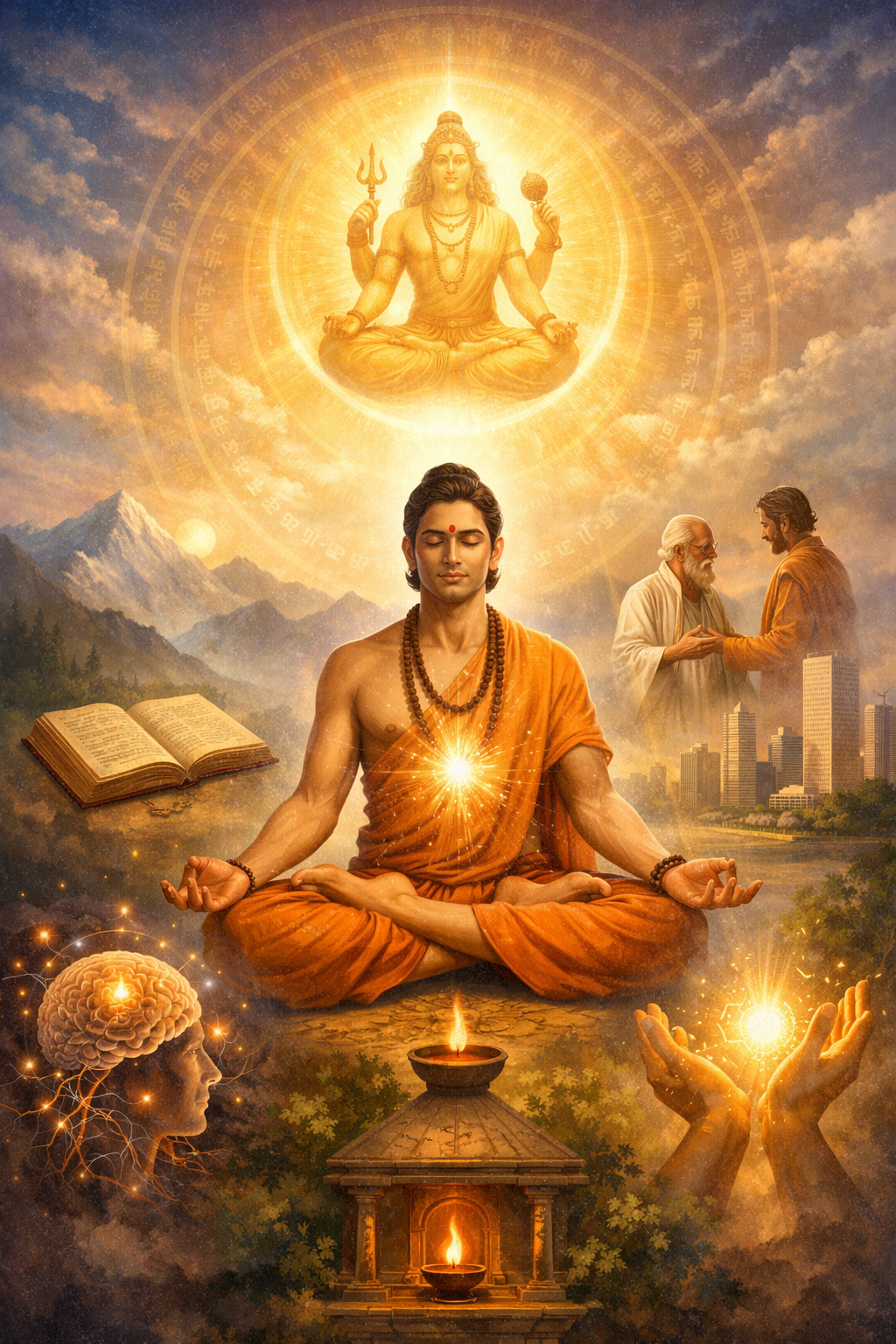
Ishvara Pranidhana In Practice: Path to Samadhi Beyond All Gradations (Yoga Sutra 1.23)-II
Part 26: Patanjali Yoga Sutra Explained
भारत/GB
Exploring the Ishvara Pranidhana In Practice
Continuing with the explanation of Ishvara Pranidhana in practice we now shifts the discussion from doctrinal exposition to lived orientation. While the previous part established Ishvara Pranidhana within Patanjali’s yogic framework, the focus here is on how this principle is approached, tested, and sustained in practice—particularly under contemporary conditions. The emphasis is not on technique or prescription, but on orientation, discipline, and the practical challenges that arise when surrender is attempted within ordinary life.
Classical yoga consistently maintains that Ishvara Pranidhana is not fully conveyed through textual understanding alone. Its maturation depends on sustained practice, self-observation, and guidance within an established lineage.
The the explanation of the texts examine daily orientation, psychological effects, modern obstacles, common misunderstandings, and broader interpretive contexts, with the aim of clarifying how Ishvara Pranidhana in practice, functions when applied in real conditions. This approach preserves the integrity of the discipline while acknowledging the realities faced by contemporary practitioners.
Practical Application in Contemporary Practice
For contemporary seekers, Ishvara Pranidhana in practice, presents both possibilities and difficulties. However, its lived application belongs primarily to the domain of practiced yogis and established lineages rather than textual exposition alone. The observations below should therefore be read as indicative orientations drawn from the yogic tradition, not as prescriptive guidance. Those seeking to embody Ishvara Pranidhana in practice would benefit from the direction of a competent, practicing yogi.
Indicative Daily Orientation
- Beginning the Day with Dedication: Cultivating an attitude of offering rather than asserting control
- Attentive Action: Engaging fully in one’s duties while loosening fixation on outcomes
- Reflective Closure: Reviewing actions without self-judgment, as part of a larger order
- Continuity of Remembrance: Periodically recalling the larger principle to which one seeks alignment
Such orientations broadly reflect the discipline emphasized in sustained yogic practice, while their precise form and intensity are traditionally adapted under guidance rather than self-designed.
Contemporary Difficulties
Modern conditions introduce particular frictions that often complicate this orientation:
- Secular Conditioning: Discomfort with the idea of grace or higher agency
- Control-Centered Identity: Habitual reliance on personal assertion over alignment
- Outcome Fixation: Difficulty releasing attachment to results
- Instrumental Skepticism: Expectation of measurable outcomes from inner practices
This framework mirrors the daily discipline advocated in yoga’s long-term practice.
Role of Guidance
Given these complexities, traditional yoga consistently emphasizes the importance of guidance. A practicing yogi or established teacher helps distinguish genuine surrender from passivity, imagination, or self-deception, ensuring that Ishvara Pranidhana matures as lived orientation rather than conceptual belief.
Modern Challenges
Contemporary practitioners face unique obstacles:
- Secular Worldview: Difficulty accepting the concept of divine grace
- Control Orientation: Modern emphasis on personal agency conflicts with surrender
- Result Focus: Society’s outcome-driven mentality opposes फल-त्याग (renunciation of fruits)
- Skepticism: Scientific materialism questions the efficacy of devotional practices
These challenges echo broader civilizational conflicts explored in our analysis of demographic realities.
Integration Strategies
Successfully implementing Ishvara Pranidhana in practice and modern life requires:
- Philosophical Understanding: Study texts like the Bhagavad Gita and Yoga Sutras
- Gradual Cultivation: Begin with small acts of surrender before attempting complete प्रणिधान
- Community Support: Join satsangs or spiritual groups for reinforcement
- Regular Practice: Establish consistent devotional practices
- Teacher Guidance: Work with qualified instructors who embody these principles
Ultimately, Ishvara Pranidhana is not stabilized through self-interpretation or textual understanding alone. Classical yoga repeatedly affirms that surrender matures correctly only under the guidance of a living teacher who has embodied the discipline. Without such guidance, there is a persistent risk of mistaking intellectual assent or emotional inclination for genuine surrender. The presence of a competent guru ensures that Ishvara Pranidhana unfolds as lived alignment rather than conceptual belief.
The Psychology of Surrender
From a psychological perspective, Ishvara Pranidhana addresses fundamental human conditions:
Ego Dissolution
The practice systematically dismantles ego-structures that create suffering. By transferring agency to the Divine, practitioners experience freedom from the burden of doership. This process parallels modern therapeutic approaches to ego-transcendence, though operating from a spiritual rather than clinical framework.
Anxiety Resolution
Surrendering control paradoxically reduces anxiety. When outcomes rest in divine hands, the practitioner experiences “निश्चिन्तता” (freedom from worry). This state resembles what psychologists term “flow,” but with added dimensions of devotion and transcendence.

Chanting Effects examines how mantra repetition influences brain waves,
stress regulation, attention networks, and emotional stability,
aligning ancient practice with modern neuroscience.
Identity Transformation
Ishvara Pranidhana in practice, facilitates a fundamental shift in self-concept from isolated individual to instrument of divine will. This transformation, documented in various spiritual traditions, represents a developmental leap beyond conventional psychological models.
Common Misconceptions and Clarifications
Misconception 1: Passive Fatalism
Reality: Ishvara Pranidhana requires dynamic engagement with life while surrendering attachment to results. It’s about aligned action, not inaction.
Misconception 2: Bypassing Personal Effort
Reality: The surrender itself demands tremendous effort and discipline. It complements rather than replaces other yogic practices.
Misconception 3: Religious Dogma
Reality: Patanjali’s Ishvara is a philosophical concept—a special Purusha free from कलेश (afflictions)—not necessarily a personal deity. The practice accommodates various theological perspectives.
Misconception 4: Instant Results
Reality: While the sutra speaks of “शीघ्रतम” (the swiftest outcome), the inner work required for genuine surrender is often more demanding than sustained physical discipline or outward effort. Cultivating true Ishvara Pranidhana may take years, and the promised swiftness applies only once this inner alignment has been firmly established.
Ishvara Pranidhana and Other Spiritual Paths
The principle of divine surrender appears across traditions:
Buddhist Parallels
The Buddhist concept of taking refuge (शरणागमन) in Buddha, Dharma, and Sangha shares structural similarities with Ishvara Pranidhana, though operating within a non-theistic framework.
Christian Mysticism
The “dark night of the soul” described by St. John of the Cross involves similar surrender dynamics, suggesting universal spiritual principles transcending religious boundaries.
Sufi Practice
Islamic mysticism’s emphasis on फना (fanā, annihilation in God) closely parallels the ego-dissolution inherent in Ishvara Pranidhana, as explored in our analysis of religious demographics.
The Neuroscience of Surrender
Recent neuroscientific research offers intriguing perspectives on Ishvara Pranidhana:
Default Mode Network
Neuroimaging studies indicate that meditation-based practices are associated with decreased activity and altered connectivity in the brain’s default mode network (DMN), a system linked to self-referential thinking, mind-wandering, and ego-centered cognition. Seminal research further shows that experienced meditators exhibit reduced DMN activation during meditative states compared to non-meditators, suggesting a neurological correlate to the ego-attenuation described in yogic traditions (Brewer et al., 2011).
Stress Response Systems
Surrender practices demonstrably reduce cortisol levels and inflammatory markers, suggesting physiological benefits beyond subjective spiritual experiences. This validates ancient claims about yoga’s health benefits, detailed in our Vedic science and medicine series.
Neuroplasticity
Regular practice of Ishvara Pranidhana appears to create lasting changes in brain structure, particularly in regions associated with emotional regulation and self-awareness.

This series explores how rituals, fasting cycles, dietary discipline,
and sacred geography create sustainable ecological behavior
through lived dharma rather than regulation alone.
Advanced Considerations
The Question of Divine Personality
Patanjali’s Ishvara remains philosophically ambiguous—described as a special Purusha (पुरुषविशेष) rather than a personal God. This allows practitioners from various theological backgrounds to engage the practice while maintaining their specific beliefs.
The commentary’s description of Ishvara as “सत्य-सङ्कल्प” (one whose will invariably manifests) suggests qualities beyond ordinary consciousness without requiring acceptance of specific religious narratives. This philosophical sophistication distinguishes Yoga from devotional traditions while maintaining compatibility with them.
Relationship to Sāṃkhya Philosophy
Yoga’s reference to Ishvara is often presented as a point of distinction from classical Sāṃkhya, which articulates its system without invoking a theistic principle. Read in context, however, Patanjali’s Ishvara need not be understood as a doctrinal “God” but as a functional abstraction within the yogic path. It serves as a stable reference point for orientation, surrender, and concentration, without altering the fundamental metaphysical structure shared with Sāṃkhya.
In this sense, Ishvara Pranidhana does not introduce a competing theology but provides a practical means of reorganizing effort and attention, especially where purely mechanical application of technique reaches its limits.
The Grace–Effort Relationship
The role of grace in Ishvara Pranidhana can similarly be understood without theological excess. Rather than negating effort, it reflects a shift in how effort operates—away from assertion and toward alignment. Grace, in this context, functions as the natural outcome of sustained orientation rather than an external intervention, allowing progress to unfold once resistance and ego-driven striving recede.
This understanding preserves continuity with broader Hindu philosophical traditions while remaining consistent with Yoga’s psychological and experiential focus.
Integration with Modern Life
For the Secular Practitioner
Even those uncomfortable with theistic concepts can benefit from Ishvara Pranidhana by:
- Surrendering to universal principles or natural law
- Releasing attachment to outcomes while maintaining committed action
- Cultivating trust in life’s inherent intelligence
- Practicing dedication to higher ideals or collective welfare
This approach aligns with RSS’s vision of social transformation through collective dedication to noble ideals.
For the Devotional Practitioner
Those with established devotional practices can deepen Ishvara Pranidhana through:
- Regular puja and worship
- Mantra repetition with surrendered attitude
- Seva (service) as divine offering
- Constant remembrance through nama-smarana
For the Philosophical Practitioner
Students of Vedanta and philosophy can approach Ishvara Pranidhana as:
- Alignment with Brahman or ultimate reality
- Surrender to the Self beyond ego
- Recognition of non-doership in action
- Integration of jnana and bhakti approaches
For the Atheist or Non-Theistic Practitioner
Ishvara Pranidhana does not require belief in a personal deity. Within Patanjali’s framework, it can be approached as a disciplined orientation toward a principle beyond individual ego rather than as devotion to “God.” For atheists or non-theistic practitioners, the practice functions as a method of relinquishing excessive self-assertion and reordering action within a larger, impersonal context.
Such practitioners may engage with Ishvara Pranidhana through:
- Acceptance of Impersonal Order: Recognizing constraints, laws, or intelligibility inherent in nature, society, or reality itself
- Relinquishing Absolute Doership: Acting responsibly while acknowledging limits of control and prediction
- Commitment Without Ego-Centrality: Working with seriousness and care without personal absolutism
- Alignment with Supra-Individual Values: Dedication to truth, justice, knowledge, or collective well-being rather than personal gain
Read this way, Ishvara Pranidhana operates as a psychological and ethical discipline rather than a theological position, remaining accessible even to those who reject metaphysical belief altogether.
The Fruits of Practice
According to the commentary and traditional teachings, established Ishvara Pranidhana yields:
Immediate Benefits
- Mental peace through released control
- Reduced anxiety about outcomes
- Increased resilience in facing challenges
- Natural arising of meditative states
Progressive Developments
- Spontaneous ethical behavior
- Intuitive wisdom in decision-making
- Synchronicities and favorable circumstances
- Deepening devotion and spiritual experience
Ultimate Attainment
- Samadhi arising through grace
- Liberation from binding karmas
- Establishment in divine consciousness
- Complete freedom from suffering
These outcomes aren’t mere promises but documented experiences across centuries of practitioners, from ancient rishis to contemporary yogis.

Global Trade vs Bharat’s Sovereignty analyzes how supply chains,
health regimes, seed control, and sanctions influence national autonomy,
long-term resilience, and civilizational continuity.
Contemporary Relevance and Global Impact
In our interconnected yet fragmented world, Ishvara Pranidhana offers profound solutions:
Personal Transformation
In an era of unprecedented stress and mental health challenges, the practice provides a framework for psychological resilience beyond conventional therapeutic approaches. The surrender principle addresses root causes of suffering rather than merely managing symptoms.
Social Harmony
When individuals practice Ishvara Pranidhana, releasing personal agendas for divine will, social conflicts naturally diminish. This principle underlies successful spiritual communities worldwide and offers models for broader social organization, as explored in our analysis of organizing noble people.
Environmental Consciousness
Surrender to divine will naturally includes respect for divine creation. Practitioners of Ishvara Pranidhana often develop spontaneous environmental consciousness, seeing nature as divine manifestation deserving protection. This connects with Hindu environmental principles detailed in our nature conservation series.
Global Peace Initiatives
The principle of surrendering individual and national egos to higher purposes could transform international relations. Rather than competing for dominance, nations could collaborate in service to humanity’s collective welfare—a vision articulated in the concept of Vasudhaiva Kutumbakam.
The Revolutionary Choice of Ishvara Pranidhana in Practice
Ishvara Pranidhana stands as perhaps Yoga’s most revolutionary teaching—not because it’s complex, but because of its profound simplicity. After elaborating intricate gradations of practice, Patanjali essentially says: “Or, you can simply surrender completely to the Divine.”
This “or” (वा) isn’t dismissive of gradual paths but recognizes that some souls are ready for direct surrender. It acknowledges that divine grace operates beyond mechanical spiritual laws, responding to sincere devotion with swift deliverance. The path remains available to all, regardless of their position in the nine-fold categorization of practitioners.
For contemporary seekers, Ishvara Pranidhana offers hope that spiritual realization isn’t reserved for those with perfect circumstances for practice. The busiest householder, fully engaged in worldly duties, can practice surrender as effectively as the secluded monk. Every action becomes potential worship; every outcome, an opportunity for surrender.
As we face civilizational challenges explored throughout our platform—from demographic upheavals to technological disruptions—Ishvara Pranidhana provides both personal solace and collective solutions. It reminds us that beyond human effort and planning lies a deeper intelligence accessible through surrender.
The practice doesn’t ask us to abandon discrimination or responsibility but to perform our duties with excellence while releasing anxiety about results. In this surrender, we find not loss but ultimate gain—the freedom that comes from alignment with cosmic will, the peace of released control, and the joy of divine communion.
As Patanjali will elaborate in subsequent sutras, this Ishvara to whom we surrender is no ordinary being but a special consciousness (पुरुषविशेष) forever free from the afflictions that bind ordinary souls. Understanding this Ishvara’s nature—the subject of our next exploration—deepens our capacity for genuine प्रणिधान and opens doors to the highest spiritual attainments.
The choice Patanjali presents remains eternally relevant: continue climbing the graduated ladder of spiritual effort, or take the direct path of complete surrender. Both lead to the same summit, but for those capable of genuine Ishvara Pranidhana, the journey can be remarkably swift. The only question is: are we ready to let go completely and trust the divine intelligence that governs all existence.
Disclaimer: This discussion reflects an interpretive reading of the texts and commentarial tradition, not a claim of personal yogic attainment.
This exploration of Ishvara Pranidhana continues our systematic study of Patanjali’s Yoga Sutras. Next, we’ll examine Sutra 1.24, which defines the nature of Ishvara—the Supreme Consciousness to whom this surrender is directed. Understanding Ishvara’s unique characteristics will deepen our appreciation of why प्रणिधान to this special Purusha yields such extraordinary results.
Feature Image: Click here to view the image.
Glossary of Terms
- Ishvara Pranidhana: A yogic discipline described by Patanjali involving the conscious surrender of action, intention, and results to a higher principle, enabling progress toward samadhi through alignment rather than assertion.
- Yoga Sutra 1.23: A sutra by Patanjali stating that samadhi may be attained through Ishvara Pranidhana, presented as an alternative to graded effort-based practice.
- Samadhi: A state of deep meditative absorption in yoga where mental fluctuations subside and awareness becomes stable and unified.
- Kaivalya: Final liberation in Yoga philosophy, signifying the complete independence of consciousness from material nature.
- Purusha-vishesha: A “special consciousness” described by Patanjali as Ishvara, distinct from ordinary purusha and free from afflictions, karma, and impressions.
- Pranidhana: Profound dedication or complete placing of oneself into a higher principle, implying disciplined surrender rather than emotional devotion.
- Bhakti-vishesha: An intensified, non-sentimental form of devotion characterized by total orientation rather than ritual expression.
- Phala-tyaga: Renunciation of attachment to the fruits of action, central to both Yoga and Bhagavad Gita teachings.
- Kriya Yoga: A practical yogic discipline consisting of tapas (austerity), svadhyaya (self-study), and Ishvara Pranidhana.
- Niyama: Personal observances in the eight-limbed Yoga system that guide ethical and inner discipline.
- Anugraha (Grace): Non-mechanical assistance that arises through sustained surrender and alignment rather than effort alone.
- Default Mode Network (DMN): A brain network associated with self-referential thinking and mind-wandering, shown to reduce activity during meditative practices.
- Ego Dissolution: The weakening of self-centered doership through surrender, reducing psychological friction and anxiety.
- Sharanagati: The act of taking refuge in a higher principle, found in multiple Indic traditions.
- Samkhya Philosophy: A dualistic Indian philosophical system distinguishing consciousness (purusha) from material nature (prakriti).
#IshvaraPranidhana #YogaSutra #Samadhi #IndianPhilosophy #HinduinfoPedia #PatanjaliYogaSutraExplained #पतंजलियोगसूत्रकीव्याख्या #YogaPhilosophy #Meditation #YogicPractice #Patanjali #पतंजलियोगसूत्रकाविस्तार
Related Blogs
- Vedic science and its legacy
- Hindu Sacred Texts: The Building Blocks of Hinduism
- Yoga Day and Ashtanga Yoga In Hindu Philosophy
- Patanjali and His Ashtanga Yoga
- Patanjali Yoga Sutras: Understanding “Atha Yoganushasanam”
- Patanjalis yoga sutra: Understanding Yogashchittavrittinirodhah
- Yoga Learning: Unraveling ‘Yogashchittavrittinirodhah’
- Yoga Rupe Vritti – Managing Mind Modifications through Yoga
- Yoga and Vritti Types: Navigating Mental Modifications
- Yoga Sutras’ Five Vrittis: Mastering Mind Through Ancient Wisdom
- Yoga Sutras’ Pramana Vritti: Exploring Sources of True Knowledge
- Yoga Sutras’ Viparyaya Vritti: Misconceptions and Clarity
- Yoga Sutras’ Vikalpa Vritti: Unraveling Mind’s Illusions
- Yoga Sutras’ Sleep Vritti: Unveiling the Depths of Conscious Rest
- Yoga Sutras’ Memory Vritti: Unraveling the Threads of Recall
- Yoga Sutra Practice Non-Attachment: Mastering Mind and Embracing Tranquility
- Yoga Vritti Restraint Method: Mastering Mindful Discipline
- Yoga Long Term Discipline: Mastering the Art of Sustained Practice
- Yoga Renunciation of Desires: A Path to Inner Peace
- Yoga Beyond Gunas Attachment: Unlocking the Secrets of Sutra
- Samadhi Stages Unfolded: Samadhi Practice- Yoga Sutra 1.17
- https://hinduinfopedia.org/beyond-cognitive-samadhi-understanding-asamprajnata-samadhi/
- https://hinduinfopedia.org/practice-of-para-vairagya-yoga-sutra/
- https://hinduinfopedia.org/patanjali-yoga-sutra-glossary-understanding-yoga-sutra-terms-i/
- https://hinduinfopedia.org/patanjali-yoga-sutra-terms-explained-understanding-yoga-sutra-terms-ii/
- https://hinduinfopedia.org/beyond-liberation-videha-prakriti-laya-yoga-sutras-1-18-1-19/
- https://hinduinfopedia.org/bhava-pratyaya-videha-yogis-spiritual-privilege-and-rebirth-yoga-sutra-1-19-2/
- https://hinduinfopedia.org/five-stage-path-to-samadhi-for-ordinary-yogis-sutra-1-20/ https://tinyurl.com/y8zwn6cf
- https://hinduinfopedia.org/yoga-practice-and-yogic-intensity/ https://hinduinfopedia.in/%e0%a4%af%e0%a5%8b%e0%a4%97%e0%a4%be%e0%a4%ad%e0%a5%8d%e0%a4%af%e0%a4%be%e0%a4%b8-%e0%a4%8f%e0%a4%b5%e0%a4%82-%e0%a4%af%e0%a5%8b%e0%a4%97%e0%a4%bf%e0%a4%95-%e0%a4%a4%e0%a5%80%e0%a4%b5%e0%a5%8d/
- https://hinduinfopedia.org/ishvara-pranidhana-the-direct-path-to-samadhi/ https://hinduinfopedia.in/%e0%a4%88%e0%a4%b6%e0%a5%8d%e0%a4%b5%e0%a4%b0-%e0%a4%aa%e0%a5%8d%e0%a4%b0%e0%a4%a3%e0%a4%bf%e0%a4%a7%e0%a4%be%e0%a4%a8-%e0%a4%b8%e0%a4%ae%e0%a4%b8%e0%a5%8d%e0%a4%a4-%e0%a4%95%e0%a5%8d%e0%a4%b0/
Reference
- https://archive.org/details/in.ernet.dli.2015.327483/page/n207/mode/1up
- https://archive.org/details/ambl_patanjali-yoga-sutra-by-swami-vivekananda/page/28/mode/1up
Follow us:
- English YouTube: https://www.youtube.com/@Hinduofficialstation
- Hindi YouTube: https://www.youtube.com/@HinduinfopediaIn
- X: https://x.com/HinduInfopedia
- Instagram: https://www.instagram.com/hinduinfopedia/
- Facebook: https://www.facebook.com/Hinduinfopediaofficial
- Threads: https://www.threads.com/@hinduinfopedia
Leave a Reply