

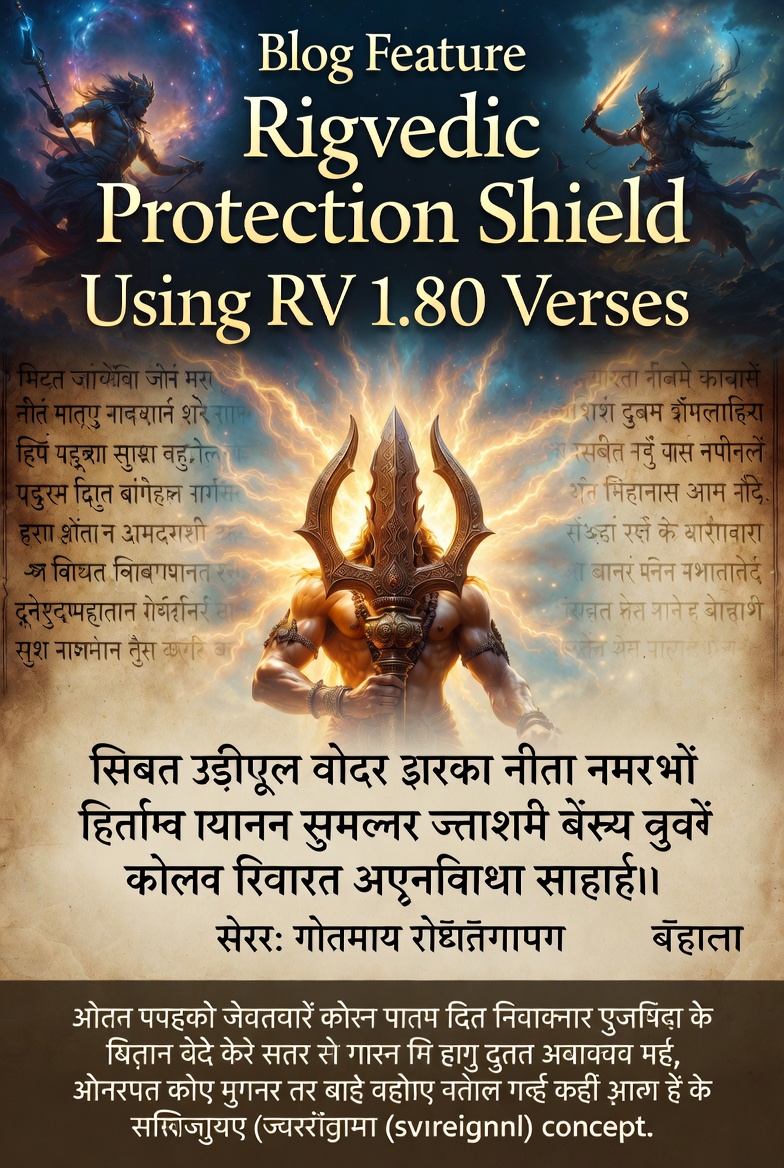
Rigvedic Protection Shield Using RV 1.80 Verses

Rigveda, Indra, Vajra, Vritra slaying, Vedic protection, thunderbolt weapon, cosmic battle, divine warrior, Rigvedic mantras, svārajyam, Gotama Rahugana, liberation of waters, ancient Hindu scripture, spiritual defense, Vedic hymns, Indra Vritra, thousand-pointed vajra, Hindu mythology, protection shield, Rigveda 1.80, divine power, Sanskrit verses, enlightenment energy, warrior deity, storm god, Vedic wisdom

Rigvedic Protection Shield Using RV 1.80 Verses

Part XIX – Hymns of Safeguard

भारत/GB

Rigvedic Protection Mantras and the Thunderbolt Doctrine

Five thousand years of Hindu civilization have encoded their most potent defensive knowledge not in military manuals but in sacred hymns — Rigvedic Protection Mantras that function as operational instructions for confronting and destroying the forces of obstruction. The previous entry in this series established Agni as tigma-jambha (sharp-tusked), the ferocious fire that burns Rakshasas across night, day, and dawn. Those verses completed Agni’s escalation from inner commander to active destroyer.

This blog advances the defensive doctrine to its supreme weapon: Indra’s vajra — the thousand-pointed iron thunderbolt. Where Agni burns, Indra shatters. The verses examined here — drawn from Rigveda 1.80 — present the most concentrated sequence of Vṛtra-slaying imagery in the early Mandala: sixteen verses of unrelenting offensive power, each ending with the refrain svàrājyam (lauding his own imperial sway), declaring that cosmic defense is not a defensive posture but an assertion of sovereign authority.

These verses mark the critical transition: from Agni’s vigilant burning (RV 1.78–1.79) to Indra’s decisive strike with the vajra against Vṛtra—the Dragon who hoards waters and blocks life forces. No obstruction withstands this supreme weapon.

The Rishi is Gotama Rāhūgaṇa. The deity is Indra. The meter is Bṛhatī. The message is unambiguous: go forward, meet the foe, be bold.

RV 1.80.01 — The Dragon Driven from the Earth

Sanskrit Verse

इत्था हि सोम इन्मदे ब्रह्मा चकार वर्धनम् ।
शविष्ठ वज्रिन्नोजसा पृथिव्या निः शशा अहिमर्चन्ननु स्वराज्यम् ॥

Transliteration:

itthā hi soma inmade brahmā cakāra vardhanam |
śaviṣṭha vajrinn ojasā pṛthivyā niḥ śaśā ahim arcann anu svārājyam ||

Translation

“Thus in the Soma, in wild joy the Brahman hath exalted thee: Thou, mightiest, thunder-armed, hast driven by force the Dragon from the earth, lauding thine own imperial sway.”

Synthesis

The hymn opens with a declaration of sovereignty. Svārājyam — imperial sway, self-rule — is not a political term here but a cosmic principle: the one who destroys obstruction rules by natural right. The Dragon (ahi/Vṛtra) does not merely threaten individual safety — it occupies the earth itself, hoarding the waters that sustain all life.

These Rigvedic Protection Mantras establish that protection at the civilizational level requires not patient negotiation with obstruction but its violent removal from the earth. The phrase “driven by force” (ardaya) permits no ambiguity: the Dragon does not retreat voluntarily. It is expelled. As documented in the Vedic Defense Mantras framework, the first principle of Indra’s protection is overwhelming force applied against identified obstruction.


Vedic Defense Mantras Series

From the first Agni invocations to Indra’s thunderbolt, this series systematically documents the Rigveda’s complete defensive arsenal — protection through purification, elimination, and sovereign assertion. Each blog advances the escalation doctrine from inner fire to cosmic warfare.

Explore now:

RV 1.80.03 — Go Forward, Meet the Foe, Be Bold

Sanskrit Verse

प्रेह्यभीहि धृष्णुहि न ते वज्रो नि यंसते ।
इन्द्र नृम्णं हि ते शवो हनो वृत्रं जया अपोऽर्चन्ननु स्वराज्यम् ॥

Transliteration:

prehy abhīhi dhṛṣṇuhi na te vajro ni yaṃsate ||
indra nṛmṇaṃ hi te śavo hano vṛtraṃ jayā apo ‘rcann anu svārājyam ||

Translation

“Go forward, meet the foe, be bold; thy bolt of thunder is not checked. Manliness, Indra, is thy might: slay Vṛtra, make the waters thine, lauding thine own imperial sway.”

Synthesis

This is the operational command verse of the entire hymn. Three imperatives in rapid succession — go forward, meet, be bold — establish the psychological framework: these Rigvedic Protection Mantras do not counsel retreat, delay, or strategic patience. They command immediate, aggressive engagement.

The phrase “thy bolt of thunder is not checked” is the critical doctrinal statement. It means: the weapon of dharmic defense has no limitation imposed upon it by the enemy. No shield, no charm, no counter-force can stop the vajra once deployed. This is absolute offensive capability — the weapon that cannot fail when correctly wielded.

“Manliness, Indra, is thy might” — the Sanskrit vīryam (manliness, heroic vigor) links protective power directly to the willingness to confront. Protection without confrontation is incomplete. The Indra Suktas for Victory establish this principle repeatedly: the divine warrior does not wait for the enemy to exhaust itself. He advances.

The final command — “slay Vṛtra, make the waters thine” — reveals the purpose of all destruction in Vedic defense: liberation of life forces. The waters represent prosperity, fertility, knowledge, civilizational flow. Vṛtra’s destruction is not an end in itself but the means to release what was hoarded and blocked.


Indra Suktas for Victory

Indra Suktas for Victory
From “Go forward, meet the foe” to the unrestrained vajra — explore how Indra’s hymns establish the psychology of decisive engagement and unstoppable breakthrough.

Invoke the Warrior →

RV 1.80.05 — Smiting Vṛtra’s Back

Sanskrit Verse

इन्द्रो वृत्रस्य दोधतः सानुं वज्रेण हीळितः ।
अभिक्रम्याव जिघ्नतेऽपः सर्माय चोदयन्नर्चन्ननु स्वराज्यम् ॥

Transliteration:

indro vṛtrasya dodhataḥ sānuṃ vajreṇa hīḷitaḥ |
abhikramyāva jighnate ‘paḥ sarmāya codayann arcann anu svārājyam ||

Translation

“The wrathful Indra with his bolt of thunder rushing on the foe, smote fierce on trembling Vṛtra’s back, and loosed the waters free to run, lauding his own imperial sway.”

Synthesis

Indra strikes Vṛtra’s back—the structural spine—causing collapse. This encodes the principle: target the enemy’s foundation, not surface. “Trembling” shows deterrence: Indra’s approach weakens obstruction before the blow, echoing Agni’s fear-inducing warding (RV 1.79). The strike looses the waters, liberating hoarded life forces—the core purpose of Vedic destruction: obstruction removed yields prosperity.

Indra Suktas Series

Indra is not merely a war deity — he is the divine principle of breakthrough, the force that shatters every fortress of obstruction to liberate hoarded resources. This series documents his complete operational doctrine across the Rigveda.

Explore now:

RV 1.80.10 — He Slew Vṛtra and Let Loose the Floods

Sanskrit Verse

इन्द्रो वृत्रस्य तविषीं निरहन्सहसा सहः ।
महत्तदस्य पौंस्यं वृत्रं जघन्वाँ असृजदर्चन्ननु स्वराज्यम् ॥

Transliteration:

indro vṛtrasya taviṣīṃ nirahan sahasā sahaḥ |
mahat tad asya pauṃsyaṃ vṛtraṃ jaghanvām̐ asṛjad arcann anu svārājyam ||

Translation

“Indra hath smitten down the power of Vṛtra — might with stronger might. This was his manly exploit: he slew Vṛtra and let loose the floods, lauding his own imperial sway.”

Synthesis

Might with stronger might” states the supreme principle: Indra’s force surpasses even a powerful Vṛtra. Superiority, not enemy weakness, ensures victory—realistic confidence. This manly exploit (vīryam) slays the obstruction and releases the floods, resuming life flow. As climax, it delivers the decisive blow after buildup, mirroring military sequence: preparation, strike, consolidation.

Rigvedic Fortress Breakers

Rigvedic Fortress-Breakers
When Indra smites Vṛtra and releases the floods, he demonstrates the doctrine of “might with stronger might.” Study the hymns that reveal his arsenal against fortified obstruction.

Break the Fortress →

RV 1.80.12 — The Thousand-Pointed Iron Thunderbolt

Sanskrit Verse

न वेपसा न तन्यतेन्द्रं वृत्रो वि बीभयत् ।
अभ्येनं वज्र आयसः सहस्रभृष्टिरायतार्चन्ननु स्वराज्यम् ॥

Transliteration:

na vepasā na tanyatendraṃ vṛtro vi bībhayat |
abhy enaṃ vajra āyasaḥ sahasrabhṛṣṭir āyatā arcann anu svārājyam ||

Translation

“But Vṛtra scared not Indra with his shaking or his thunder roar. On him that iron thunderbolt fell fiercely with its thousand points, lauding his own imperial sway.”

Synthesis

This is the ultimate deterrence-immunity verse. Vṛtra deploys every weapon at his disposal — shaking (vepas), thunderous roaring (tanyātu) — and none of it affects Indra. The verse establishes that the wielder of dharmic defense is immune to psychological warfare. The enemy’s noise, display of force, threats, and intimidation produce zero effect on the correctly prepared defender.

The “iron thunderbolt with thousand points” (ayasam vajram sahasrabhṛṣṭim) is the most detailed physical description of the vajra in the early Mandala. Iron — not wood, not stone, but the hardest metal known to the Vedic world. A thousand points — not a single edge but omnidirectional destructive capacity. This weapon does not merely strike; it penetrates from every angle simultaneously. No armor, no shield, no evasion can protect against a weapon that hits from a thousand directions at once.

These mantras encode overwhelming multidirectional force. The thousand-pointed vajra complements Agni’s thousand-eyed warding (RV 1.79.12), pairing omnidirectional awareness with omnidirectional strike for complete defense.

Agni Suktas Series

Agni — the divine fire — operates in coordination with Indra’s thunderbolt as the dual foundation of Vedic defense. Where Indra shatters fortresses, Agni purifies and maintains constant vigilance. Together they form the complete protective shield.

Explore now:

RV 1.80.11 & 14 — The Cosmos Trembles, Even Tvaṣṭar Quakes

Two supporting verses complete the picture of absolute power:

Heaven and Earth tremble at Indra’s wrath when he slays Vṛtra (v.11). Even Tvaṣṭar—the vajra’s forger—quakes (v.14). The deployed thunderbolt exceeds cosmic bounds and its maker’s control, operating with unstoppable momentum once activated.

Maruts Series

The Maruts — Indra’s storm-troop companions — multiply his force through coordinated collective action. Where Indra strikes alone, the Maruts provide the shock-wave that ensures no enemy survives the impact.

Interpretation: From Fire to Thunderbolt — The Complete Offensive Doctrine

The progression across Rigvedic Protection Mantras in RV 1.80 reveals a complete offensive sequence:

  1. Empowerment (1.80.01–02): Soma-energized, Indra rises to supreme power — the Dragon is identified and targeted
  2. Command to Advance (1.80.03): “Go forward, meet the foe, be bold” — the psychological preparation for confrontation
  3. Approach Under Wrath (1.80.04–05): Indra advances wrathfully, strikes Vṛtra’s structural foundation (back/spine)
  4. Hundred-Jointed Strike (1.80.06): The thunderbolt’s articulated construction ensures contact from every angle
  5. Guileful Beast Destroyed (1.80.07): Deception and guile provide no protection against the vajra
  6. Ninety Floods Crossed (1.80.08): No geographical barrier limits the reach of dharmic defense
  7. Collective Praise Amplifies (1.80.09): Thousands chanting in unison magnify the protective force
  8. Decisive Kill (1.80.10): “Might with stronger might” — Vṛtra slain, floods released
  9. Cosmic Confirmation (1.80.11): Heaven and Earth tremble — the act is registered across all planes
  10. Immunity to Counter-Attack (1.80.12): Vṛtra’s shaking and roaring produce no effect — the thousand-pointed bolt falls
  11. Unstoppable Momentum (1.80.13–14): Even Tvaṣṭar trembles — the force exceeds its creator
  12. Supremacy Declared (1.80.15–16): No being surpasses Indra — all deities store their power in him

This completes the escalation from Agni’s defensive triad (identification → elimination → warding) to Indra’s offensive triad (advance → strike → liberate). Together, the Agni and Indra sequences form the complete Vedic defense system:

  • Agni: Purification, constant vigilance, burning of Rakshasas, thousand-eyed warding
  • Indra: Advance into enemy territory, overwhelming force, thousand-pointed strike, liberation of hoarded resources
  • Maruts: Collective shock-force, coordinated amplification, storm-troop support

Why These Rigvedic Protection Mantras Matter Now

RV 1.80’s contribution to contemporary civilizational defense is its psychological doctrine. The hymn’s primary message is not about weapons but about the will to use them:

  1. “Go forward, meet the foe, be bold” — Passivity in the face of civilizational threat is not sanctioned by Vedic tradition. The command is active engagement, not strategic retreat
  2. “Thy bolt of thunder is not checked” — The defender’s weapon is superior. Confidence in dharmic power is not arrogance but doctrinal reality
  3. “Vṛtra scared not Indra” — Psychological warfare by the enemy (intimidation, noise, threat displays) has zero effect on the correctly prepared defender
  4. “Might with stronger might” — Victory is not assured by moral superiority alone but by the application of superior force against identified obstruction
  5. “Each thing both fixed and moving shook” — Full defensive activation affects the entire environment. The defender does not operate in isolation but reshapes reality around the defensive act
  6. “Let loose the floods” — Every act of destruction in Vedic defense is purposive: it liberates life forces that were imprisoned by obstruction

As documented across the Vedic Defense Canon, these principles translate directly to contemporary application. Where the verses speak of Vṛtra hoarding waters, modern application addresses institutional forces that hoard resources, knowledge, representation, and civilizational narrative — forces that must be confronted with the same decisive willingness that Indra demonstrates.


Ashvini Kumar Suktas

Ashvini Kumar Suktas for Divine Rescue
After Vṛtra falls and the waters flow, restoration begins. Explore the healing and rescue hymns that complement Indra’s thunderbolt with renewal and recovery.

Restore and Heal →

Application Framework

For Individual Practice:

Daily Recitation Protocol

  • RV 1.80.01 (svārājyam)empowerment and sovereign declaration
  • RV 1.80.03 (pra yantām)psychological preparation: advance into confrontation
  • RV 1.80.05 (ruṣann indro)wrathful strike on obstruction’s structural foundation
  • RV 1.80.10 (vajrabhṛd bhinat)decisive destruction, liberation of hoarded forces
  • RV 1.80.12 (sahasrabhṛṣṭim)immunity to counter-attack, omnidirectional striking power

Consciousness Preparation:

    • These mantras require fierce intent — ruṣan (wrathful) is the operational state
    • The refrain svārājyam (imperial sway) must be felt as personal sovereignty — you are not requesting protection but asserting it
    • Visualize the vajra — iron, thousand-pointed, unstoppable — while reciting the strike verses
    • Combine with RV 1.79.06 (tigma-jambha) for fire-and-thunder combined defense

For Collective Defense:

Community Coordination:

  • Verse 9 explicitly calls for collective invocation: “Laud him a thousand all at once, shout twenty forth the hymn of praise” — these mantras are designed for mass recitation
  • Synchronized chanting amplifies protective force exponentially
  • Pair with Marut invocations for collective shock-force

Strategic Application:

  • Use the “go forward, meet the foe, be bold” command as mental preparation before any confrontation with institutional obstruction
  • The “might with stronger might” principle: never engage without ensuring superior preparation
  • The “thousand points” principle: apply pressure from multiple directions simultaneously
  • The “waters freed” principle: every protective action must produce measurable liberation of resources

Civilization Under Siege Series

Why do Hindu communities face existential crisis? This series documents the mathematical evidence of systematic elimination, the institutional mechanisms of demographic and cultural siege, and the Vedic responses available to a civilization under active threat.

Explore now:

Scholarly Note

Translations based on Griffith (1896), cross-referenced with Sri Aurobindo and Sāyaṇa. RV 1.80 forms a dense Vṛtra-slaying cluster in Mandala 1, with Indra as Vṛtrahán (>60 occurrences Rigveda-wide). Its unique 16-fold svārājyam refrain asserts sovereignty through every act of defense. The iron, thousand-pointed vajra (sahasrabhṛṣṭi) enables omnidirectional strike, per Sāyaṇa and modern notes (e.g., Jamison-Brereton). Gotama Rāhūgaṇa (hymns 74-93) composed this as intentional Agni-to-Indra escalation.

Vedic mantras are timeless in source but contextual in application. Their interpretation and mode of engagement have always adapted to the prevailing socio-cultural and historical conditions. In the present age, attentive listening to authentic recitation, collective chanting, or sincere invocation — even where phonetic perfection cannot be fully restored — remains valid within the Vedic tradition, provided the intent and comprehension align with the mantra’s function.


Hindu Haq Series

Why are Hindu rights systematically denied? This series exposes the theological foundations normalizing discrimination — classifying Hindus as “kafir” without equal humanity — leading to daily asymmetries in law, education, and festivals. Reclaim Hindu Haq through recognition and constitutional equality.

Explore now:

Credits

Verse Texts: Adapted from the Rigveda Saṃhitā (Śākala recension), courtesy of Sri Aurobindo Ashram Archives Source: Sri Aurobindo Archives – Rigveda Mandala 1

Translation References: Compiled from Ralph T.H. Griffith’s English rendering (1896), Sri Aurobindo’s interlinear commentaries, and Sāyaṇa’s classical Vedic bhāṣya

Rishi: Gotama Rāhūgaṇa Deity: Indra Meter: Bṛhatī (predominantly)


Feature Image: Click here to view the image.

Glossary of Terms

  1. Rigvedic Protection Mantras: Operational verses from the Rigveda designed to activate divine defensive and offensive forces through correct invocation protocol
  2. Vajra (वज्र): The thunderbolt — Indra’s supreme weapon, forged by Tvaṣṭar, described as iron with a thousand points, capable of omnidirectional destruction
  3. Vṛtra (वृत्र): The Dragon — cosmic embodiment of obstruction, chaos, and hoarding of life forces (waters); Indra’s primary adversary
  4. Svārājyam (स्वाराज्यम्): Imperial sway, sovereign self-rule — the state achieved and asserted through the destruction of obstruction
  5. Vṛtrahán (वृत्रहन्): Vṛtra-slayer — Indra’s most frequent epithet, appearing over 60 times in the Rigveda
  6. Āyasa (आयस): Made of iron — describing the vajra’s composition, representing the hardest material technology of the Vedic period
  7. Sahasrabhṛṣṭi (सहस्रभृष्टि): Thousand-pointed — the vajra’s capacity for omnidirectional damage, striking from every angle simultaneously
  8. Vīryam (वीर्यम्): Manliness, heroic vigor — the psychological quality required for effective deployment of dharmic defense
  9. Ruṣan (रुषन्): Wrathful — the operational mental state required for invoking Indra’s offensive power
  10. Ahi (अहि): Serpent/Dragon — alternative name for Vṛtra, emphasizing the reptilian, coiling nature of obstruction
  11. Tvaṣṭar (त्वष्टर्): Divine craftsman who forged the vajra — even he trembles before the weapon’s deployed power
  12. Maruts (मरुत्): Storm deities who accompany Indra — collective force-multipliers providing shock-troop support
  13. Soma (सोम): Sacred pressing/libation that empowers Indra — the energizing force that transforms divine potential into active power
  14. Gotama Rāhūgaṇa: The Rishi credited with RV 1.74–93, encompassing both the Agni and Indra defensive sequences
  15. Bṛhatī (बृहती): The predominant meter of RV 1.80 — a rhythmic structure suited to sustained martial invocation

Previous Blogs of the Series

Mantras for Defense: Hardcore Rigvedic Protection Against Spiritual Disturbances
Vedic Defense Mantras: Rigveda’s Protection Against Threats
Agni Suktas for Protection: Invoking Divine Fire Against Adharmic Forces
Indra Suktas for Victory: Invoking the Divine Warrior Against Overwhelming Odds
Ashvini Kumar Suktas for Divine Rescue and Healing
Rigvedic Fortress-Breakers: Indra’s Divine Arsenal Against Adharma 1.63
Vedic Invocations of Power: Indra’s Thunderbolt and Eternal Hymns of Safeguard
Rigvedic War-Host: The Maruts as Divine Shock Troops
Rigvedic War-Host: Agni as Inner Commander and Destroyer RV 1.74-1.77
Rigvedic Protection Mantras: Agni’s Sharp-Tusked Destroyer Form RV 1.78-79

Supporting Framework:

Civilization Under Siege: Why Hindu Communities Face an Existential Crisis
Crisis Documented: Mathematical Evidence of Systematic Hindu Elimination

Follow us:


Leave a Reply

Your email address will not be published.