

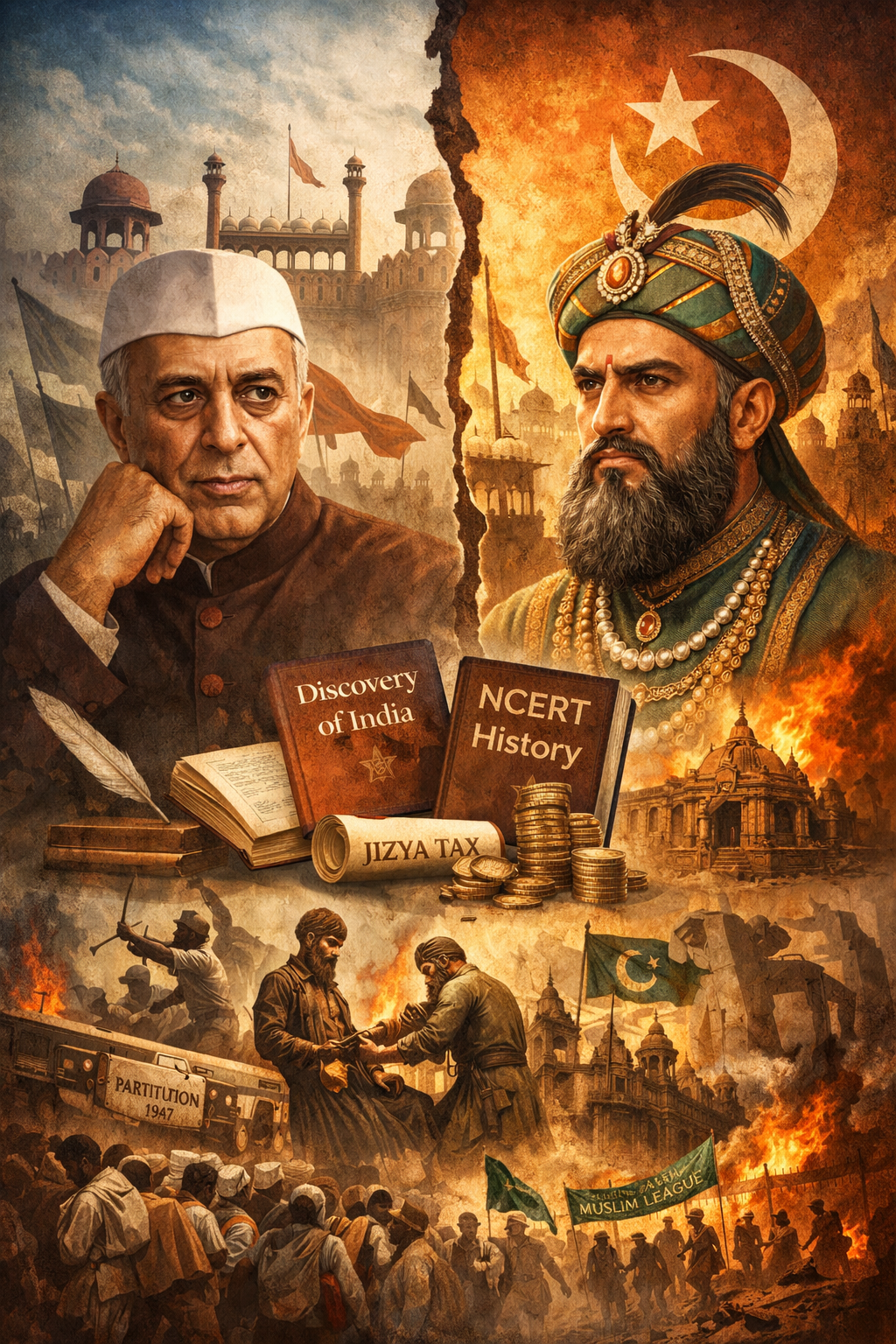
Aurangzeb in Nehru’s Praise: Political Necessity and 70-Year Whitewash
Part 5-II/#7: Nehru’s View on Islamic Invaders
भारत/GB
Introduction: From Technique to Ideology
In Part I, we documented HOW Jawaharlal Nehru humanized Aurangzeb through virtue-first framing, euphemistic vocabulary (“narrow religious ideas”), and strategic omissions (Guru Tegh Bahadur’s martyrdom, Sambhaji’s 40-day torture, thousands of destroyed temples abstracted into vague “religious measures”). The technique was sophisticated: present personal virtues before discussing crimes, creating psychological barriers to moral judgment.
Now we examine WHY. What political necessity drove Nehru to defend India’s most systematically persecutorial Mughal emperor? Why transform temple destruction into “unfortunate policies” and forced conversions into “religious narrowness”? The answer reveals the ideological foundation of Nehruvian historiography and explains how Aurangzeb in Nehru’s praise continues shaping Indian textbooks, political discourse, and historical consciousness seventy years after Independence.
This wasn’t accidental historical interpretation—it was calculated political necessity. The humanization of Aurangzeb served the synthesis narrative, which served the unity project, which served Nehru’s political positioning in 1944-1946. Understanding this chain reveals why honest historical reckoning with Islamic rule remained impossible for seven decades.
The Ideological Purpose: Why Nehru Needed to Humanize Aurangzeb
The Synthesis Narrative’s Weak Point
As we documented in our analysis of how Nehru portrayed Muhammad Ghori, the synthesis narrative required transforming Islamic conquest into cultural contribution. Akbar could serve this purpose because his political pragmatism created plausible deniability—maybe he genuinely believed in tolerance?
Aurangzeb destroyed that possibility. He was orthodox Islam implemented—no Din-i-Ilahi experiments, no jizya suspension, no political marriages framed as tolerance. He was what Islamic rule looked like when theological imperatives overrode political pragmatism.
This created a Aurangzeb in Nehru’s Praise:
If Akbar was “greatest since Ashoka,” then Aurangzeb must be an aberration, not the Islamic norm If synthesis was real, then Aurangzeb must be personally flawed, not theologically consistent If Hindu-Muslim unity was natural, then Aurangzeb must have narrow ideas, not orthodox implementation
Aurangzeb’s Nehru historical perspective solves this problem through humanization: by making Aurangzeb personally complex—”hardworking but narrow,” “devout but rigid,” “able but intolerant”—Nehru transforms theological consistency into character flaw. Islamic orthodoxy becomes personal limitation.
The 1946 Political Context
Aurangzeb’s Nehru historical perspective must be understood in its political context. Discovery of India was completed in 1944-1946, during:
- Muslim League’s Pakistan demand gaining strength
- Direct Action Day violence (August 1946) demonstrating communal tensions
- Congress’s desperate attempt to maintain united India
- Nehru’s positioning as bridge between Hindu majority and Muslim League
In this context, admitting that even the “most orthodox” Mughal emperor systematically persecuted Hindus would validate Pakistan’s demand—proving that Hindu-Muslim coexistence required separation, not unity.
Nehru needed to prove that even Aurangzeb’s reign could be framed as complex rather than simply oppressive, as theologically motivated rather than personally cruel, as “unfortunate narrowness” rather than Islamic orthodoxy implemented.
The humanization of Aurangzeb served immediate political purposes: demonstrating that even the worst Islamic rule in India could be explained without indicting Islam itself, making demands for Pakistan seem unnecessary.
But the long-term cost was historical truth. By humanizing systematic persecution, Aurangzeb’s Nehru historical perspective taught generations of Indians that:
- Hindu suffering under Islamic rule was exaggerated
- Islamic religious motivation was “personal narrowness,” not doctrinal consistency
- Demanding acknowledgment of historical persecution was “communal,” not legitimate
The Modern Consequences: Aurangzeb’s Ghost in Contemporary Debates
From Textbooks to Political Discourse
As we documented in our analysis of Nehruvian historiography’s modern impact, Aurangzeb’s Nehru historical perspective became embedded in NCERT textbooks for seven decades.
What Indian students learned:
- “Aurangzeb was a capable administrator who was personally devout”
- “His religious policies created some difficulties”
- “He lacked his ancestors’ tolerance”
What students didn’t learn:
- 2,000+ temples systematically destroyed
- Guru Tegh Bahadur tortured and beheaded
- Sambhaji’s 40 days of torture for refusing conversion
- Guru Gobind Singh’s sons bricked alive
- Jizya’s ritual humiliation system
- Theological basis for persecution
This educational erasure created what we can call “The Aurangzeb Illusion”—the belief that Hindu concerns about Islamic persecution were exaggerated communalism, not historical reality.
The Naming Controversy
The humanization technique’s modern consequence appears clearly in debates over naming public infrastructure after Aurangzeb. When Aurangzeb Road in Delhi was renamed in 2015, the controversy revealed how Aurangzeb’s Nehru historical perspective shapes contemporary discourse:
Those Defending “Aurangzeb Road” Argued:
- “Can’t erase history”
- “He was a capable administrator”
- “Personal beliefs separate from public role”
- “All rulers were complex”
- “Renaming is communal politics”
Notice the arguments—straight from Aurangzeb in Nehru’s Praise. The humanization framework makes removing Aurangzeb’s name seem like erasing nuance rather than refusing to honor systematic religious persecution.
Compare this to Germany’s approach to Hitler: No “Hitler Street” exists because systematic persecution can’t be balanced by administrative ability. Yet India retained “Aurangzeb Road” for 70 years because Aurangzeb’s Nehru historical perspective successfully humanized persecution.
The “Balance” Fallacy
Perhaps the most insidious consequence of Aurangzeb’s Nehru historical perspective is the demand for “balance” when discussing Aurangzeb:
Modern Defenders Argue:
- “Yes, temple destruction happened, BUT he also built infrastructure”
- “Yes, jizya was imposed, BUT he was personally austere”
- “Yes, forced conversions occurred, BUT Muslim rulers also suffered”
- “Must present balanced view showing complexity”
This “balance” demand is itself a product of Nehru’s humanization technique. We don’t demand “balance” when discussing genocide: “Yes, Holocaust happened, BUT Hitler loved dogs and built highways.”
The demand for balance when discussing systematic religious persecution is Aurangzeb’s Nehru historical perspective embedded so deeply it seems like reasonable historiography rather than ideological manipulation.
📊 SYSTEMATIC EVIDENCE: Partition Demographic Catastrophe: Yogi Adityanath’s Statistical Proof (1800-1947)
How did Aurangzeb’s policies affect long-term demographic patterns? Examine population statistics from Mughal period through Partition. Kashmir’s transformation, Moplah violence, and Pakistan’s minority collapse reveal consequences of the “narrow religious ideas” Nehru euphemized. Numbers document what narratives conceal.
Toward Historical Honesty: Aurangzeb Without Humanization
What Honest Historiography Requires
Moving beyond Aurangzeb’s Nehru historical perspective requires rejecting false complexity in favor of moral clarity:
Aurangzeb’s Real Administrative Record:
- Expanded empire to greatest territorial extent
- Efficient revenue collection through improved systems
- Maintained large standing army
- Administered complex bureaucracy effectively
- Showed personal courage in military campaigns
Aurangzeb’s Real Religious Record:
- Systematically destroyed 2,000+ Hindu temples
- Reimposed jizya with ritual humiliation
- Forced conversions through violence and economic pressure
- Martyred Guru Tegh Bahadur for refusing Islam
- Tortured Sambhaji for 40 days for refusing conversion
- Ordered bricking alive of Guru Gobind Singh’s young sons
- Implemented orthodox Islamic law targeting polytheists
- Created legal discrimination against Hindus
Both Can Be Acknowledged Without Humanization:
Aurangzeb was administratively capable AND systematically persecuted Hindus. These aren’t contradictory—administrative ability enabled more efficient persecution. Complexity doesn’t require moral ambiguity.
The Correct Framework:
Nazi administrators were efficient AND implemented genocide. We acknowledge their administrative competence while condemning their crimes—we don’t humanize them by emphasizing personal virtues before discussing atrocities.
Aurangzeb destroyed thousands of temples because of his “sincere Islamic devotion,” not despite it. His “personal piety” wasn’t separate from persecution—it motivated persecution. Separating these, as Aurangzeb’s Nehru historical perspective does, fundamentally misrepresents causation.
The Comparison Nehru Avoided
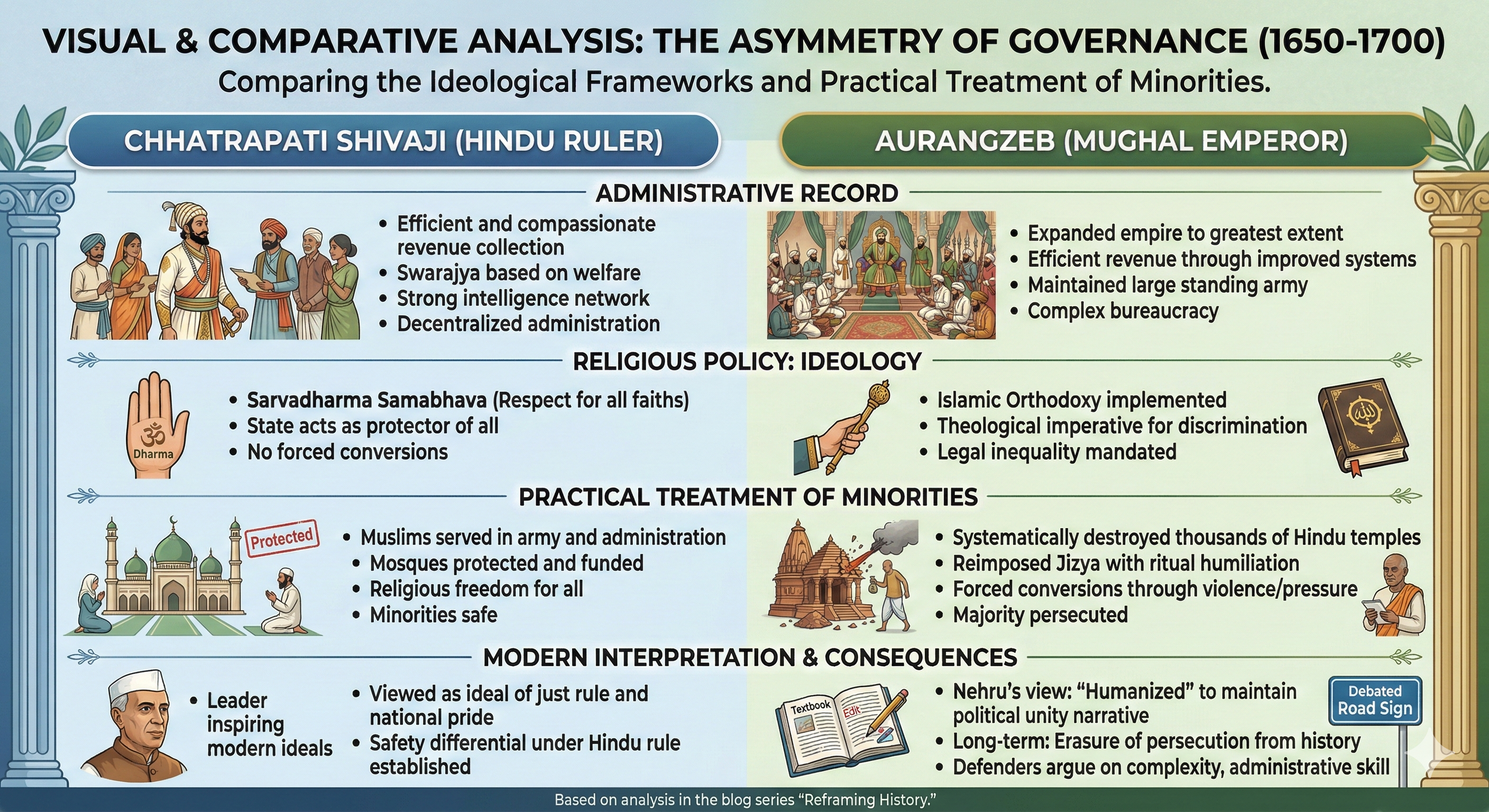
To truly understand Aurangzeb requires comparing his treatment of Hindus with how Hindu rulers treated Muslims during the same period. As documented in Yogi Adityanath’s comparative analysis:
Hindu Rulers’ Treatment of Muslim Minorities (1650-1700):
- Shivaji’s kingdom: Muslims served in army and administration, mosques protected
- Vijayanagara remnants: Muslims practiced freely, no forced conversions
- Rajput kingdoms: Muslim traders operated freely, legal equality maintained
- Zero systematic temple-to-mosque conversions by Hindu rulers
Aurangzeb’s Treatment of Hindu Majority:
- Systematic temple destruction
- Jizya with ritual humiliation
- Forced conversions
- Legal discrimination
- Economic persecution
The asymmetry reveals what Aurangzeb’s Nehru historical perspective conceals: the safety differential between minorities under Hindu versus Islamic rule wasn’t about individual rulers’ personalities but about theological frameworks.
As examined in Islamic doctrinal analysis, Islamic theology mandates subordination of polytheists, creating structural barriers to equality that even politically pragmatic rulers like Akbar couldn’t fully overcome—and that orthodox rulers like Aurangzeb actively implemented.
Conclusion: Why Aurangzeb’s Humanization Matters Today
Aurangzeb’s Nehru historical perspective—the technique of virtue-first framing that neutralizes moral judgment before evidence is presented—represents perhaps the most sophisticated form of historical manipulation in modern Indian historiography.
By emphasizing Aurangzeb’s “hardworking nature,” “personal austerity,” “administrative ability,” and “sincere devotion” before discussing temple destruction, jizya, and systematic persecution, Nehru created psychological barriers to moral clarity that persist seven decades later.
This wasn’t accidental. It was essential to a larger project of Aurangzeb in Nehru’s Praise, which we’ve documented across this series:
- Muhammad Ghori’s conquest became “historical transition”
- Mahmud’s massacres became architectural appreciation
- Akbar the Jihadi became synthesis builder
- Aurangzeb’s persecution became “personal narrowness”
The pattern is consistent: Islamic conquest and rule must be reframed as complex, nuanced, and morally ambiguous—never as systematic religious persecution motivated by theological imperatives.
The cost has been profound. For seven decades, Indian education taught students that:
- Demanding acknowledgment of Hindu suffering is communalism
- Islamic persecution was individual aberration, not doctrinal consistency
- Systematic religious violence was “narrow religious ideas”—personality flaw, not theology implemented
- Complexity requires moral ambiguity—evil can’t be called evil if it’s administratively competent
But historical truth requires rejecting these distortions. Aurangzeb wasn’t complex in a way that prevents moral judgment—he was systematically cruel in ways his own court chronicles proudly documented. His “personal piety” wasn’t separate from persecution but motivated it. His “administrative ability” enabled more efficient oppression. His “sincere devotion” demanded the destruction of Hindu sacred sites.
Aurangzeb’s Nehru historical perspective taught Indians to feel sophisticated by humanizing systematic religious persecution. Historical honesty requires recovering the moral clarity to call systematic persecution what it was—regardless of the persecutor’s personal habits or administrative competence.
As Yogi Adityanath’s safety analysis demonstrates, the question isn’t whether individual Muslim rulers varied in tolerance but whether Islamic theological frameworks created structural barriers to genuine equality that made persecution doctrinally consistent rather than personally aberrant.
Aurangzeb answered that question. He was orthodox Islam implemented—and the result was systematic religious persecution proudly documented in court chronicles. Humanizing this through vocabulary manipulation served Nehru’s political project but betrayed historical truth.
The next post in this series will examine The Synthesis Myth—how Nehru transformed conquest into “cultural contribution” by erasing the power asymmetry that made “synthesis” actually subjugation. If “hardworking and sincere” Aurangzeb still destroyed thousands of temples, what does this reveal about the synthesis narrative’s fundamental dishonesty?
Keywords: Aurangzeb Nehru historical perspective, Aurangzeb temple destruction, jizya tax Aurangzeb, Guru Tegh Bahadur martyrdom, Sambhaji torture execution, virtue-first framing technique, humanization of persecution, narrow religious ideas euphemism, Nehruvian historiography Aurangzeb, systematic religious persecution India, Hindu suffering under Mughals, Aurangzeb vs Vijayanagara, Islamic orthodoxy implemented, theological motivation persecution
This blog is part of the series “Reframing History: A Critical Analysis of Nehru’s Narrative on Islamic Invasions” examining how Jawaharlal Nehru’s historical writings shaped Indian understanding of Islamic conquests through selective emphasis, strategic omission, and psychological framing techniques that neutralize moral judgment.
Feature Image: Click here to view the image.
Glossary of Terms
- Jawaharlal Nehru: Independent India’s first Prime Minister whose book Discovery of India shaped post-Independence historiography and interpretations of medieval Islamic rule.
- Aurangzeb: Sixth Mughal emperor (1658–1707) known for territorial expansion, reimposition of jizya, and temple destruction policies debated in modern historiography.
- Discovery of India (1944–46): Nehru’s prison-written work presenting a civilizational narrative of India, influential in academic and textbook interpretations of medieval history.
- Nehruvian Historiography: A school of post-Independence historical writing emphasizing syncretism, composite culture, and political unity over civilizational conflict.
- Virtue-First Framing Technique: A narrative method that highlights personal virtues before discussing controversial actions, shaping moral perception through sequencing.
- Euphemistic Vocabulary: Use of softened terms such as “narrow religious ideas” instead of explicit descriptions like persecution or forced conversion.
- Synthesis Narrative: The theory that medieval Islamic rule produced a composite Indo-Islamic culture through harmonious integration rather than conflict.
- Jizya: A tax historically imposed on non-Muslims (dhimmis) under certain Islamic polities, reinstated by Aurangzeb in 1679.
- Temple Destruction Policy: Documented demolitions of Hindu temples during Aurangzeb’s reign, debated regarding scale, motive, and documentation.
- Guru Tegh Bahadur: Ninth Sikh Guru executed in 1675, regarded in Sikh tradition as martyred for defending religious freedom.
- Sambhaji: Maratha ruler, son of Shivaji, executed by Mughal forces in 1689 after refusing conversion, according to Maratha chronicles.
- Guru Gobind Singh: Tenth Sikh Guru whose young sons were executed during Mughal conflict, central to Sikh historical memory.
- Direct Action Day (1946): Political mobilization by the Muslim League in August 1946 that led to communal violence in Calcutta.
- Muslim League’s Pakistan Demand: Pre-Partition political movement advocating a separate Muslim-majority state, culminating in Partition (1947).
- NCERT Textbooks: Educational textbooks published by India’s National Council of Educational Research and Training, influencing historical curriculum.
- The Aurangzeb Illusion: A conceptual term in the blog describing the belief that concerns about medieval persecution are exaggerated or communal.
- Orthodox Islamic Implementation: Governance aligned closely with classical Islamic jurisprudence and theological imperatives.
- Din-i-Ilahi: A syncretic religious initiative introduced by Mughal emperor Akbar, often cited in discussions of tolerance versus orthodoxy.
- Composite Culture Theory: Academic proposition that Indo-Islamic interaction created shared cultural synthesis minimizing conflict narratives.
- Virtue-Humanization Paradigm: Analytical term describing portrayal of controversial rulers as morally complex to reduce moral condemnation.
#Historiography #TempleDestruction #HinduHistory #NCERT #Aurangzeb #Nehru #IndianHistory #MughalRule #HinduCivilization #IslamicInvasions #MuhammadGhori #Tarain1192 #NehruHistoriography #HinduinfoPedia #Nehru #NehrusviewonIslamicinvaders
Related Reading
List of Previous Blogs
- https://hinduinfopedia.in/nehrus-historical-narrative-how-he-shaped-indian-histography/
- https://hinduinfopedia.in/nehrus-intentional-omissions-mathura-massacre-and-appreciation/
- https://hinduinfopedia.org/nehrus-portrayal-of-muhammad-ghori-i/ https://hinduinfopedia.in/?p=24532
- https://hinduinfopedia.org/nehru-glorifying-islamic-invaders-the-vigorous-and-virile-narrative/ https://hinduinfopedia.in/?p=24676
- https://hinduinfopedia.org/aurangzeb-in-nehrus-writings-how-hardworking-and-sincere-neutralized-systematic-persecution/ https://hinduinfopedia.in/?p=24937
Historical Context – Aurangzeb Period:
- Political Islam vs Sanatan Dharma: Yogi Adityanath’s Lessons from Mughals
- Aurangzeb’s Early Life: Prelude to Power of Criminal Empire
- Aurangzeb’s Ascent: Governance and Policy Dynamics
- Aurangzeb’s Tyrannical Monuments: A Legacy of Despotism
- Guru Tegh Bahadur: Legacy of a Martyr
- Guru Arjan Dev Martyrdom: Consequence of Islamic Fundamentalism
Hindu Resistance to Aurangzeb:
- Chhatrapati Shivaji
- Chhatrapati Sambhaji Maharaj’s Attack on Burhanpur
- Battle of Sirhind: A Victory Shaping the Sikh Empire
- Maharana Pratap: History Unveiled
- Guru Tegh Bahadur: Legacy of Faith and Freedom
- Guru Har Rai Ji: A Legacy of Compassion and Diplomacy
Theological Framework:
- Hindu Haq Is Denied: The Theological Foundation That Normalizes Discrimination
- Islamic Doctrinal History: From Ridda Wars to Love Jihad
- Nazia’s Classification Crisis: Why Hindus Are ‘Kafir,’ Not ‘People of the Book’
- Islamic Texts and Polytheist Verdict on Hindu Muslim Interactions
Comparative Analysis:
- Yogi Adityanath On Hindu Safety vs Muslim Safety: A Civilizational Pattern
- Partition Demographic Catastrophe: Yogi Adityanath’s Statistical Proof (1800-1947)
- Yogi Adityanath on Coexistence: Historical Evidence- Early Islamic Encounters
Hindu Civilizational Achievements:
- Vijayanagar Dynasty: Among Ten Most Influential Dynasties in Bharat’s History
- Krishna Janmabhoomi Temple: A Spiritual Journey in Mathura
- Maha Kumbha Mela 2025: Analyzing Mad Rush of Hindus to Holy Waters-II
British Period Context:
- Gandhi’s Murder: Was Nehru Involved?
- British Loot and Industrialize: How India Funded Britain’s Rise
- Bengal Famine and British Genocides: How Colonial Policies Killed Millions
Follow us:
- English YouTube: https://www.youtube.com/@Hinduofficialstation
- Hindi YouTube: https://www.youtube.com/@HinduinfopediaIn
- X: https://x.com/HinduInfopedia
- Instagram: https://www.instagram.com/hinduinfopedia/
- Facebook: https://www.facebook.com/Hinduinfopediaofficial
- Threads: https://www.threads.com/@hinduinfopedia
Leave a Reply