
यह ब्लॉग नेपाल के वंश-विरोधी जन-आक्रोश और भारत में उभरे “इंडो किड्स कथा-निर्माण” के अंतर को स्पष्ट करता है। जहाँ नेपाल में जनता ने राजनीतिक वंशों को चुनौती दी, वहीं भारत में अभिजात राजनीतिक संताने स्वयं को जन-असंतोष का नेतृत्वकर्ता दिखाने लगीं। यह विश्लेषण सत्ता, मीडिया और कथानक के गठजोड़ को उजागर करता है।
Building Without Master Craftsman: Compare with RSS Assembly
Modern education processes children but fails to form humans. This blog contrasts institutional schooling with the RSS shakha system, showing how authority, discipline, repetition, and structured pressure create resilient character. While schools abandon formative authority, shakhas preserve the master craftsman model that produces stability, responsibility, and civilizational continuity.
इस्लामी सिद्धांतों का ऐतिहासिक क्रम: रिद्दा युद्धों से लव जिहाद तक
यह ब्लॉग इस्लामी सिद्धांतों के 1400 वर्षों के ऐतिहासिक व्यवहार का विश्लेषण करता है—रिद्दा युद्धों से लेकर लव जिहाद तक। यह दर्शाता है कि सिद्धांत, सत्ता और जनसंख्या रणनीतियाँ कैसे हिंदू सभ्यता को लक्ष्य बनाती रही हैं, और क्यों पवित्र सीमाओं का संरक्षण ऐतिहासिक रूप से अस्तित्व का प्रश्न रहा है।
फ्रांस सरकार का पतन: राजनीतिक अस्थिरता का प्रभाव
फ्रांस सरकार का विघटन केवल आंतरिक राजनीतिक असफलता नहीं था, बल्कि एक रणनीतिक दुर्बलता-काल था। 2024–2025 के दौरान बार-बार सरकार गिरने से संगठित जनसांख्यिकीय और वैचारिक दबाव सक्रिय हुए, जिनके परिणामस्वरूप फिलिस्तीन मान्यता 2025 जैसे निर्णय संभव हुए। यह लेख लोकतांत्रिक प्रक्रियाओं के भीतर छिपे दबाव-तंत्र को उजागर करता है।
How Nehru Portrayed Muhammad Ghori: Darkest Defeat Became ‘Historical Progress’-II
This article examines How Nehru Portrayed Muhammad Ghori by analyzing the narrative techniques used to transform India’s most consequential military defeat into “historical progress.” By tracing linguistic minimization, symbolic erasure, and euphemistic framing, it explains how the civilizational rupture at Tarain was rendered historically weightless, shaping generations of misunderstanding about conquest, sovereignty, and long-term consequences.
Nehru’s Portrayal of Muhammad Ghori: Darkest Defeat Became ‘Historical Progress’-I
The defeat of Prithviraj Chauhan at the Second Battle of Tarain in 1192 marked the most decisive rupture in Indian history, opening North India to centuries of Islamic rule. This article examines how Nehru’s portrayal of Muhammad Ghori reframed permanent conquest as civilizational transition, severing causation from consequence and erasing historical trauma.
Buddhist Reservation Paradox: Why Buddhists Get SC Benefits
This article examines the Buddhist Reservation Paradox—how Buddhists retain Scheduled Caste benefits while explicitly rejecting the Hindu framework that created those protections. By tracing constitutional amendments, Ambedkarite ideology, judicial patterns, and ethical principles of Dharma, it argues that reservation has become a right detached from responsibility, raising serious questions of equity, gratitude, and constitutional consistency.
Five-Stage Path to Samadhi for Ordinary Yogis: Sutra 1.20
Yoga Sutra 1.20 reveals Patanjali’s universal path to samadhi for ordinary practitioners through five sequential stages—śraddhā, vīrya, smṛti, samādhi, and prajñā. Rather than inherited privilege, liberation unfolds through disciplined removal of inner obstructions, allowing dormant yogic samskāras to awaken naturally and culminate in objectless absorption.
KBC Exposing Authority Collapse in Human Manufacturing
A single moment on KBC revealed a deeper civilizational failure: the collapse of authority in modern human formation. This article examines how dismantling hierarchy, discipline, and correction—under the guise of equality and rights—has distorted human manufacturing. Drawing from Hindu philosophy, it argues that structured authority is essential for upright, responsible individuals and social stability.
इस्लामी अधिकार विरोधाभास विश्लेषण – संरक्षण की असमानता से संरचना का अनावरण
यह लेख इस्लामी अधिकार विरोधाभास का विश्लेषण करता है, जहाँ व्यवहारिक दंड संरचनाएँ यह उजागर करती हैं कि पैग़ंबर मुहम्मद का संरक्षण ईश्वर की तुलना में अधिक कठोर और घातक है। क़ुरआनी आयतों, हदीसों और आधुनिक निंदा-विरोधी कानूनों के तुलनात्मक अध्ययन के माध्यम से यह ब्लॉग दिखाता है कि यह विरोधाभास वैचारिक नहीं, बल्कि विधिक और संरचनात्मक रूप से क्रियाशील है।
Bhava Pratyaya Videha Yogis: Spiritual Privilege And Rebirth (Yoga Sutra 1.19)
Bhava Pratyaya Videha Yogis represent inherited meditative capacity carried across lifetimes, granting effortless access to profound samadhi. Patanjali warns that such absorption—whether bliss-based or cosmic—remains within nature unless completed by viveka-khyāti. True liberation arises not from experience alone, but from discriminative wisdom that dissolves even subtle bondage.
KBC and the Plumb Line: When a Society Loses Its Moral Measure
This article explores how modern society abandoned its moral plumb line, leading to collapsing discipline, confused rights, and fractured families. Through Hindu principles of dharma, balanced reward–correction, and compassionate firmness, the piece explains why early guidance forms character and why false kindness creates long-term harm. A call to restore structure and rebuild human formation.
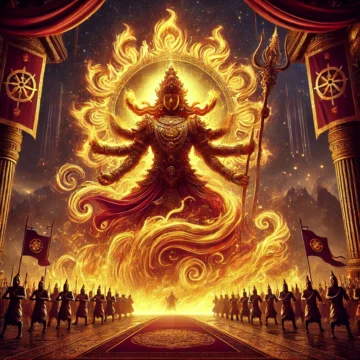
Rigvedic Fire-General: Agni as Army Commander – Rigveda 1.66
Rigveda 1.66.5-8 reveals Agni as strategic commander—eternal will incarnate, brilliant as golden chariots in battle, commanding like an army rushing to attack, operating with twin-force across present and future. These verses establish Vedic doctrine of organized defense under righteous leadership, completing the canonical triad with Indra's fortress-breaking and Maruts' shock-troops for civilizational protection.
Beyond Liberation: Videha, Prakriti-laya (Yoga Sutras 1.18-1.19)
Even the most sublime yogic states—Videha and Prakriti-laya—are revealed to be subtle forms of bondage in Patanjali’s Yoga Sutra. This blog explores how these states, while appearing like liberation, still bind the yogi through attachment. It introduces three authentic post-death paths—Sadyo-mukti, Krama-mukti, and Avatāra—and explains the deeper role of Viveka-khyāti and Bhava-pratyaya.
KBC Guru to Guide: Not Just a Teacher
When the Guru became a teacher, and the teacher a tutor, the sacred science of human construction collapsed into content delivery. This blog analyzes how ancient traditions shaped character with friction and force, while modern systems fear discipline. The guru was a potter — today’s tutor is a performer. The result? Bricks without buildings.
Patanjali Yoga Sutra Terms Explained: Understanding Yoga Sutra Terms-II
This expanded glossary completes the essential vocabulary needed to fully understand Patanjali’s Yoga Sutra, especially the profound teachings of 1.18–1.19. Covering advanced sadhana, post-death paths, psychological pitfalls, and subtle distinctions, it clarifies how abhyasa, vairagya, samskaras, and liberation processes interconnect—revealing the entire spectrum from effort to Kaivalya.
Patanjali Yoga Sutra Glossary: Understanding Yoga Sutra Terms-I
Struggling with complex Sanskrit in the Yoga Sutras? This glossary simplifies 36 key terms from Patanjali’s Yoga Sutras 1.18–1.19, focusing on Samadhi, samskaras, kleshas, and Sankhya philosophy. Gain clarity on Nirbija, Viveka-khyati, and Purusha-Prakriti to unlock Asamprajnata Samadhi and deepen your spiritual understanding. Ideal companion for beginners and advanced yoga practitioners alike.
Rigvedic War-Host: The Maruts as Divine Shock Troops
The Rigvedic hymn 1.64 presents the Maruts as a unified storm-host embodying the protective power of ṛta. Far from mere poetic embellishment, traditional and modern commentaries show the Maruts functioning as guardians of order who remove obstacles, strengthen communities, support rightful authority, and provide the inner resilience needed for civilizational continuity and collective defense.
Practice of Para Vairagya – Yoga Sutra
Patanjali’s Yoga Sutra 1.18 reveals the Practice of Para Vairagya—the supreme detachment that leads the yogi beyond all cognition into Asamprajnata Samadhi. Through Neti-Neti and repeated practice, the mind’s fluctuations cease, leaving only the subtle impressions of stillness. This process culminates in freedom, where consciousness rests in its own radiant nature.
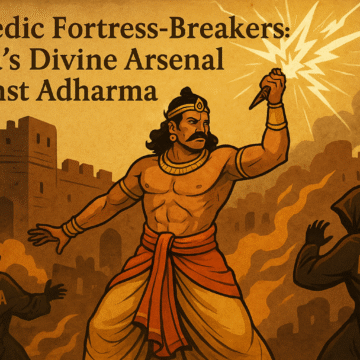
Rigvedic Fortress-Breakers: Indra’s Divine Arsenal Against Adharma 1.63
Rigvedic Fortress-Breakers reveal Indra’s battlefield doctrine — the divine authorization for self-defence rooted in Vedic dharma. Hymns 1.63.2–1.63.7 depict fortress-breaking, slaying of Dasyus, and divine protection for kings and sacrificers. Far from metaphor, these verses establish a Vedic right to resist annihilation and preserve sacred civilization against Adharmic conquest.