

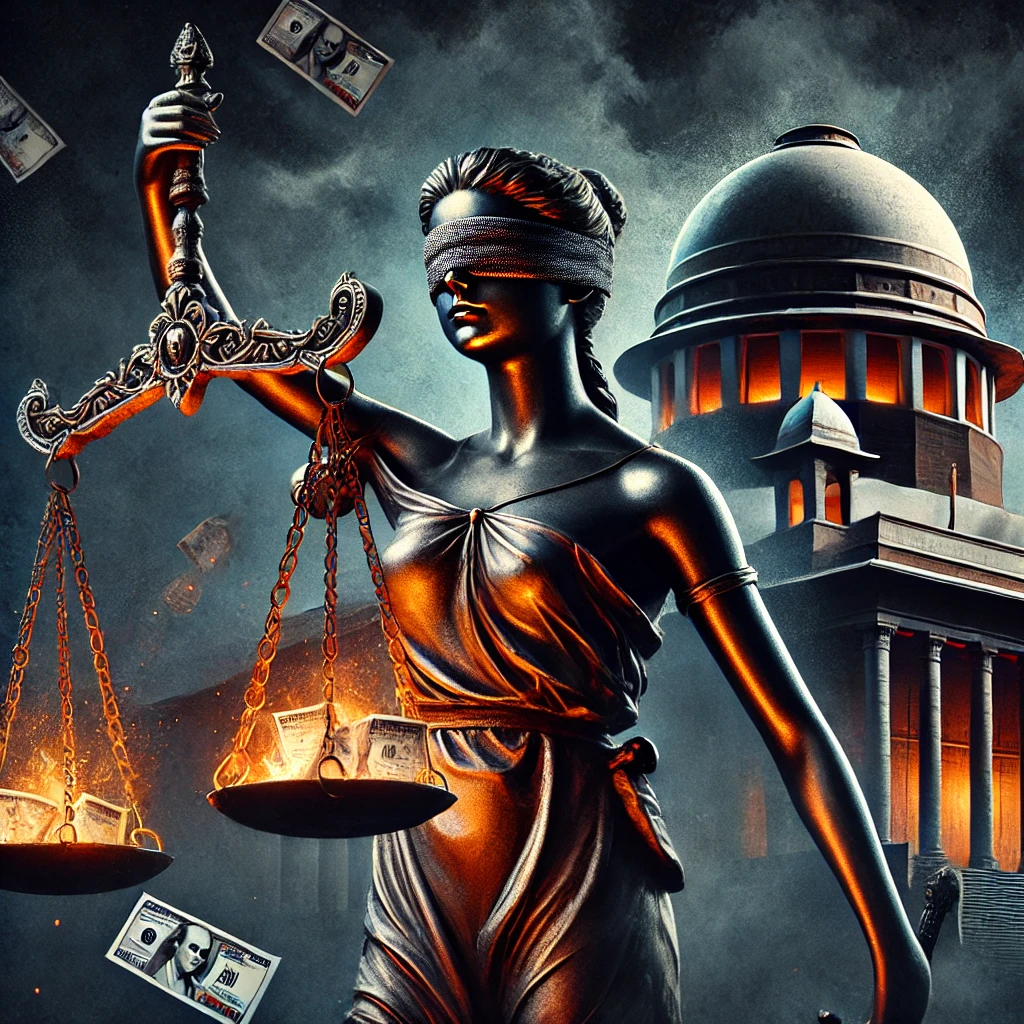
Institutional Corruption in Indian Judiciary: When Bar Council Admits
Blog 6|7#: When Courts Fail Both Ancient Dharma and Modern Jurisprudence
Institutional Corruption in Indian Judiciary: The Statement That Shook India
While investigating the circumstances and conditions that gave rise to the shoe-throwing incident inside the Supreme Court, we encountered a video conversation that fundamentally altered the direction of our inquiry. An interview conducted by Abhaya Sharma, founder of Regally Legal, with Ved Prakash Sharma, Co-Chairman of the Bar Council of India, raised questions that went far beyond one courtroom outburst. The candour with which systemic issues were discussed compelled us to look deeper—away from isolated incidents and toward a larger, more disturbing pattern. That investigation ultimately led to this blog and to a sustained examination of Institutional Corruption in the Indian Judiciary.
On March 23, 2025, in an exclusive conversation with Republic TV’s Editor-in-Chief Arnab Goswami, Senior Advocate K.K. Manan made a shocking revelation: “90% of judges in the lower judiciary are corrupt.”
This wasn’t a random activist or political commentator. This was:
- Former Chairman of Bar Council of Delhi (three terms: 2009-2010, 2010-2011, 2011-2012)
- Senior Advocate with over 40 years of practice
- Former Central Government Standing Counsel
- Someone who has appeared before these judges for decades
When asked if the Justice Yashwant Varma cash-burning incident was isolated, Manan responded bluntly: “90% of judges in the lower judiciary are corrupt. The remaining 10% who are honest are suffering, and lawyers are well aware of which judges are corrupt.”
When the Chairman of Bar Council of Delhi publicly states that “90% of judges in the lower judiciary are corrupt,” and cash burns in a High Court judge’s home with no criminal investigation—that’s not allegation, that’s admitted institutional rot.
This statement—coming from someone at the pinnacle of India’s legal establishment—validates everything our series When Courts Fail Both Ancient Dharma and Modern Jurisprudence has been documenting. As we established in our analysis of the Judicial Accountability Crisis, when the Supreme Court investigates itself and clears accused judges within a month, it sets the tone for the entire judicial system. The institutional manipulative approach we documented at the highest level has metastasized throughout the judiciary—and now, insiders are finally admitting it.
When Cash Burns, Truth Emerges
The Justice Yashwant Varma Case
March 14, 2025, 11:35 PM: A fire erupts at the residence of Delhi High Court Justice Yashwant Varma at 30 Tughlak Crescent, New Delhi. When firefighters arrive at 11:43 PM to extinguish the flames, they discover something shocking in a storeroom: heaps of burnt and partially burnt cash—₹500 notes in massive quantities.
Initial reports estimated close to ₹15 crore was found at Justice Varma’s residence during the firefighting operation, though the exact figure has not been officially confirmed. The scene of large sums of Indian money being burnt was described by witnesses as “shocking.”
This wasn’t a minor discrepancy. This was unaccounted cash in quantities that raised immediate questions about judicial integrity—questions that would expose the entire system’s approach to internal corruption.
The Supreme Court’s “Response”
According to Supreme Court Observer’s detailed timeline, the five-judge Collegium led by Chief Justice Sanjiv Khanna:
- March 22, 2025: CJI Khanna constituted a three-member committee to investigate—Justice G.S. Sandhawalia (Chief Justice of Himachal Pradesh HC) and Justice Anu Sivaraman (Karnataka HC judge)
- March 24, 2025: Collegium recommended Justice Varma’s transfer from Delhi High Court back to Allahabad High Court
- March 28, 2025: Union government notified the transfer, with explicit instructions that he would not be assigned any judicial work
- May 3, 2025: Three-member inquiry committee concluded investigation, finding “strong inferential evidence” of Justice Varma’s “covert or active control” over the cash
- Criminal investigation? NONE. Delhi Police could not register an FIR against a sitting High Court judge without CJI’s permission—a requirement stemming from a 1991 Supreme Court ruling
The law mandates registration of an FIR, suo motu or otherwise, in a case as serious as unaccounted crores found at a judge’s residence; yet Delhi Police did not act, plausibly owing to fear of backlash from the legal community—a risk demonstrated during the October 2019 Tis Hazari Court complex clash, where the Delhi High Court took suo motu cognisance and ordered action against police officials, rather than allowing the ordinary criminal law process to proceed freely and impartially on the basis of facts and evidence (Times of India, Oct 2019, LiveLaw, Oct 2019).
Read that timeline again: Unaccounted cash worth crores found burning in a judge’s home, and the Supreme Court’s response is transfer to another court and an in-house inquiry—the same pattern of judges investigating judges we exposed in our analysis of the Gogoi sexual harassment case.
K.K. Manan’s Explosive Questions
In his Republic TV conversation, K.K. Manan raised questions that cut to the heart of the Institutional Corruption in Indian Judiciary:
“What were the Chief Justice of India and the Delhi High Court doing until March 21 [in the cash burning case at Justice Verma’s residence in Delhi], when this information was made public, even though the incident occurred on March 14?”
“Judges are now questioning: if Yashwant Varma was involved, who else might be? Why not conduct a 2-3 day investigation and transfer the case to the CBI or ED? Why no concrete action?”
“Does the law only apply to the poor and not the rich? There should be an investigation into the properties and assets owned by judges—many have moved from DDA flats to posh localities after retirement.”
These aren’t rhetorical questions. They’re indictments of a system that has insulated itself from every form of accountability—the central thesis of our entire series.
Modern Jurisprudence: The Constitutional Violations
From a pure legal standpoint, the handling of judicial corruption represents multiple constitutional failures we’ve been documenting throughout this series.
Equal Application of Law (Article 14) – Abandoned
As we explored in our Dharma vs Jurisprudence Framework, Article 14 guarantees equal protection of law. But consider the stark contrast:
Common citizen with unaccounted cash:
- FIR filed immediately
- Arrest within hours
- Prosecution under Prevention of Money Laundering Act
- Media trial begins instantly
- Assets frozen pending investigation
High Court Judge with about ₹15 crore burnt cash:
- No FIR (police need CJI permission)
- Transfer to another court (called “routine”)
- In-house inquiry by judicial colleagues
- No criminal investigation
- No asset seizure
This isn’t just unequal protection—it’s aristocratic exemption from the law. The Constitution doesn’t create special categories where judges are above criminal investigation. Yet that’s precisely what the 1991 Supreme Court ruling created—a shield that protects judicial corruption.
Natural Justice Violation – Repeated
The Supreme Court’s response of setting up an in-house committee repeats the judicial self-investigation pattern we documented extensively in Judicial Accountability Crisis: When Judges Investigate Themselves. The three-member panel—all judges—investigated another judge. No external oversight, no independent agency, no public accountability.
As JURIST’s legal analysis notes, this violates the fundamental principle of nemo judex in causa sua (no one should be a judge in their own cause). When the judiciary investigates itself, it’s not justice—it’s institutional self-protection.
The Systematic Nature of Corruption
K.K. Manan’s “90% corrupt” claim isn’t hyperbole when you examine the evidence:
Asset Disclosures: Bar & Bench documented that judges are supposed to file asset declarations, but these are rarely made public and almost never scrutinized. When they are disclosed, the information often raises more questions than answers.
Post-Retirement Wealth: As Manan noted, judges moving from DDA flats to luxury properties in posh localities raises obvious questions about unexplained wealth accumulation during or after tenure.
Lawyer Knowledge: Manan’s statement that “lawyers are well aware of which judges are corrupt” indicates this is an open secret within the legal community—known to insiders, invisible to the public.
The System Protects Itself: According to JURIST’s analysis, to date, impeachment proceedings have been initiated only five times against sitting judges in Indian history—none have been successful. Only one judge (Justice Soumitra Sen) resigned after the Rajya Sabha passed impeachment, but before the Lok Sabha voted.
This creates a system where corruption has zero real consequences—a pattern we’ve been exposing throughout this series, from Shaheen Bagh’s selective urgency to judges investigating themselves.
Ancient Dharma: When Institutional Adharma Becomes Systemic
The Institutional Corruption in Indian Judiciary violates not just modern constitutional principles but also ancient Indian jurisprudence’s most fundamental tenets.
The Arthashastra’s Warning
Kautilya’s Arthashastra explicitly warned about judicial corruption, prescribing severe punishments for judges who took bribes or delivered unjust verdicts. The text recognized that when the guardians of justice become corrupt, the entire social order collapses.
The Arthashastra states: When judges accept bribes, they don’t just harm individual litigants—they undermine Rta (cosmic order) itself. The corruption of those meant to uphold dharma creates cascading adharma throughout society.
The Mahabharata’s Teaching
The Shanti Parva contains the story of King Rantideva, who warns: “A corrupt judge destroys not just the litigants before him, but seven generations of his family and undermines the foundations of dharma itself.”
This wasn’t metaphor—it was recognition that judicial corruption creates cascading harm throughout society. When justice can be bought, when verdicts depend on bribes rather than truth, when the powerful escape consequences while the poor suffer—that’s not just individual wrongdoing, it’s civilizational collapse.
The Principle of Satya (Truth) Abandoned
We explored in our framework analysis that Satya (truthfulness) is foundational to justice. When judges accumulate unexplained wealth measured in crores, when they transfer corrupt colleagues rather than prosecute them, when they create systems that protect institutional corruption through in-house inquiries—they abandon Satya completely.
The Vedic principle demands: Those who judge others must be satya-vrata (committed to truth) in all aspects. When supposedly, approximately ₹15 crore burns in a judge’s storeroom and the response is “routine transfer,” truth has been sacrificed for institutional protection.
Sama-Darshana (Equal Vision) Inverted
The 90% corruption admission reveals that judges don’t apply sama-darshana—the equal vision we discussed in our framework. They have created one standard for themselves (no FIR, internal inquiry, transfer) and another for everyone else (immediate arrest, prosecution, asset seizure).
Ancient texts are explicit: A judge who shows different levels of legal accountability based on whether the accused is a judge or a citizen has abandoned dharma—regardless of how many legal precedents justify the distinction.
Ved Prakash Sharma’s Institutional Perspective
Shri Ved Prakash Sharma, Co-Chairman of Bar Council of India since 2019, brings additional institutional weight to these concerns. With a practice spanning since 1978, three-time President of Delhi Bar Association, and former Chairman of Bar Council of Delhi (2009-2010), Sharma represents the voice of India’s legal establishment.
In recent public statements and video conversations, Sharma has reinforced concerns about systemic judicial issues:
On Corruption Reality: Acknowledging that a significant number of lower court judges engage in corrupt practices—a statement that echoes K.K. Manan’s stark 90% assessment
On Delays as Symptom: The mandatory mediation process and procedural delays often result from judicial apathy and, in some cases, corruption where delays benefit those willing to pay bribes to expedite or obstruct cases
On Judicial Apathy: Lower courts exhibiting frustration and indifference—creating an environment where corruption thrives unchecked because honest judges become demoralized
On Need for Accountability: Emphasizing that transparency and accountability are crucial for maintaining public faith—but noting candidly that “change is slow and resistance is deeply rooted”
On Judicial Transfers: At Justice Dinesh Kumar Sharma’s farewell, Ved Prakash Sharma emphasized that judicial transfers were essential for maintaining independence—a statement that takes on new meaning in light of the Varma case where “transfer” became punishment-by-relocation rather than accountability through prosecution.
When both the Delhi Bar Council Chairman (K.K. Manan) and the national Bar Council of India Co-Chairman (Ved Prakash Sharma) acknowledge systemic corruption in similar terms, this transcends individual opinion—it becomes institutional confession.
Why Lawyers Know What Citizens Don’t
K.K. Manan’s statement that “lawyers are well aware of which judges are corrupt” reveals something profound about the Institutional Corruption in Indian Judiciary: The corruption is visible to insiders but systematically hidden from the public.
The Silence System
Contempt Power: Lawyers who speak publicly about specific judges’ corruption face contempt proceedings that can end their careers. The same power we discussed in our judicial accountability analysis silences those who witness corruption daily.
Professional Survival: Lawyers must appear before these judges regularly—calling them out publicly means professional suicide. Cases get adjourned indefinitely, bail applications denied without reason, arguments cut short. The corrupt judge’s power over a lawyer’s practice creates forced complicity.
Institutional Omerta: Bar associations know which judges are corrupt but can’t act without evidence that corrupt judges will never allow to surface. Court staff know. Opposing lawyers know. Litigants suspect. But no one can speak without risking everything.
Media Dependence: Legal journalism in India is structurally dependent on court access and judicial sources, a constraint reflected in high-profile controversies over judicial criticism. In the Prashant Bhushan contempt case, senior advocates arguing that allegations of judicial corruption should be investigated were met with contempt proceedings, and commentators noted the chilling effect such rulings have on free expression and media scrutiny of the judiciary [thewire.in www.barandbench.com].
The result: Millions of litigants interact with corrupt judges daily, paying bribes through touts, middlemen and advocates, watching cases decided based on payments rather than law, while the system maintains a facade of judicial integrity.
Only when something dramatic happens—like cash burning in a judge’s home—does the truth briefly surface before the system works to bury it again.
The Real Cost of Judicial Corruption
The Institutional Corruption in Indian Judiciary extends far beyond money changing hands. Its impact cascades throughout society in ways that connect to every failure we’ve documented in this series.
Undermines Constitutional Democracy
When justice can be bought, rule of law dies. Constitutional rights become privileges for those who can pay. Democratic governance requires a functional judiciary to check executive and legislative power—when that judiciary is corrupt, the entire constitutional framework collapses.
As we documented in our analysis of how courts showed selective urgency in the Shaheen Bagh case, when judicial decisions appear driven by factors other than law, public faith in institutions erodes catastrophically.
Judicial corruption and selective enforcement actively reconfigure the power structure of society. This was revealed by multiple exposes in Uttar Pradesh under the BJP rule where thousands of acres of public land captured by musclemen was recovered through effective policing.
Economic Damage
Businesses won’t invest where contracts aren’t enforced fairly. International rankings suffer when judicial corruption is endemic. The World Bank’s Ease of Doing Business rankings consistently penalize India for “enforcing contracts”—a euphemism for judicial efficiency and integrity.
As we showed in our analysis of how politically connected accused receive swift bail while others languish, selective justice based on power or payment or through the use of legal muscle—hiring prohibitively expensive lawyers whose stature and cost make judges reluctant to question them, thereby distorting scrutiny and outcomes.
Social Disintegration
Poor litigants lose cases they should win because they can’t afford bribes. Women seeking justice for harassment face judges demanding payments. Families fighting property disputes see their cases drag on for decades because one party pays for delays.
As we documented in our analysis of the Assam Agitation and Khoirabari Massacre, when people lose faith in legal institutions, they resort to extra-legal methods—not because they’re inherently violent, but because they see no other recourse.
The Delhi Riots we analyzed happened partly because judicial failures created an environment where law enforcement seemed optional, where roadblocks could continue for 101 days, where different standards applied to different groups. When institutions fail, violence fills the vacuum.
Civilizational Crisis
India’s claim to be the world’s largest democracy rings hollow when its judiciary—the guardian of constitutional rights—is admitted by its own Bar Council leadership to be 90% corrupt.
The ancient dharmic tradition of justice, codified in texts like Manusmriti and Arthashastra, emphasized judicial integrity as foundational to civilizational order. When millions undertake arduous journeys to Maha Kumbha Mela seeking divine justice, part of that spiritual yearning stems from a civilization that recognizes human justice has failed.
As we’ve documented in our series on how courts fail both dharma and jurisprudence, the Institutional Corruption in Indian Judiciary represents not just legal failure but dharmic collapse—the abandonment of principles that sustained Indian civilization for millennia.
The Pattern Across Our Series
The Institutional Corruption in Indian Judiciary connects directly to every failure we’ve documented:
Blog 1: Shoe-Throwing Incident – When people lose faith in institutional integrity, frustration explodes into symbolic acts
Blog 3: Shaheen Bagh – When courts apply selective urgency (101 days vs. instant stays), questions arise: Is this law or is this corruption of purpose?
Blog 4: Judges Investigating Themselves – The accountability vacuum doesn’t just enable misconduct—it enables systematic corruption
Waqf Act Selective Protection – When courts consistently favor certain groups through judicial protection, when judicial responses show systematic bias, the question becomes: What drives these patterns?
Manish Sisodia Swift Bail – When politically connected accused get instant relief while others wait months, is it judicial discretion or something darker?
The corruption isn’t just about cash in hand. It’s about:
- Selective application of law based on who benefits (politically, financially, communally)
- Institutional protection of corrupt colleagues through in-house inquiries and transfers
- Post-retirement rewards for favorable judgments (as we’ll examine in our next blog on Bhopal)
- Zero accountability for misconduct, enabling systematic abuse
K.K. Manan’s 90% admission and Ved Prakash Sharma’s acknowledgment of “deeply rooted resistance” to change confirm what our series has been proving: The judicial system has become a closed aristocracy that protects itself while claiming to deliver justice to others. hr 55 ay 2088
What Reform Actually Requires
Any discussion of reform is incomplete unless it begins with judicial appointments. Unless the process by which judges are selected, elevated, and transferred is fundamentally corrected, no amount of oversight, asset scrutiny, or post-retirement regulation can succeed, because a system that appoints compromised individuals cannot later discipline them into integrity.
Both K.K. Manan and Ved Prakash Sharma have indicated what’s needed—though Sharma’s acknowledgment that “resistance is deeply rooted” reveals the challenge:
Independent Oversight
External Investigation Body: Cannot be judges investigating judges. Must include public representatives, retired judges from other jurisdictions, forensic accountants, and law enforcement professionals.
Criminal Accountability: When evidence of corruption surfaces (like about ₹15 crore in cash), FIRs must be filed automatically. No requirement for CJI permission—judges must face the same criminal law as everyone else.
CBI/ED Involvement: Serious cases like Varma’s should immediately go to Central Bureau of Investigation or Enforcement Directorate—agencies with forensic capacity to trace money trails.
Asset Verification
Mandatory Public Disclosure: All judicial assets must be publicly declared annually, including family members’ assets and post-retirement income sources.
Forensic Audits: Unexplained wealth should trigger automatic forensic audits. Judge living beyond disclosed means? Investigate the source.
Lifestyle Monitoring: As K.K. Manan noted, judges moving from DDA flats to posh properties need to explain the wealth source. If they can’t, prosecution follows.
Post-Retirement Scrutiny
Cooling-Off Period: Minimum 2-year ban on any government appointments, tribunal positions, or roles that benefit from cases decided while serving.
Wealth Tracking: Monitor judges’ wealth for 5 years post-retirement. Sudden affluence triggers investigation.
Connection Scrutiny: Investigate connections between judgments delivered and benefits received post-retirement—as we’ll examine in our next blog on the Bhopal Gas Tragedy case.
But There’s the Problem…
As Ved Prakash Sharma candidly admitted: “Change is slow and resistance is deeply rooted.”
Why? Because according to K.K. Manan, 90% of judges are corrupt. They won’t reform themselves. They won’t vote for systems that expose their corruption. They won’t accept oversight that threatens their untouchable status.
And the honest 10%? As Manan noted, they’re “suffering”—marginalized, demoralized, unable to change a system where they’re outnumbered nine to one.
This is why the Institutional Corruption in Indian Judiciary is so devastating. It’s not a few bad apples—it’s systematic rot where the corrupt majority protects itself through the very institutions meant to uphold justice.
Cumulative Evidentiary Context from This Series
The assessment articulated by K.K. Manan does not emerge in isolation. Across this series, we have repeatedly documented patterns that point to systemic dysfunction rather than isolated misconduct. From the extreme loss of public faith reflected in the incident examined in Shoe at Supreme Court: Symbol of India’s Judicial Crisis, to the structural benchmark failures outlined in Dharma vs Jurisprudence: The Framework for Measuring Judicial Failure, the evidence consistently indicates a judiciary increasingly detached from both constitutional equality and civilizational ethics.
This pattern becomes sharper in lower-court behaviour, where insider frustration surfaced publicly in Ranchi Court Confrontation: When Lawyers Challenge Judicial Arrogance, reinforcing Manan’s observation that lawyers are acutely aware of which judges are compromised. At the apex level, the selective application of urgency in Shaheen Bagh and the systemic self-protection detailed in Judges Investigating Themselves demonstrate how accountability collapses precisely where it is most needed. Additional analyses—whether examining judicial arrogance (Lord Vishnu Can Repair Himself) or selective constitutional interpretation (The Buddhist Reservation Paradox)—reinforce the same institutional trajectory.
Taken together, these documented patterns indicate a judiciary in which deviations from law, equality, and accountability are neither rare nor accidental, but recurrent and structurally sustained.
The manner in which Rakesh Kishore, regarded by many as one of the brightest advocates of his generation, was effectively removed from the rolls of advocates reveals the depth of institutional defects within India’s justice system. Regardless of procedural labels, the end result is undeniable: he can no longer practice law. The speed, unanimity, and severity with which the legal establishment acted against an advocate—while extending institutional protection to judges facing far graver allegations—demonstrates a system that closes ranks to defend itself, even at the cost of sacrificing its own. This episode is not about one individual’s misconduct; it is about how dissent against judicial authority is punished absolutely, while judicial wrongdoing is managed, diluted, and shielded.
Scope of Inference
Accordingly, based on the cumulative evidence presented so far in this series while our investigation still continues, it is reasonable to conclude that the institutional conditions described above substantially support K.K. Manan’s assertion regarding the scale of corruption in the lower judiciary. At the same time, this conclusion does not rest on numerical precision or the moral character of every individual judge, but on the observable consistency of outcomes, incentives, and protective mechanisms that allow corruption to persist while insulating the institution from meaningful scrutiny.
From Allegations to Admitted Reality in Institutional Corruption in Indian Judiciary
When the Chairman of Bar Council of Delhi publicly states that “90% of lower court judges are corrupt,” when the Co-Chairman of Bar Council of India acknowledges systematic issues and “deeply rooted resistance” to reform, when about ₹15 crore burns in a High Court judge’s home and the response is “routine transfer” with no criminal investigation—we’re not documenting allegations anymore.
We’re documenting admitted institutional reality.
This is the Institutional Corruption in Indian Judiciary that completes our series’ thesis: Indian judiciary fails both modern jurisprudence (Article 14’s equal application of law) and ancient dharma (Satya, Sama-darshana) because it has become a corrupt aristocracy that protects itself while claiming to deliver justice to others.
The shoe thrown at CJI Gavai, the 101-day delay in Shaheen Bagh, the judges investigating themselves, the selective urgency patterns—all these connect to one underlying reality: A system that has insulated itself from accountability inevitably becomes corrupt.
Next: We examine how this corruption manifests in specific high-profile cases. Starting with the Bhopal Gas Tragedy, we’ll analyze how judicial decisions that denied justice to thousands of victims appeared connected to post-retirement benefits for judges—showing that the Institutional Corruption in Indian Judiciary isn’t just about cash in hand, but about trading justice itself for personal gain.
Key Takeaways:
✅ Bar Council Delhi Chairman K.K. Manan publicly stated “90% of lower judiciary judges are corrupt”
✅ Bar Council India Co-Chairman Ved Prakash Sharma acknowledged systematic issues and “deeply rooted resistance” to change
✅ Nearly ₹15 crore found burning at Justice Yashwant Varma’s residence—no criminal investigation, just “routine transfer”
✅ Delhi Police cannot file FIR against sitting judges without CJI permission (1991 SC ruling)
✅ Supreme Court set up in-house committee (judges investigating judges) rather than independent probe
✅ Modern jurisprudence violation: Article 14 equal protection abandoned—different standards for judges vs. citizens
✅ Ancient dharma violation: Satya (truth) and Sama-darshana (equal vision) principles destroyed by institutional self-protection
✅ Impeachment proceedings initiated only 5 times in Indian history—NONE successful
✅ Lawyers “well aware” which judges are corrupt but silenced by contempt power and professional survival needs
Feature Image: Click here to view the image.
Glossary of Terms
- Institutional Corruption in Indian Judiciary: Systemic misuse of judicial power where corruption is embedded within judicial structures rather than isolated individual misconduct.
- Bar Council of India (BCI): Statutory body regulating legal education and professional conduct of advocates in India.
- Bar Council of Delhi: State-level statutory body governing advocates practicing in Delhi courts.
- In-House Judicial Inquiry: Internal investigation conducted by judges against fellow judges without external or independent oversight.
- Collegium System: A mechanism through which senior Supreme Court judges appoint and transfer judges, operating without statutory transparency.
- Justice Yashwant Varma Cash Incident: March 2025 event where unaccounted cash was found burnt at a sitting Delhi High Court judge’s residence.
- Chief Justice of India (CJI): The head of the Indian judiciary and Supreme Court, vested with administrative authority.
- 1991 Supreme Court Ruling on FIRs: Judicial precedent requiring prior CJI permission before police can register an FIR against sitting judges.
- Article 14 (Indian Constitution): Constitutional provision guaranteeing equality before law and equal protection of laws.
- Nemo Judex in Causa Sua: Principle of natural justice stating that no one should judge their own case.
- Judicial Accountability Crisis: Systemic failure of mechanisms meant to investigate and punish judicial misconduct.
- Selective Urgency: Judicial practice where courts act swiftly in some cases while delaying others without consistent legal justification.
- Contempt of Court Powers: Authority enabling courts to punish criticism deemed harmful to judicial authority, often chilling dissent.
- Post-Retirement Judicial Appointments: Government or tribunal roles assigned to retired judges, often scrutinized for conflict of interest.
- Dharma: Ancient Indian civilizational concept of moral order, justice, and righteous conduct.
- Adharma: Breakdown or inversion of dharma, representing injustice and moral decay.
- Satya: Principle of truthfulness foundational to ancient Indian jurisprudence.
- Sama-Darshana: Dharmic ideal of equal vision and impartial treatment.
- Arthashastra: Ancient Indian treatise by Kautilya outlining governance, law, and judicial ethics.
- Judicial Aristocracy: Term describing insulation of judges from accountability, creating an elite class above ordinary law.
#IndianJudiciary #JudicialCorruption #RuleOfLaw #IndianCourts #InstitutionalCorruptionCrisis #LowerJudiciaryCorruption #JusticeYashwantVarma #KKManan #BarCouncilAdmits #JudicialReform #DharmaVsJurisprudence #WhenCourtsFailAncientDharmaandModernJurisprudence
Related Reading
Videos
Understanding the Justice Varma Case:
- Business Standard: Cash Found at Judge’s House After Fire
- Ummid: Pile of Unaccounted Cash – ₹15 Crore Estimate
- Wikipedia: Yashwant Varma Cash Row Complete Timeline
- Supreme Court Observer: In-House Inquiry Timeline
- Supreme Court Observer: Justice Varma Challenges In-House Procedure
- India TV: Transfer Notification Details
- The Week: Why Delhi Police Couldn’t Register FIR
Understanding K.K. Manan’s Statement:
- Republic World: K.K. Manan’s Explosive “90% Corrupt” Claim
- Bar & Bench: Nine Former Judges Who Spoke of Corruption
Understanding the Pattern:
- JURIST: Reimagining Judicial Impeachment After Delhi HC Scandal
- Article 14: Equality Before Law – Constitutional Foundation
Our Related Posts:
- Waqf Act Selective Judgment
- Waqf Act and Judging Justice
- Judicial Response to Waqf Act Unrest
- Delhi Riots 2020: Real Causes
- Manish Sisodia Bail Analysis
- Maha Kumbha Mela 2025
- Assam Agitation & Khoirabari Massacre
Previous Blogs in the Series
- https://hinduinfopedia.in/shoe-at-supreme-court-symbol-of-indias-judicial-crisis/
- https://hinduinfopedia.in/dharma-vs-jurisprudence-the-framework-for-measuring-judicial-failure/
- https://hinduinfopedia.in/ranchi-court-confrontation-when-lawyers-challenge-judicial-arrogance/
- https://hinduinfopedia.in/public-order-and-protests-supreme-courts-shaheen-bagh-failure/
- https://hinduinfopedia.in/judicial-accountability-crisis-when-judges-investigate-themselves/
- https://hinduinfopedia.in/lord-vishnu-can-repair-himself-when-chief-justice-mocks-hindu-beliefs/
- https://hinduinfopedia.org/buddhist-reservation-paradox-why-buddhists-get-sc-benefits/
Follow us:
English YouTube: Hinduostation – YouTube
Hindi YouTube: Hinduinfopedia – YouTube
X: https://x.com/HinduInfopedia
Instagram: https://www.instagram.com/hinduinfopedia/
Facebook: https://www.facebook.com/Hinduinfopediaofficial
Threads: https://www.threads.com/@hinduinfopedia
Leave a Reply