
Yoga Sutra 1.20 reveals Patanjali’s universal path to samadhi for ordinary practitioners through five sequential stages—śraddhā, vīrya, smṛti, samādhi, and prajñā. Rather than inherited privilege, liberation unfolds through disciplined removal of inner obstructions, allowing dormant yogic samskāras to awaken naturally and culminate in objectless absorption.
Tag: Patanjali
Bhava Pratyaya Videha Yogis: Spiritual Privilege And Rebirth (Yoga Sutra 1.19)
Bhava Pratyaya Videha Yogis represent inherited meditative capacity carried across lifetimes, granting effortless access to profound samadhi. Patanjali warns that such absorption—whether bliss-based or cosmic—remains within nature unless completed by viveka-khyāti. True liberation arises not from experience alone, but from discriminative wisdom that dissolves even subtle bondage.
Beyond Liberation: Videha, Prakriti-laya (Yoga Sutras 1.18-1.19)
Even the most sublime yogic states—Videha and Prakriti-laya—are revealed to be subtle forms of bondage in Patanjali’s Yoga Sutra. This blog explores how these states, while appearing like liberation, still bind the yogi through attachment. It introduces three authentic post-death paths—Sadyo-mukti, Krama-mukti, and Avatāra—and explains the deeper role of Viveka-khyāti and Bhava-pratyaya.
Patanjali Yoga Sutra Terms Explained: Understanding Yoga Sutra Terms-II
This expanded glossary completes the essential vocabulary needed to fully understand Patanjali’s Yoga Sutra, especially the profound teachings of 1.18–1.19. Covering advanced sadhana, post-death paths, psychological pitfalls, and subtle distinctions, it clarifies how abhyasa, vairagya, samskaras, and liberation processes interconnect—revealing the entire spectrum from effort to Kaivalya.
Patanjali Yoga Sutra Glossary: Understanding Yoga Sutra Terms-I
Struggling with complex Sanskrit in the Yoga Sutras? This glossary simplifies 36 key terms from Patanjali’s Yoga Sutras 1.18–1.19, focusing on Samadhi, samskaras, kleshas, and Sankhya philosophy. Gain clarity on Nirbija, Viveka-khyati, and Purusha-Prakriti to unlock Asamprajnata Samadhi and deepen your spiritual understanding. Ideal companion for beginners and advanced yoga practitioners alike.
Practice of Para Vairagya – Yoga Sutra
Patanjali’s Yoga Sutra 1.18 reveals the Practice of Para Vairagya—the supreme detachment that leads the yogi beyond all cognition into Asamprajnata Samadhi. Through Neti-Neti and repeated practice, the mind’s fluctuations cease, leaving only the subtle impressions of stillness. This process culminates in freedom, where consciousness rests in its own radiant nature.
Beyond Cognitive Samadhi: Understanding Asamprajnata Samadhi
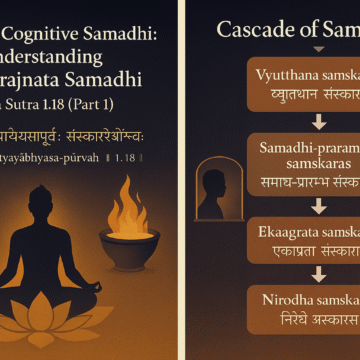
Asamprajnata Samadhi, described in Patanjali’s Yoga Sutra 1.18, is the transcendence of even the most refined meditative cognition. Through Para Vairagya—supreme detachment—every mental modification ceases, leaving only subtle impressions of cessation (Saṁskāra-Śeṣa). It marks a categorical shift from knowing to being, where pure consciousness abides in its own nature, beyond all thought.
Samadhi Secrets Unlocked: An Exploration of Yoga Sutra 1.17
Explore the depths of Yoga Sutra 1.17, a cornerstone in yogic philosophy that introduces Samprajnata Samadhi—stages of deep meditation leading to spiritual enlightenment. This blog delves into the multifaceted levels of consciousness that guide practitioners from mere concentration to the profound unity of the universe.
Yoga: The Gateway to Infinity – A Comprehensive Resource Guide
Explore the infinite journey of yoga with our comprehensive resource guide. Delve into the wisdom of Patanjali’s Yoga Sutras and discover how yoga serves as more than physical exercise, but a holistic path to balance mind, body, and spirit. It’s your gateway to personal enlightenment and a deeper universal understanding.
Yoga Long Term Discipline: Mastering the Art of Sustained Practice
Explore the profound teachings of Patanjali's Yoga Sutra 1.14 and how it champions the virtues of dedication, consistency, and reverence in practice. This blog delves into the historical interpretations, practical applications, and the vital role of Gunas in establishing a transformative Yoga Long Term Discipline.
Yoga Vritti Restraint Method: Mastering Mindful Discipline
Explore the transformative journey of mastering mindful discipline through Patanjali's Yoga Sutra 1.13. Delve into the disciplined application of 'Abhyasa' and its impact on spiritual and personal growth, highlighting the importance of continual practice and the profound philosophical implications of the Yoga Vritti Restraint Method for achieving mental clarity and inner peace.
Yoga Sutras’ Memory Vritti: Unraveling the Threads of Recall
In 'Yoga Sutras' Memory Vritti,' we delve into how memory, a crucial mental modification, shapes our experiences and spiritual practices. Understanding the dynamics of memory, as outlined in Sutra 1.11, allows for greater control over our mental processes, enhancing both spiritual development and cognitive abilities.
Yoga Sutras’ Sleep Vritti: Unveiling the Depths of Conscious Rest
Explore the profound insights of "Yoga Sutras’ Sleep Vritti" as we delve into Sutra 1.10, where sleep is not just rest but a transformative mental modification. This blog uncovers how understanding sleep as a vritti can enhance our meditation practices and lead to deeper spiritual and mental well-being.
Yoga Sutras’ Vikalpa Vritti: Unraveling Mind’s Illusions
Explore the profound implications of "Yoga Sutras’ Vikalpa Vritti," a key concept that illustrates the mind's tendency to fabricate realities based on verbal delusions. This ancient wisdom not only enriches our spiritual practices but also offers practical insights into navigating the complexities of modern communication and personal relationships.
Yoga Sutras’ Viparyaya Vritti: Misconceptions and Clarity
Explore the profound concept of Viparyaya Vritti from Patanjali's Yoga Sutras. This blog delves into the cognitive distortions of false knowledge, its implications for personal and spiritual growth, and practical techniques to cultivate true perception, enhancing clarity and reducing misconceptions in both yoga practice and daily life.
Yoga Sutras’ Five Vrittis: Mastering Mind Through Ancient Wisdom
Dive into the profound world of the Yoga Sutras to explore the five Vrittis—modifications of the mind that shape our perceptions and influence our spiritual practices. Understand how mastering these cognitive patterns can guide you toward clarity and inner peace, enhancing both your personal growth and your journey in yoga.
Yoga and Vritti Types: Navigating Mental Modifications
Dive into the profound world of Patanjali’s Yoga Sutras with our latest exploration on "Yoga and Vritti Types." This blog uncovers how understanding the five types of vrittis—painful and not painful—can transform your yoga practice and daily life, guiding you toward deeper self-awareness and mental clarity.
Yoga Mindfulness Practices: Settling Within to Discover True Self
Explore the profound teachings of Patanjali's Yoga Sutras in our latest blog, where we delve into the ancient wisdom that guides mindfulness and self-awareness. Discover how Sutra 1.3 emphasizes the importance of calming the mind to reveal our true nature, offering deep insights for a serene and spiritually fulfilled life.
Patanjalis yoga sutra: Understanding Yogashchittavrittinirodhah
Yogashchittavrittinirodhah,' a key sutra from Patanjali's Yoga Sutras. This concept, meaning 'Yoga is the cessation of the modifications of the mind,' offers a profound path to tranquility and self-realization. Understanding this sutra is essential for mastering the mind’s fluctuations and achieving deep insight into one’s true self.
Patanjali Yoga Sutras: Understanding “Atha Yoganushasanam”
Explore the foundational sutra "Atha Yoganushasanam" from Patanjali's Yoga Sutras, which marks the commencement of a profound journey in Ashtanga Yoga. This sutra signifies readiness and a disciplined approach to learning, setting the stage for deep spiritual and practical insights into yoga's transformative power.