

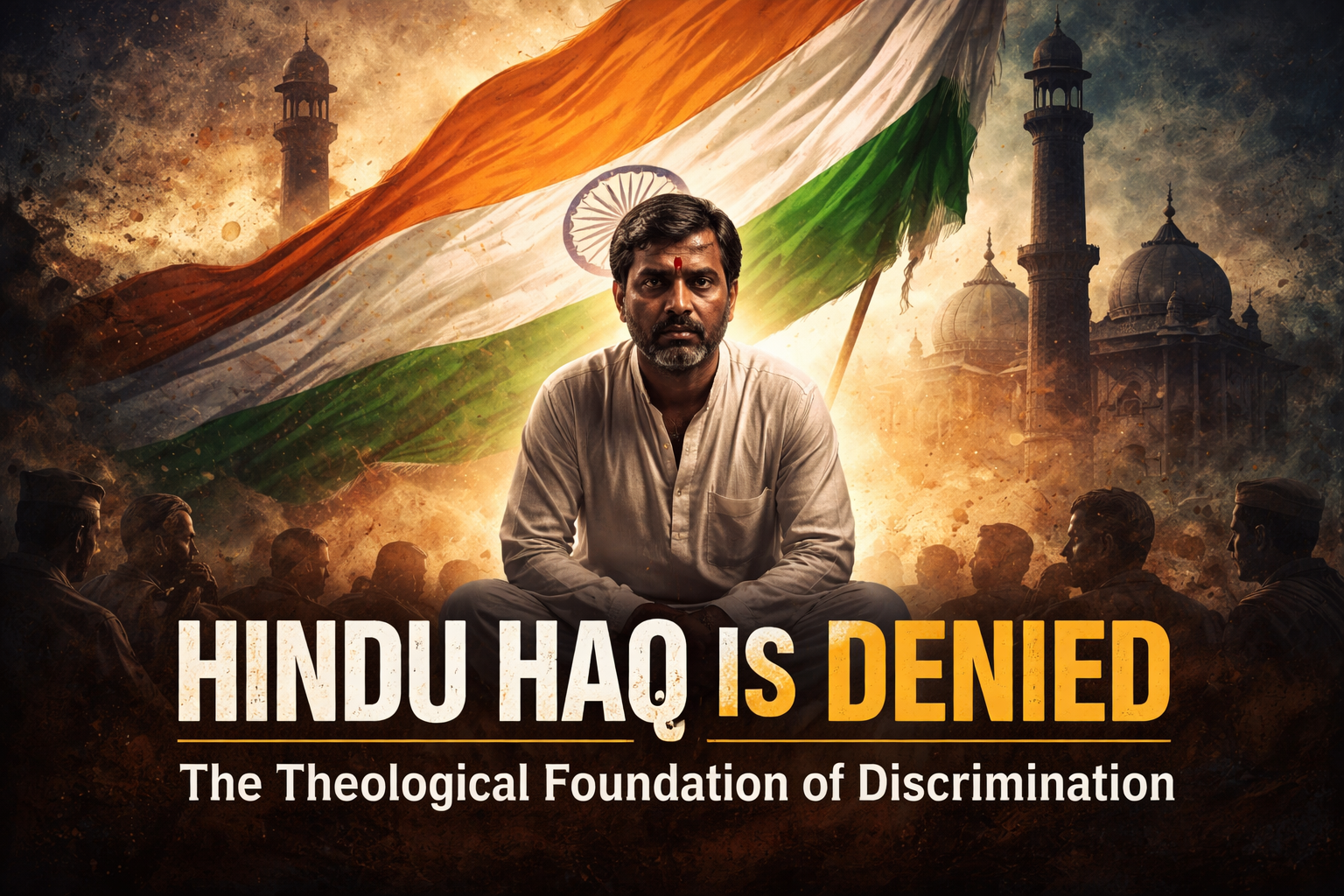
Hindu Haq Is Denied: The Theological Foundation That Normalizes Discrimination
भा१/भा२/GB
Part 2 : The Hindu Haq Movie Analysis Series
Interpreting How Hindu Haq Is Denied
The Haq movie asked whose rights matter. We answered: Hindu Haq Is. But this immediately raises a deeper question—why Hindu Haq is denied in the first place. Why does the assertion of rights by one community attract applause, while similar assertions by Hindus are reflexively framed as extremism? And why do so many Hindus readily endorse discussions on the Haq of a community whose perceived grievances receive institutional validation even at international forums such as the United Nations [Ref 1], yet respond with hesitation or apology when Hindu Haq is asserted—such as in films like The Kashmir Files, which reference platforms like Wikipedia repeatedly classify as “propaganda,” thereby pre-emptively delegitimizing Hindu testimony rather than engaging with its claims?
The answer lies not in politics, not in economics, not in accidents of history—but in theology.
Hindu Haq is denied because Islamic doctrine classifies Hindus as “kafir”—the theologically lowest category of humanity, marked not for protection but for conversion or subjugation—while, in contrast, Hindu civilization recognizes all people as part of one family (Vasudhaiva Kutumbakam), without denying dignity, rights, or humanity on the basis of belief.
This isn’t conspiracy theory. This isn’t Islamophobia. This is documented theological reality operating across domains—from daily religious assertions such as Azaan and Namaz (Nazia’s Daily Doctrine), to Supreme Court asymmetries, to educational and cultural engineering, to Wakf Board land claims, all rooted in a historical continuum of political Islam traced through Mughal governance.
The Haq movie showed Shazia Bano challenging religious authorities who claimed divine sanction for her oppression. This blog documents the theological classification system that gives divine sanction for Hindu oppression—and why Hindu Haq Is denied through doctrinal certainty, not mere prejudice.
The Question the Haq Movie Raises
In the film’s marketplace scene, Shazia encourages women to pick up the Quran themselves—to read, to interpret, to challenge male religious authorities who claim monopoly on divine truth. Critics called it “a mic-drop moment without losing the intricacy of the topic.”
But here’s what the movie doesn’t address: What happens when the text itself—not just its interpreters—creates hierarchy?
When Shazia reads the Quran and finds it supports her claim to maintenance, she wins legal recognition. When Hindus read Islamic texts and find systematic othering, they’re told they’re “misunderstanding” or “taking things out of context.”
The question the Haq movie raises but cannot answer: When religious texts themselves classify people as sub-human, how does one demand equal rights within that framework?
The answer determines why Hindu Haq Is denied—not through interpretation disputes, but through core classification.
The Kafir Classification: Not Interpretation, But Doctrine
Wikipedia’s own definition states clearly: “Kāfir is the active participle of the verb kafara, from root K-F-R… Ideologically, it implies a person who hides or covers the truth.”
But the theological reality goes deeper. Islamic jurisprudence doesn’t treat all non-Muslims equally. There’s a hierarchy:
1. Muslims (Believers)
2. Ahl al-Kitab (People of the Book – Jews, Christians)
3. Mushrikūn (Polytheists/Idolaters) – This is where Hindus fall
Wikipedia explicitly documents: “Hindus are generally viewed as mushrikūn because their worship involves polytheism and image-veneration, which are considered forms of shirk in Islam.”
This classification isn’t academic hairsplitting. It has concrete consequences documented across centuries of conquest: “Muslim historians recalled the conquests as heroic wars against pagan infidels (kafirs), and they lauded conversions along with the destruction of Hindu temples.”
Why Classification Matters: From Theology to Brutality
The Haq movie shows Abbas’s advocate saying, “If you were a true Muslim and faithful wife, you would never have said such things”—weaponizing religious identity against Shazia’s rights.
Now imagine that weaponization backed not just by patriarchal interpretation, but by fundamental theological classification that denies your humanity.
NDTV documented the historical impact: “There is no bigger humiliation and danger than being declared a kafir. The person not only loses all his rights but forfeits his life too… It is this generational memory of subjugation and humiliation that continues to haunt Hindus.”
Haq Is denied to Hindus because the theological framework that governed India for centuries—and still shapes attitudes today—never recognized Hindus as deserving equal standing.
Consider what classical Islamic jurisprudence prescribed. Encyclopedia.com documents court historian Diya’ al-Din Barani (1285-1357) counseling rulers to “use their efforts to insult and humiliate and to cause grief to and bring ridicule and shame upon the polytheistic and idolatrous Hindus.”
This wasn’t extremism. This was mainstream theological guidance.
The “People of the Book” Escape Hatch—Why Hindus Don’t Get It
Some argue that Hindus could be granted dhimmi (protected) status like Jews and Christians. Indeed, many Mughal rulers did extend pragmatic protection.
But here’s the theological distinction that matters: Jews and Christians are “People of the Book”—they follow prophets recognized in Islam. As elaborated before, Hindus worship idols and, hence, they do not get the same immunity as Jews and Christians.
The Quran’s treatment differs dramatically:
- For People of the Book: Limited protection, jizya tax, second-class but recognized status
- For Mushrikūn: Classical jurisprudence based on the Sword Verse prescribed “a choice between conversion to Islam and fight to the death, which may be substituted by enslavement.” The same conclusion is drawn in our analysis in Nazia’s Bombshell.
Yes, practical governance meant most rulers didn’t implement this literally. But the theological principle remained—and remains.
As seen above, the limited exceptions offered by Sufi traditions were short-lived and have since been eliminated from Indian Islam, while the majority theological consensus continued to classify Hindus as mushrikūn.
Haq is denied to Hindus because this theological foundation—treating Hindus as polytheists—remains dominant, irrespective of minority scholarly dissent.
How Nazia Exposed What Most Won’t Name
The documentation you need exists—not in Hindu nationalist propaganda, but in Muslim woman’s own theological analysis.
Nazia Erum’s research, examined across multiple detailed blogs, exposes how Islamic theology systematically classifies and others Hindus. Her work matters precisely because it comes from within the tradition, documenting:
- Quranic verses targeting mushrikūn specifically
- Hadith traditions legitimizing differential treatment
- Historical implementation through conquest and conversion
- Contemporary manifestation through Azaan and public assertions
The Nazia series shows how theological classification translates into daily normalization—a topic we’ll explore in Part 3. But the foundation is this: Haq Is denied because Islamic doctrine doesn’t recognize Hindus as equal in theological standing, and that theological inequality shaped (and shapes) legal, social, and political reality.
The Generational Wound: Why “Kafir” Still Cuts
NDTV documented captures the ongoing impact: “If nearly 300 years after the Muslim rule, Hindus still feel so hurt at being called kafir, it shouldn’t be hard to imagine how deep their sense of injury must be. Historical memories, passed on from generation to generation, in oral traditions and through folklores, resonate more with collective consciousness than the curated facts and ideological interpretations in history books.”
The Haq movie shows Shazia’s humiliation accumulating—the small indignities, the daily dismissals, the systematic denial of voice. Hindu experience mirrors this across centuries, not decades.
When you’re classified as kafir:
- Your temples become legitimate targets (documented destruction across India’s history)
- Your testimony carries less legal weight (dhimmi status under Islamic law)
- Your religious practices get labeled “shirk”—theological crime
- Your festivals face disruption (contemporary Ganesh Visarjan attacks)
- Your children learn shame (NCERT curriculum manufacturing contempt)
Hindu Haq Is denied because centuries of kafir classification created institutional, legal, and social structures that persist even after political independence.
From Mughal Courts to Modern India: The Classification Continues
The theological classification didn’t end with British colonization. It evolved.
Consider these contemporary manifestations:
Legal Asymmetry:
The Wakf Act gives Muslims property claiming powers that no Hindu institution enjoys—not despite constitutional equality, but enabled by post-independence governments appeasing theological constituencies.
Educational Contempt:
British cultural genocide replaced Gurukuls with colonial schools teaching Hindu shame—a system independent India maintained, adding Marxist contempt to colonial disdain.
Judicial Double Standards:
Supreme Court patterns show selective urgency—instant relief for Muslim petitioners, decades-long delays for Hindu temple reclamation despite archaeological evidence.
Festival Disruption:
Contemporary attacks on Ganesh processions, Durga immersions, and Diwali celebrations mirror historical theological attitudes—Hindu practices as pollution to be contained, not rights to be protected. [Ref 2]
Haq Is denied to Hindus through modern mechanisms, but the root remains theological classification that never granted Hindus equal standing.
The Haq Movie Parallel: When Texts Create Hierarchy
Remember how the Haq movie ends? The 1985 Supreme Court grants Shah Bano maintenance rights under Section 125—secular law protecting her despite Muslim Personal Law. The film depicts this landmark case through Shazia Bano’s character.
Then what happens? The Rajiv Gandhi government immediately passes the Muslim Women (Protection of Rights on Divorce) Act, 1986, overturning the judgment, restricting maintenance to just 90 days.
Why? Because theological constituencies demanded it. Because secular law threatened religious law. Because rights granted by courts could be revoked by political appeasement.
Hindus face the same pattern, but worse. When archaeological evidence proves temple sites like Ram Janmabhoomi and Krishna Janmabhoomi existed before mosques, courts delay for decades—and even favorable verdicts come at political cost for judges who rule based on evidence rather than sentiment.
When temple revenues get stolen by government control while mosques remain autonomous, Parliament stays silent.
When Wakf boards claim property without proof, amendments get watered down.
Haq Is denied not just through theological classification, but through its modern political manifestation—treating Hindu rights as negotiable, Muslim sentiments as sacrosanct.
Why This Matters for Hindu Haq
The Haq movie showed one woman challenging patriarchal interpretation of religious texts. She could do this because:
- The Quran itself doesn’t explicitly deny women maintenance
- Indian secular law (Section 125) supported her claim
- Progressive Muslims could argue her case within Islamic framework
Hindus face a different challenge. They’re not fighting interpretation—they’re fighting classification. Islamic theology doesn’t just limit Hindu rights through patriarchal readings; it denies Hindu equal standing through fundamental doctrinal categories.
You can’t “reinterpret” your way out of being classified as mushrikūn any more than Shazia could “reinterpret” her way out of being female. The classification is structural, not interpretive.
This is why Hindu Haq Is denied more systematically than Muslim women’s rights—because one fights within theological framework, the other fights against the framework itself.
The Way Forward: Recognition Without Apology
The Haq movie shows Shazia refusing to accept maulvis’ verdict—choosing constitutional law over religious authority. Hindu Haq requires the same refusal, but broader:
Refuse theological classification. Hindus don’t need Islamic theological approval to exist with dignity.
Demand constitutional equality. India’s constitution doesn’t recognize kafir categories—it grants equal rights regardless of theological classifications.
Document historical reality. The British drain of $45 trillion, famines killing 30-60 million, and cultural genocide through education all built on existing theological othering.
Assert rights without violence. Just as Shazia used courts, not mobs, Hindu Haq means legal assertion, constitutional challenges, and democratic mobilization.
Hindu Haq Is also denied through theological classification—but it can be reclaimed through constitutional assertion.
Next in Series
We’ve documented why Haq Is denied at theological foundation.
Part 3: Daily Drumbeat and Hindu Haq
How Azaan, Namaz, and Surah Tawbah recitations normalize Hindu subordination through five-times-daily assertions of Islamic supremacy
Because understanding theological classification is step one. Understanding how it operates daily is step two.
The Haq movie showed systematic humiliation accumulating into oppression. The next part documents the same pattern—but scaled across millions of Hindus, repeated five times daily, amplified through technology, and protected by political appeasement.
Hindu Haq Is. And this series documents exactly why it’s denied—and how it must be reclaimed.
Feature Image: Click here to view the image.
Videos
Glossary of Terms
- Hindu Haq: The civilizational, constitutional, and moral rights of Hindus as an indigenous religious community, argued in the blog as being systematically denied through theological and institutional mechanisms.
- Kafir: An Islamic theological term meaning “one who conceals the truth,” used in classical doctrine to denote non-believers, including Hindus.
- Mushrikūn: A category in Islamic theology referring to polytheists or idol-worshippers; Hindus are historically placed in this category due to murti-puja, making them distinct from “People of the Book.”
- Shirk: The gravest sin in Islam, meaning associating partners with God; Hindu worship practices are classified as shirk in classical Islamic doctrine.
- Ahl al-Kitab (People of the Book): Jews and Christians recognized in Islam as followers of earlier prophets, granted limited protected status under Islamic law, unlike Hindus.
- Dhimmi: A protected but subordinate non-Muslim living under Islamic rule, granted limited rights in exchange for the jizya tax; this status historically excluded mushrikūn.
- Jizya: A tax imposed on non-Muslims under Islamic governance as a condition for limited protection and religious practice.
- Sword Verse (Qur’an 9:5): A Qur’anic verse frequently cited in classical jurisprudence prescribing coercive measures against polytheists after the expiry of treaties.
- Vasudhaiva Kutumbakam: A Sanskrit phrase meaning “the world is one family,” reflecting the Hindu civilizational ethic of universal belonging without theological exclusion.
- Wakf Board: A statutory body managing Islamic charitable endowments in India, criticized in the blog for asymmetric legal powers over land claims.
- Political Islam: The fusion of Islamic theology with state power and governance, discussed in the blog as shaping historical and modern institutional behavior.
- Sufi Tradition: A mystical strand within Islam that historically emphasized inward spirituality; argued in the blog to be effectively eliminated as a theological corrective force in India.
- The Haq Movie: A contemporary film used as an analytical lens in the blog to contrast interpretive reform within Islam with structural denial faced by Hindus.
#HinduHaq #IslamicDoctrine #CivilizationalRights #Theology #HaqMovie #HinduHaqIs #HaqFilm #HinduRights #EqualityNotSupremacy #BreakTheSilence #CivilizationalDefense #TheHinduHaqMovieAnalysisSeries
Ref 1: United Nations Legitimacy, Enforcement, and Narrative Manufacturing
- Enforcement Deception: How UN Condemnations Manufacture Legitimacy
- The Genocide Inversion: How Hamas Weaponized Civilian Casualties
- Muslim Brotherhood in France: International Backers and Leverages
- Right of Return to Palestine: The Strategy Behind 75 Years of Refugees
- When Dictatorships Vote on Democracy: The UN Legitimacy Crisis
- Anti-Israel Obsession: Statistical Evidence of Institutional Bias at the UN
- The Great Deception and Global Civilizational Warfare
- The Human Rights Paradox
- International Law Under Siege
- Fertility and Faith: When Welfare Rewards the Womb
- Oslo Accords: Their Impact on Israel–Palestine Peace Efforts
- Palestine Recognition 2025: Europe’s 48-Hour Surrender Explained
- How Media Manipulation Works: The Global Template
Ref 2: Public Incidents and Unrest
FOUNDATION SERIES:
HISTORICAL CONTEXT:
- British Cultural Genocide: How Macaulay Destroyed Indian Education
- Britain’s Industrial Revolution: Built on India’s $45 Trillion
- Twelve Major Famines: Britain’s Deadliest Legacy
DHARMIC FOUNDATIONS:
- Building Without Plumb and Line: Character Formation Through Hindu Principles
- RSS Centenary Vision: Balancing Tradition and Modernity
Previous Blog of the Series
Follow us:
- English YouTube: https://www.youtube.com/@Hinduofficialstation
- Hindi YouTube: https://www.youtube.com/@HinduinfopediaIn
- X: https://x.com/HinduInfopedia
- Instagram: https://www.instagram.com/hinduinfopedia/
- Facebook: https://www.facebook.com/Hinduinfopediaofficial
- Threads: https://www.threads.com/@hinduinfopedia
Leave a Reply