

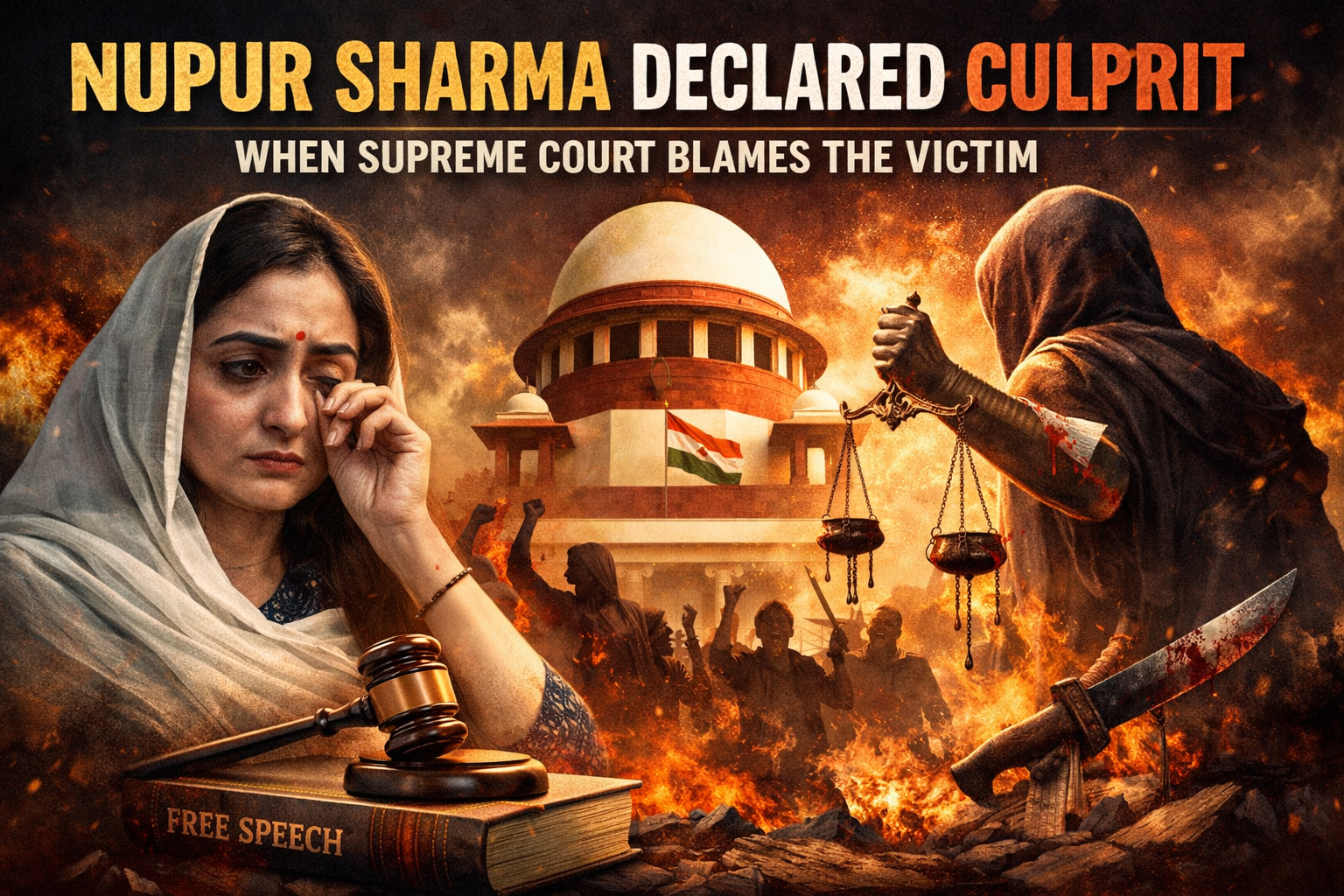
Nupur Sharma Declared Culprit: When Supreme Court Blames the Victim for Violence
Blog 7|8#: When Courts Fail Both Ancient Dharma and Modern Jurisprudence
भारत/GB
Why Was Nupur Sharma Declared Culprit For Quoting Islamic Texts?
Over the course of this series, a consistent pattern has emerged within India’s higher judiciary—selective sensitivity, unreasoned moralising, and fear-driven departures from constitutional principle. From the Supreme Court’s prolonged inaction during Shaheen Bagh, to judges investigating themselves, to casual mockery of Hindu beliefs without consequence, the institutional failure has not been accidental or isolated. The Nupur Sharma case is not an aberration within this pattern—it is its most revealing manifestation. On July 1, 2022, during a procedural hearing, the Supreme Court made oral observations that went far beyond legal necessity, framing a citizen who quoted authoritative religious texts as responsible for nationwide unrest, while offering no comparable judicial condemnation of those who responded with murder. Was Nupur Sharma Declared Culprit without trial?
Let us analyze. This blog examines how the Nupur Sharma episode fits squarely within the broader judicial crisis documented in this series—where fear of violent reaction, rather than constitutional principle, increasingly determines judicial posture.
The Statement That Exposed Everything
“This lady is single-handedly responsible for what is happening in the country,” declared Justice Surya Kant on July 1, 2022. “She and her loose tongue have set the country on fire,” the bench added. “She should apologise to the whole nation.”
This wasn’t a criminal verdict. This was a procedural hearing where Nupur Sharma, former BJP spokesperson, sought consolidation of multiple FIRs filed against her. The Supreme Court refused—and then went far beyond procedural matters with Nupur Sharma declared culprit in language so harsh it shocked legal observers.
The bench of Justices Surya Kant and JB Pardiwala stated her “outburst is responsible for the unfortunate incident at Udaipur”—a reference to the June 28 beheading of Hindu tailor Kanhaiya Lal by two Muslim men who filmed the act and posted it online, claiming they killed him for supporting Nupur Sharma. As we documented in Blog 6 about the Lord Vishnu mockery, Selective judgement of Waqf act: Socio-judicial bias, Waqf Act and Judging Justice: Selectivity or Silence, and Judicial Response to Waqf Act Unrest: Are the Courts Neutral Arbiters the Supreme Court shows vastly different sensitivity to different faiths. The Nupur Sharma case proves this isn’t isolated perception—it’s systematic victim-blaming when violence follows truthful speech about Islam.
What Nupur Sharma Actually Said
On May 27, 2022, Nupur Sharma participated in a Times Now television debate on the Gyanvapi Mosque dispute. During the heated discussion, fellow panelist Taslim Ahmed Rehmani made derogatory comments about Hindu god Shiva and the Shivling discovered in Gyanvapi compound.
In response, Sharma stated:
“Should I start mocking claims of flying horses or the flat-earth theory as mentioned in your Quran? You are marrying a 6-year-old girl and having sex with her when she turned 9. Who did it?”
Were Her Statements Factually Accurate?
Yes. Sharma quoted directly from Sahih al-Bukhari 5134; Book 67, Hadith 70, which states:
“The Prophet married Aisha when she was six years old, and he consummated his marriage when she was nine years old.”
This is not disputed Islamic scholarship. Saudi cleric Sheikh Assim Al-Hakeem confirmed it as “100% true” when asked specifically about Nupur Sharma’s statement. In a 2025 viral video, Assim Al-Hakeem stated:
“The Prophet married Aisha when she was 9… If you doubt the Prophet for a second, you are a full-fledged kafir.”
📚 UNDERSTANDING THE PATTERN:
Islamic Authority and Victim Narratives:
🔹 Islamic Authority Paradox Series – How textual authority creates asymmetric protection
🔹 Human Rights Paradox – Universal rights selectively applied
🔹 Religious Tolerance Algorithms – How media manufactures selective outrage
Sahih al-Bukhari is considered by the vast majority of Muslims to be one of the most genuine collections of Prophet Muhammad’s Sunnah. Nupur Sharma didn’t invent these facts—she quoted from Islam’s most authoritative sources.
Yet when Nupur Sharma declared culprit by the Supreme Court, her factual accuracy was irrelevant. The Court cared only about offense taken, not truth spoken.
The Violence That Followed—And Who Was Really Responsible
Timeline of Targeted Killings:
June 28, 2022: Hindu tailor Kanhaiya Lal brutally beheaded in Udaipur by Mohammad Riyaz Attari and Ghouse Mohammad. The killers filmed the murder and posted it online, claiming they killed Lal for posting social media support for Nupur Sharma.
Kanhaiya Lal had sought police protection after receiving death threats. Police mediated a “compromise” with his accusers. Six days later, he was dead.
June 21, 2022: Umesh Kolhe, a chemist in Amravati, was murdered while returning from his shop. Attackers slit his throat in front of his son and daughter-in-law. Five arrested. Police stated Kolhe was killed for sharing WhatsApp posts supporting Nupur Sharma. The conspirators included one of his friends whom Kohle had supported and helped multiple times.
June 13, 2022: Saad Ansari, a Muslim youth, assaulted by Muslim mob in Bhiwandi for posting: “A 50-year-old man marrying a 6-9-year-old girl is clearly child abuse.” He was arrested for his post.
Supreme Court’s Response to These Murders?
Blame Nupur Sharma.
Not the beheaders. Not the mob attackers. Not those who turned factual statements into death warrants. The Supreme Court declared the woman who spoke truth “responsible for the unfortunate incident at Udaipur.”
This is the definition of victim-blaming elevated to judicial doctrine.
📚 RELATED ANALYSIS:
Violence and Accountability Patterns:
🔹 Shaheen Bagh: 101-Day Delay – Selective urgency when minority protests block roads
🔹 Judicial Accountability Crisis – When judges investigate themselves
🔹 False Causality Matrix – How media manufactures blame narratives
Modern Jurisprudence Failure: Perpetrator Responsibility Abandoned
Article 19(1)(a): Freedom of Speech Protection
Article 19(1)(a) of the Constitution guarantees freedom of speech and expression. The Supreme Court has repeatedly held this right fundamental to democracy.
In Shreya Singhal v. Union of India (2015), the Court emphasized that speech cannot be criminalized merely because it offends. In Brandenburg v. Ohio (1969), the US Supreme Court established that speech can only be restricted if it creates “imminent lawless action.”
Nupur Sharma’s statements:
- Were made in response to mockery of Hindu deities
- Quoted authoritative Islamic texts accurately
- Triggered violence by others days and weeks later
There was no “imminent” action. The violence was perpetrated by those offended, not caused by the speech itself.
Criminal Law Principle: Blame Perpetrator, Not Speaker
Every civilized legal system holds that:
- Violence is the responsibility of those who commit it
- Being offended doesn’t justify murder
- Victim-blaming enables future violence
When the Supreme Court states Nupur Sharma is “responsible” for beheadings committed by others, it:
- Inverts causality: Speech becomes the crime, murder becomes the response
- Rewards violence: Proves that beheading works to silence speech
- Endangers truth-speakers: Anyone quoting uncomfortable facts faces death
Legal scholars criticized the Court’s remarks as setting “a dangerous precedent” that treats “verbal excess amounting to religious hurt as valid ground for perpetration of violence.”
The Salman Rushdie Comparison
Salman Rushdie faced fatwas and death threats for The Satanic Verses. Western courts never blamed Rushdie for violence committed against him. The perpetrators were condemned, not the author.
Yet when Nupur Sharma declared culprit by India’s highest court, the same civilizational principle—blame the violent, not the speaker—was abandoned. The message: Islamic offense justifies violence; victims are to blame.
🎯 CIVILIZATIONAL CRISIS:
When Courts Abandon Core Principles:
🔹 Civilization Under Siege – Why Hindu communities face existential threats
🔹 Mathematical Evidence – Data-driven analysis of systematic targeting
🔹 International Law Under Siege – How frameworks enable demographic warfare
Ancient Dharma Violation: Truth vs Pleasant Speech
Satya vs Priya: The Eternal Dilemma
The Mahabharata poses this question: When truth (satya) conflicts with pleasant speech (priya), which should prevail?
Bhagavad Gita 17.15 answers:
“अनुद्वेगकरं वाक्यं सत्यं प्रियहितं च यत्”
“Speech that does not agitate, that is truthful, pleasant, and beneficial.”
The ideal is truth that doesn’t unnecessarily offend. But when truth itself offends—when facts documented in opponent’s own texts contradict their claims—what then?
Yudhishthira’s example provides guidance. During the Kurukshetra war, Dronacharya asked Yudhishthira if his son Ashwatthama was dead. Bhima had killed an elephant named Ashwatthama. Yudhishthira spoke truth with a qualifier: “Ashwatthama is dead—the elephant” (though the qualifier was lost in the noise).
The dharmic principle: Speak truth, even if unpleasant, but without malicious intent.
Nupur Sharma spoke in response to mockery of Shiva. Her statement quoted Islamic texts. Her intent wasn’t unprovoked attack—it was defensive response to prior offense.
The Perpetrator’s Dharma Violation
Those who murdered Kanhaiya Lal, Umesh Kolhe, and others violated fundamental dharma:
Ahimsa (non-violence): The highest dharma is protecting life, not taking it over words.
Kshama (forbearance): Even if offended, dharma requires patience, not murder.
Nyaya (justice): Beheading someone for speech is adharma of the highest order.
The Supreme Court’s failure to condemn these dharma violations while blaming the truth-speaker represents judicial abandonment of moral clarity.
The Contrast with Lord Vishnu Comment: Double Standard Exposed
On September 16, 2025, CJI Gavai mocked Lord Vishnu by telling a devotee to “ask the deity itself” to repair a mutilated idol. No violence followed. No Hindu beheaded anyone. Yet the Court showed casual disrespect.
Compare the judicial responses:
| Nupur Sharma Quoting Hadith | CJI Gavai Mocking Lord Vishnu |
|---|---|
| Quoted Islamic texts accurately | Mocked Hindu deity sarcastically |
| Court: “She set country on fire” | Court: Mild clarification after outcry |
| Blamed for violence BY others | No accountability for offense |
| Multiple FIRs, life in hiding | No consequences, returned to bench |
| Death threats, beheadings | No violence (Hindus didn’t murder) |
The pattern is unmistakable. As we documented in Blog 6, the Supreme Court applies vastly different standards based on which community might respond violently.
This isn’t about religious sensitivity. It’s about fear of violence creating judicial reluctance.
The Court has learned: Mock Hindus freely (they won’t behead). Quote Islamic texts factually (expect beheadings, blame the speaker).
📚 DEEPER INVESTIGATION:
Systematic Judicial Bias:
🔹 Dharma vs Jurisprudence Framework – Measuring systematic failures
🔹 Institutional Corruption – Bar Council admits 90% judges corrupt
🔹 Buddhist Reservation Paradox – Ideological capture of judiciary
Consequences and Current Status: Life in Hiding
Nupur Sharma’s Reality Since July 2022:
Security Threat Level:
- Death threats from India, Pakistan, UAE, and across Middle East
- International bounties on her head
- Calls for beheading circulated globally
- Location unknown for safety reasons
Legal Harassment:
Multiple FIRs in different states
Supreme Court refused to consolidate cases
Forced to travel state-to-state for hearings
Justice Surya Kant remarked mockingly: “There must have been red carpet for you” regarding police investigation
Career Destroyed:
- BJP suspended her (under diplomatic pressure)
- Lost national spokesperson position
- Professional life destroyed for quoting facts
No Judicial Protection:
Court refused consolidation of FIRs
Court blamed her instead of protecting her
No acknowledgment she’s victim of death threats
Meanwhile, Mohammed Javed, who informed killers of Kanhaiya Lal’s location, was granted bail by Rajasthan High Court in September 2024. The man who helped facilitate a beheading walks free. The woman who quoted a hadith lives in hiding.
This is Nupur Sharma declared culprit in practice: blame the truth-speaker, free the murder accomplice.
Why This Case Defines Judicial Failure
Indian constitutional law independently prohibits such reasoning.
In Kranti Associates Pvt. Ltd. v. Masood Ahmed Khan (2010), the Supreme Court held that reasons are the heartbeat of every judicial conclusion and that a decision without analytical reasoning is arbitrary and violative of Article 14.
By attributing blame for murder to a speaker without establishing imminence, causality, or intent, the Court abandoned both the Brandenburg test and its own binding doctrine against unreasoned judgments.
The Brandenburg Test Abandoned
The US Supreme Court established in Brandenburg v. Ohio (1969) that speech can only be restricted if it:
- Is directed at inciting imminent lawless action
- Is likely to produce such action
Nupur Sharma’s statement:
Was defensive response to provocation
Was factually accurate quotation
Did not call for violence
Did not create imminent threat
The beheadings occurred weeks later in different cities. There was no “imminent” connection. The violence was perpetrated by those who chose to respond violently to accurate quotations.
Under any civilized legal standard, blaming Nupur Sharma is judicial malpractice.
The Chilling Effect on Truth
The Supreme Court’s victim-blaming sends a clear message:
Don’t quote Islamic texts, even accurately—you’ll be blamed for any violence that follows.
This creates what legal scholars call a “heckler’s veto”—where threat of violence by opponents silences speech. Newslaundry noted:
“It’s hard to find which form of modern jurisprudence treats verbal excess amounting to religious hurt as a valid ground for perpetration of violence.”
We can conclude:
By making Nupur Sharma declared culprit, the Court validated the murderers’ logic: offensive speech justifies murder.
The International Embarrassment
Nearly 20 countries called in their Indian ambassadors for explanation after Sharma’s comments. Gulf nations protested. India faced diplomatic pressure.
The Court caved to international Islamic pressure rather than defending constitutional free speech principles.
Imagine if Western courts blamed Salman Rushdie because Iran protested. Imagine if Charlie Hebdo journalists were declared “responsible” for their own murders.
India’s Supreme Court did exactly that—and called it justice.
Counter Views and Debunking of Critiques
Counter View 1: “These were only oral observations, not a judgment.”
Debunked:
Judicial authority is judged by its effect, not its label. To a common citizen, statements from the Supreme Court carry the force of law, regardless of whether they are styled as a judgment or oral observations.
Counter View 2: “Public order justified strong judicial language.”
Debunked:
This amounts to shooting the messenger. The reasoning ignores who actually disturbed public order and why. Violence was triggered not by incitement, but by the quoting of content from texts that Muslims themselves consider holy.
Counter View 3: “Brandenburg is foreign law and irrelevant.”
Debunked:
The Brandenburg test represents a modern jurisprudential standard for incitement, not a jurisdictional import. Even if treated as foreign, it does not alter the core fact that the judge exceeded legal necessity and ventured into extraneous moral attribution, unsupported by Indian jurisprudence.
Counter View 4: “The Court was managing an extraordinary violent situation.”
Debunked:
Precisely for this reason, the Court was required to exercise greater caution and stricter adherence to Indian constitutional principles, not abandon them.
Counter View 5: “She should have spoken more diplomatically.”
Debunked:
This is again shooting the messenger. The argument ignores that the statement was a direct response to a Muslim participant openly criticising Hindu deities and practices. The response was defensive and contextual, not an unsolicited attack on another faith.
Counter View 6: “The Court didn’t excuse the killers.”
Debunked:
The analysis does not concern what the Court did not say. It examines what the Court did say, and the socio-legal consequences of assigning blame to a speaker while violence was unfolding.
Counter View 7: “Too much is being read into the remarks.”
Debunked:
Remarks made by a Supreme Court judge during a sensitive hearing, at a time when death threats were already circulating, carry predictable and serious consequences. Such statements risk encouraging extremist elements by signaling that violence can be rationalized through judicial moral attribution.
When Courts Choose Fear Over Principle
The Nupur Sharma case represents everything wrong with India’s judiciary documented in this series:
Pattern 1: Selective Sensitivity (Blog 6)
Mock Lord Vishnu (no consequences). Quote Hadith (blamed for beheadings).
Pattern 2: Victim-Blaming
Speaker blamed for violence committed by others—inverting causality and justice.
Pattern 3: Fear-Based Jurisprudence
Court responds not to legal principles but to which community threatens violence.
Pattern 4: International Pressure Over Constitution
Diplomatic complaints from Gulf nations matter more than Article 19(1)(a).
Pattern 5: No Protection for Truth-Speakers
Those who quote uncomfortable facts from authoritative sources face judicial condemnation, not protection.
As we established in Blog 2’s framework analysis, courts fail when they violate both modern constitutional law AND ancient dharmic principles.
The Nupur Sharma case achieves this catastrophic double failure:
Modern Jurisprudence Violations:
- Freedom of speech (Article 19(1)(a)) abandoned
- Perpetrator responsibility inverted—victim blamed
- Equal protection violated—different standards for different faiths
- Judicial protection refused to threatened citizen
Ancient Dharma Violations:
- Satya (truth) punished instead of protected
- Ahimsa (non-violence) violators not condemned
- Nyaya (justice) abandoned—beheading accomplice freed, truth-speaker blamed
- Sama-darshana (equal vision) betrayed—selective sensitivity based on fear
The next blog in our series—[Blog 8: Selective Judicial Speed](coming soon)—will document how the same Supreme Court that delayed Shaheen Bagh intervention for 101 days granted instant stay in Haldwani within hours. The pattern continues: speed and sensitivity depend on community identity, not legal principles.
The fundamental question isn’t whether Nupur Sharma should have quoted the hadith more diplomatically. The question is whether India’s judiciary will defend truth and protect citizens, or cave to violence and blame victims.
The Supreme Court chose the latter. That choice defines this era’s judicial crisis.
Share this analysis if you believe judicial victim-blaming is unacceptable. Comment below with your thoughts on whether truth-speakers deserve protection or condemnation.
Coming Next: Selective Judicial Speed – Haldwani Instant Stay vs Shaheen Bagh 101-Day Delay.
Feature Image: Click here to view the image.
Videos
Glossary of Terms
- Nupur Sharma Case: A 2022 legal and political controversy arising from remarks made during a televised debate, followed by multiple FIRs, violence, and Supreme Court observations.
- Procedural Hearing: A court hearing dealing with process (such as consolidation of FIRs) rather than determination of guilt or innocence.
- Oral Observations: Statements made by judges during hearings that are not part of a written judgment but carry institutional weight.
- Article 19(1)(a): Provision of the Indian Constitution guaranteeing freedom of speech and expression.
- Victim-Blaming: Attribution of responsibility to a person harmed or threatened rather than to perpetrators of violence.
- Brandenburg Test: A legal standard from Brandenburg v. Ohio (1969) requiring imminence and intent for speech to be restricted.
- Heckler’s Veto: A situation where speech is suppressed due to threat of violent reaction by opponents.
- Sahih al-Bukhari: One of the most authoritative collections of Hadith in Sunni Islam.
- Hadith: Recorded sayings and actions attributed to Prophet Muhammad, forming a core source of Islamic law.
- Gyanvapi Mosque Dispute: A legal dispute concerning the religious character of a site in Varanasi.
- Shivling: A sacred symbol representing Lord Shiva in Hinduism.
- Kanhaiya Lal Murder: The 2022 beheading of a Hindu tailor in Udaipur following social media posts supporting Nupur Sharma.
- Umesh Kolhe Murder: The 2022 killing of a chemist in Amravati linked to social media support for Nupur Sharma.
- Public Order Doctrine: A constitutional ground under which speech may be restricted, subject to strict tests.
- Kranti Associates Doctrine: Supreme Court principle that reasons are the heartbeat of judicial decisions.
- Dharma vs Jurisprudence Framework: An analytical model comparing ancient dharmic principles with modern legal standards.
- Selective Sensitivity: Unequal judicial or institutional response depending on the community involved.
- Fear-Based Jurisprudence: Judicial behavior shaped by anticipation of violent reaction rather than legal principle.
- Ahimsa: Dharmic principle of non-violence.
- Nyaya: Dharmic principle of justice and moral order.
#NupurSharma #SupremeCourt #FreeSpeech #JudicialBias #VictimBlaming #HinduinfoPedia #NupurSharmaDeclaredCulprit #VictimBlaming #JudicialBias #FreeSpeech #Article19 #KanhaiyaLal #UdaipurBeheading #SupremeCourtIndia #DharmaVsJurisprudence
External References & Citations
Supreme Court Remarks:
- Bar and Bench: “Single-handedly responsible” statement
- Al Jazeera: “Loose tongue set country on fire”
- LiveLaw: Full court proceedings transcript
Nupur Sharma’s Statements and Verification: 4. OpIndia: What Nupur Sharma actually said 5. Saudi cleric Assim Al-Hakeem confirms “100% true” 6. 2025 video: Assim Al-Hakeem defends Prophet’s marriage to 9-year-old 7. Wikipedia: 2022 Muhammad remarks controversy
Violence and Murders: 8. Wikipedia: Murder of Kanhaiya Lal 9. Al Jazeera: Udaipur beheading 10. India TV: Udaipur murder video shared online 11. Organiser: Murder accomplice gets bail
Legal Analysis: 12. Newslaundry: Why SC remarks set dangerous precedent 13. Hindu Existence: Why are Quran and Hadith not objectionable?
Our Related Posts:
- Waqf Act Selective Judgment
- Waqf Act and Judging Justice
- Judicial Response to Waqf Act Unrest
- Delhi Riots 2020: Real Causes
- Manish Sisodia Bail Analysis
- Maha Kumbha Mela 2025
- Assam Agitation & Khoirabari Massacre
Previous Blogs in the Series
- https://hinduinfopedia.in/shoe-at-supreme-court-symbol-of-indias-judicial-crisis/
- https://hinduinfopedia.in/dharma-vs-jurisprudence-the-framework-for-measuring-judicial-failure/
- https://hinduinfopedia.in/ranchi-court-confrontation-when-lawyers-challenge-judicial-arrogance/
- https://hinduinfopedia.in/public-order-and-protests-supreme-courts-shaheen-bagh-failure/
- https://hinduinfopedia.in/judicial-accountability-crisis-when-judges-investigate-themselves/
- https://hinduinfopedia.in/lord-vishnu-can-repair-himself-when-chief-justice-mocks-hindu-beliefs/
- https://hinduinfopedia.org/buddhist-reservation-paradox-why-buddhists-get-sc-benefits/
- https://hinduinfopedia.org/institutional-corruption-in-indian-judiciary-when-bar-council-admits/ https://hinduinfopedia.in/?p=24660
Follow us:
English YouTube: Hinduostation – YouTube
Hindi YouTube: Hinduinfopedia – YouTube
X: https://x.com/HinduInfopedia
Instagram: https://www.instagram.com/hinduinfopedia/
Facebook: https://www.facebook.com/Hinduinfopediaofficial
Threads: https://www.threads.com/@hinduinfopedia
Leave a Reply