

Haq Film Sparks Query: Where Did This Contempt for Hindus Get Manufactured?
Haq Movie Raises Question Series — Part 5
भारत/ GB
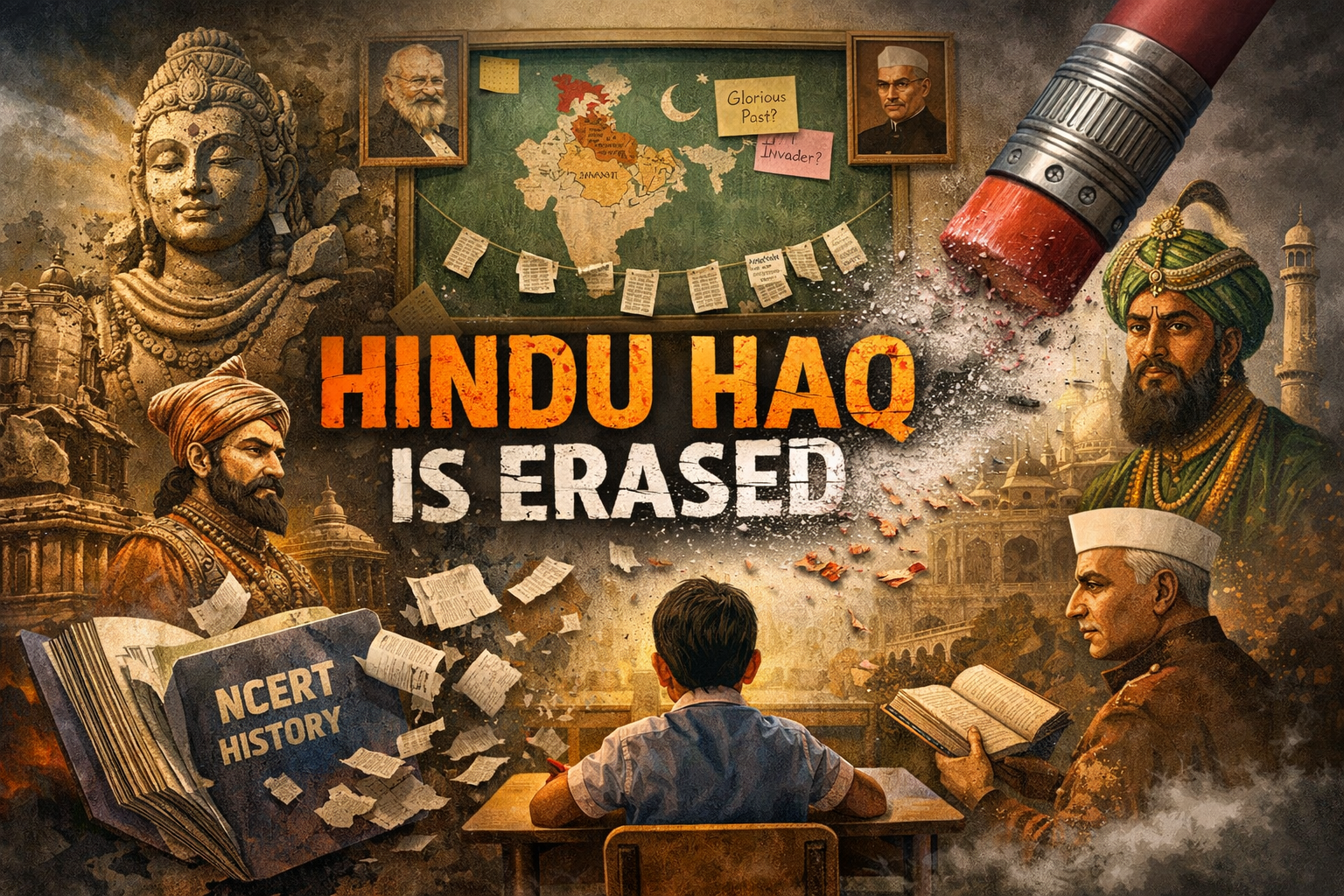
Hindu Haq Is Erased: From the Daily Drumbeat to the Permanent Classroom
In this part of the series, we documented how the daily drumbeat of Azaan, public Namaz, and Surah Tawbah recitations normalises Hindu subordination through relentless repetition — five times daily, 365 days yearly, generation after generation. But the drumbeat only conditions the adult mind. The foundational contempt — the deep, structural conviction that Hindu civilisation is primitive, its defenders villainous, its invaders heroic — is manufactured somewhere else entirely.
In the Haq movie, when Abbas tells Shazia “If you were a true Muslim and faithful wife, you would never have said such things,” he weaponises manufactured shame. He did not invent it. It was installed — through family, community, religious authority. The film shows how one woman’s self-worth was systematically dismantled.
Hindu Haq Is Erased through the same mechanism at civilisational scale. Not through violence. Through the classroom — the NCERT textbook, the JNU lecture hall, the competitive examination syllabus — where Hindu children learn civilisational shame before they are old enough to question it.
Haq Film Sparks Query: The NCERT Factory Books Creating Self-Hatred
The National Council of Educational Research and Training controls curriculum for over 40 million Indian students annually. Its textbooks are the sole resource for millions in smaller cities. What NCERT teaches becomes civilisational reality for generations.
Examine the page allocation. In NCERT’s Class 6-10 history books, the Gupta Empire — which produced Aryabhata’s astronomy, Sushruta’s surgery and surgical methods, the decimal system — receives approximately one chapter. The Mughal Empire receives dedicated chapters across multiple grades. Chola maritime power, Vijayanagara’s brilliance, Rashtrakuta and Chalukya contributions spanning centuries — compressed into passing mentions or eliminated.
Hindu Haq Is Erased through what textbooks systematically exclude. When Shivaji is reduced to five lines while Aurangzeb receives pages, when Chola naval expeditions vanish — the child learns: Hindu civilisation produced nothing worth studying, Islamic rulers built the India worth remembering. The benefits of Yagna and the fortification of food through spices were eliminated from the books.
The 2005 National Curriculum Framework embedded this architecture so deeply that subsequent governments have struggled to dislodge it. NCERT’s own admission under RTI — that it could not produce a single source for claiming Aurangzeb gave grants to rebuild temples — reveals the mechanism: insert unsourced claims, teach them as fact, then accuse questioners of “saffronisation” when Shivaji is reduced to five lines while Aurangzeb receives pages, when Chola naval expeditions vanish — the child learns: Hindu civilisation produced nothing worth studying, Islamic rulers built the India worth remembering.” Direct evidence from NCERT textbooks illustrates this imbalance:
- In Class 6 Our Pasts – I (Chapter 10: New Empires and Kingdoms), the Gupta Empire (including achievements like Aryabhata’s astronomy and the decimal system) is covered in approximately 10-15 pages within one chapter, focusing mainly on Samudragupta’s prashasti and Harshavardhana.
- In contrast, Class 7 Our Pasts – II dedicates Chapter 4 entirely to The Mughal Empire (spanning Babur to Aurangzeb, with multiple sub-sections and maps), and additional references appear in Chapters on architecture, towns, and political formations—totaling far more space across grades.
- Chola maritime power (e.g., Rajaraja and Rajendra’s naval expeditions) receives brief mention in Class 7 (Chapter 2: New Kings and Kingdoms, noting Thanjavur temples but compressing naval achievements), while Vijayanagara is largely absent or reduced to passing notes in older editions (e.g., brief in medieval sections).
Jawaharlal Nehru was the master architect of this apathy as is being revealed in the in our study: Nehru’s View on Islamic invaders – Hindu Info Pedia
These allocations persist despite RTI responses confirming no sourced evidence for claims like Aurangzeb issuing grants to repair Hindu temples (e.g., NCERT’s 2021 RTI reply: no information available on sources for such assertions in textbooks).
Nehru’s Writings and Historical Distortion
How India’s first Prime Minister described Islamic invaders as “vigorous and virile” while opposing the reconstruction of Somnath Temple — embedding civilisational contempt into the founding narrative of independent India.
Explore now:
Haq Film Sparks Query: How Academic Authority Weaponises Contempt
The NCERT textbook carries the institutional weight of India’s most prestigious universities — JNU, Delhi University, AMU — and the credentials of professors whose interpretations become unchallengeable in the examination system.
This is the credential shield. When a JNU professor writes that Aurangzeb’s temple destructions were “political, not religious,” that interpretation becomes the answer key for UPSC, state civil services, and NET. The aspirant who writes the documented truth — that Aurangzeb’s Maasir-i-Alamgiri records his order to “demolish all the schools and temples of the infidels” — risks losing marks. The aspirant who reproduces the approved narrative advances.
Hindu Haq Is Erased through this architecture with devastating efficiency. The brightest Hindu minds must internalise a version of history that diminishes their civilisation in order to pass examinations granting them authority. By the time they reach power, the contempt is installed, credentialed, and self-reinforcing.
The parallel to the Haq Film Sparks Query. Shazia’s community told her that questioning Abbas’s authority was unfaithful, irreligious, improper. The educational system tells Hindu students that questioning the approved narrative is communal, saffronised, unscholarly. Both manufacture consent for subordination through institutional authority that the individual cannot challenge without existential cost.
Haq Movie Series: Previous Parts
The complete progression from individual rights denied to civilisational rights erased.
Read the series:
The Invader-Defender Inversion: Teaching Children to Honour Their Own Oppressors
The most sophisticated feature of the NCERT contempt factory is the systematic inversion of invader and defender. Hindu kings who resisted Islamic conquest are presented as regional obstacles to “composite culture.” Islamic invaders are presented as bearers of architectural, administrative, and cultural advancement.
Nehru’s own writings set the template. His description of Islamic invaders as “vigorous and virile” while characterising Hindu society as stagnant created the intellectual architecture that NCERT textbooks would codify for decades. When he opposed the reconstruction of the Somnath Temple — destroyed seventeen times by Islamic invaders — calling it a “spectacular function with unfortunate implications,” he demonstrated the mechanism: Hindu civilisational assertion is the problem, Islamic destruction is the historical process to be understood with nuance.
The child reading NCERT learns that Mahmud of Ghazni “raided” Somnath — not that he massacred 50,000 defenders and looted wealth accumulated over centuries of devotion. The child learns that Aurangzeb was “hardworking and sincere” — not that he issued documented orders to demolish every Hindu temple and school in his empire. The child learns that the Jizya tax was an “administrative measure” — not that elephants were deployed to crush Hindus who gathered to protest it.
Hindu Haq Is Erased when the child’s own heroes are removed from the curriculum and replaced with their persecutors. This is not poor pedagogy. This is precision manufacturing of civilisational shame. The child learns that Aurangzeb was ‘hardworking and sincere’ — not that he issued documented orders to demolish every Hindu temple and school in his empire.
NCERT’s portrayal reinforces this inversion through selective language. For instance, in pre-revision Class 7 Our Pasts – II (Chapter 4: The Mughal Empire), Aurangzeb is described in contexts emphasizing his administrative sincerity and expansion, with limited critical detail on temple demolitions. A typical excerpt notes his policies but frames them neutrally or as “political.” In contrast, recent 2025 Class 8 revisions (post-blog context) describe Aurangzeb more critically as one who “destroyed temples and gurdwaras” and issued farmans to demolish structures in Banaras, Mathura, and Somnath—yet earlier editions (which shaped generations) minimized such records from Maasir-i-Alamgiri. Shivaji, meanwhile, often receives only cursory lines (e.g., 5-6 lines in some analyses of older books), portraying him as a regional figure rather than a defender against empire-wide policies.
Islamic Authority and Theological Classification
The doctrinal framework that classifies Hindus below “People of the Book” and the institutional mechanisms that enforce this hierarchy.
Explore now:
Why No Corrective Voice Challenges the Manufacturing
A reasonable question: if the NCERT curriculum manufactures Hindu contempt, and the daily drumbeat normalises subordination, why don’t moderate Islamic voices challenge either? Why don’t Sufi traditions — historically the bridge between Hindu and Muslim cultures — offer theological correction?
The answer: those voices have been systematically eliminated from Indian soil.
The Sufi tradition once offered theological flexibility. Saints like Mazhar Jan-i-Janan argued Hindus should not be classified as kafirs. Maulana Abul Kalam Azad cited Vedic unity. These represented a living theological alternative within Islam that could have moderated anti-Hindu classification.
Test this yourself: search social media, Islamic forums, academic platforms, or any institutional space for contemporary Indian Sufi voices challenging kafir classification of Hindus, shirk doctrine applied to polytheism, or the mushrikūn theological hierarchy that Part 2 of this series documented. You will find shrine tourism, dargah festivals, Rumi quotes, NGO-approved interfaith symbolism — but zero doctrinal authority. No Sufi institution in India today challenges mainstream jurisprudence on Hindu classification.
This institutional silence is the result of a “host takeover” within Sufi spaces. While the physical structures of Dargahs remain, the doctrinal authority within them has been captured by the same extremist frameworks—Deobandi, Salafi, or hardline Barelvi—that they were once thought to counter. This is the Raktbeej of Gaza applied to the Indian subcontinent: the external form of a “moderate” shrine is maintained to provide political cover, while the internal theological “seed” has been replaced by the standard Kafir-Mushrikūn hierarchy.
The modern “bottleneck” occurs because the institutions that control education and legal interpretation—primarily Deobandi and Barelvi seminaries—have largely sidelined the heterodox, inclusive interpretations of medieval Sufi saints. Consequently, while a Sufi “voice” exists in music and tourism, it is silent in the high-stakes arena of theological classification. This ensures that the “Kafir” and “Mushrikūn” labels remain unchallenged at the institutional level, regardless of how many people attend a Qawwali session.
This is not silence through consensus. This is silence through elimination. Any Sufi questioning orthodox doctrine faces denunciation as “deviant,” “bid’ati,” or “outside Islam” by Deobandi, Salafi, and mainstream Sunni institutions that now control Indian Islamic authority. The space for corrective voices was closed — not through argument but through institutional purging.
This purging is not merely academic; it is enforced through calculated social and physical violence. A primary example is the February 2026 attack in Basikala, Muzaffarnagar, where a Muslim groom and over a dozen relatives were thrashed by a mob of 50–60 people from their own community (The Statesman, 2026). The family testified that the assault was a direct reaction to their support for the BJP and the display of party flags at their home.
Such events function as a “Raktbeej” diagnostic: they demonstrate that the “Haq” to deviate from the mandated theological or political consensus is met with immediate suppression. When an individual is attacked for exercising political agency, the message to any potential “Sufi” or moderate reformer is clear: the cost of heterodoxy is the destruction of your social and personal life. This is the Enforcement Arm of the contempt factory—ensuring that even if a “moderate” voice exists, it is functionally paralyzed by the fear of being declared a traitor to the community.
Demographic and Civilisational Warfare
How population arithmetic, funding flows, and institutional capture interact to produce civilisational transformation.
Explore now:
Haq Film Sparks Query: Two Parallel Systems, One Outcome
The educational contempt factory operates through two parallel systems that produce the same outcome through opposite mechanisms.
System One:
Islamic theological institutions — madrasas, fatwa bodies, Islamic councils — manufacture anti-Hindu classification and enforce it by eliminating internal dissent. Sufis who might moderate the theology are purged. The result: monolithic theological hostility toward Hindus with no moderating force.
System Two:
Indian educational institutions — NCERT, universities, examination boards — manufacture Hindu self-contempt and enforce it by delegitimising anyone who asserts Hindu civilisational dignity. Scholars who challenge the approved narrative are branded “Hindutva,” “communal,” or “revivalist.” The result: institutional contempt for Hinduism taught by Hindus themselves, with no corrective voice permitted.
Hindu Haq Is Erased through both systems simultaneously. The madrasa teaches that Hindus are kafirs deserving subordination. The NCERT classroom teaches Hindu children that their civilisation produced nothing worthy of pride while their invaders were “vigorous and virile.” Neither system permits dissent. Both maintain orthodoxy by eliminating heterodoxy. The Hindu child emerges from twelve years of education believing the contempt is justified — because the people who taught it had credentials, institutional backing, and examination authority.
This is why the Haq movie’s question — “Where did this contempt get manufactured?” — cannot be answered by pointing to one community alone. The contempt factory has two assembly lines. One produces external hostility. The other produces internal surrender. Together they manufacture the condition in which Hindu Haq is not merely denied — it is erased from the civilisational consciousness of the people whose birthright it is.

Great Deception Framework
How global institutions, media narratives, and legal frameworks systematically mask the operational realities of civilisational warfare — from academic credentialism to algorithmic suppression.
Explore now:
From Classroom to Courtroom: The Bridge to Part 5
The Haq movie showed what happens when one woman stays silent — abuse continues, rights denied, suffering multiplies. Part 5 of this series will show what happens when an entire civilisation stays silent: Kashmir, 1990. The complete documentation of a genocide that the education system taught Hindus to deny, the media trained them to minimise, and the government rewarded with the linguistic reframing of “exodus” instead of “genocide.”
The classroom manufactured the contempt. Kashmir showed where that contempt leads when silence enables violence. The pattern is not coincidence. It is production line to product.

Raktbeej Thesis Series
The ancient Vedic diagnostic that explains why conventional approaches fail — from starfish biology to civilisational pathology — and the Dagdhabeej solution framework.
Explore now:
Credits
Primary Framework: Haq (2025 film) as narrative entry point; NCERT textbook analysis (Class 6-12 history curricula); National Curriculum Framework 2005
Sources: NCERT RTI responses on Aurangzeb claims; Maasir-i-Alamgiri (historical record of Aurangzeb’s orders); Nehru’s correspondence on Somnath Temple reconstruction; UPSC/NET examination syllabi analysis; Mazhar Jan-i-Janan Sufi theological writings
Series Context: Haq Movie Raises Question Series — Part 4 on HinduInfoPedia
Feature Image: Click here to view the image.
Videos
Glossary of Terms
Leave a Reply