

The Spiritual Physics of Govardhan: Dismantling Ahankara, Elevating Chitta
One of the most common misreadings of Sanatana Dharma is to treat it as a rigid list of commandments. Dharma is not an ideological monolith; it breathes like a living spiritual organism, adapting its forms while keeping its inner law. Its sacred narratives are neither primitive fables nor mere allegories. As the Not a Myth series on HinduinfoPedia argues, Hindu texts work as layered records in which history, cosmic order (Ṛta) and the inner growth of the human being meet.
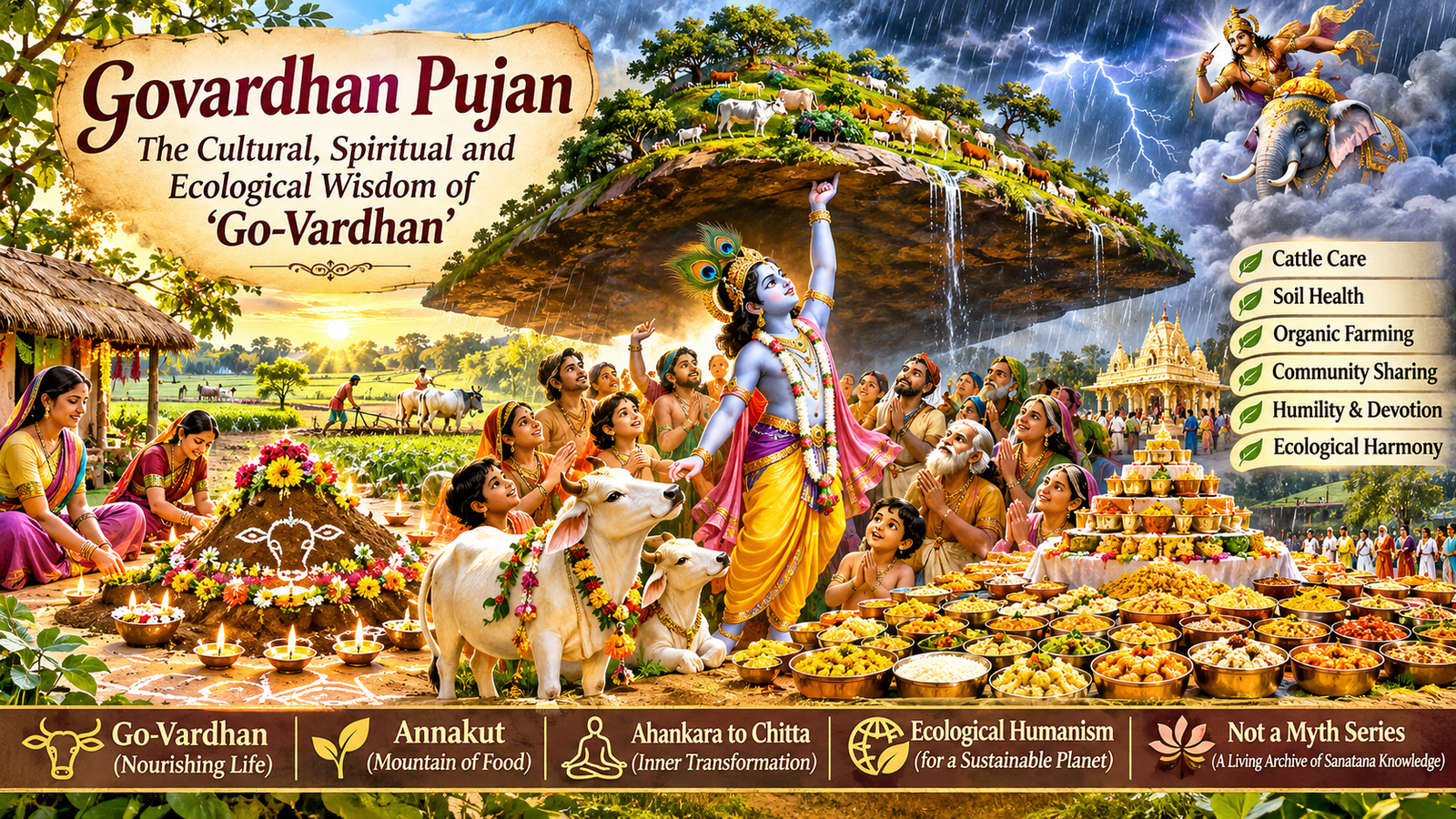
Govardhan Puja, which opens Kartika, the month the Skanda Purana calls unequalled among months and the Vaishnava tradition calls Dāmodara-māsa, is the perfect example. The episode of Govardhan Dhāraṇa, told in the tenth book of the Srimad Bhagavatam (chapters 24–27) and in the Harivamsa, is a lesson in breaking spiritual pride (mada) and turning consciousness (chitta) toward the Divine present in what is near, humble and life-giving.
From Fearful Ritual to Grateful Devotion
In the Bhagavatam, the cowherds of Vraja are preparing their yearly sacrifice to Indra. The boy Krishna questions his father, Nanda Maharaja: why offer to a distant god out of fear, when the hill, the cows and the forest sustain us every day? He asks them to worship Govardhan, the cows and the learned instead.
Vedic tradition links Indra with the indriyas, the senses, and with the power of rain. When ritual becomes a transaction — “I give, so you must give back” — it feeds ahankāra, the sense of being the doer who can control cosmic forces. Krishna’s lesson is clear: devotion born of gratitude frees; ritual driven by fear binds. Krishna does not reject worship. He redirects it.
Then comes a striking verse (SB 10.24.35). As the people make their offerings, Krishna takes on a vast form and declares, “śailo ’smi” — “I am the mountain” — and accepts the offerings himself. The Divine is not far away above the clouds; it is present in the very hill that shelters the herds. This is why devotees still worship Govardhan stones (Govardhan śilā) as Krishna himself.
The Storm and the Little Finger
Offended, Indra sends the sāṁvartaka clouds, the clouds of cosmic dissolution, to flood Vraja. Krishna lifts Govardhan with one hand — tradition remembers it as his little finger — and holds it for seven days as an umbrella over every person and animal. Read inwardly, the storm is the turmoil of the restless mind and its cravings; the mountain is steady, centred awareness. The ease of the little finger shows that the one resting in the Self (Ātman) holds steady against the mind’s fiercest storms without strain. And everyone shelters together under the hill: the realised one protects the whole community, not just themselves.
Surabhi and the Coronation of Humility
When the rains end, Indra’s pride is broken. In chapter 27 he comes in humility, with Surabhi (Kamadhenu), the celestial mother of cows. Surabhi bathes Krishna with her own milk; Indra bathes him with the heavenly Ganga carried by Airavata, and together they name him Govinda — the Lord who protects and delights the cows, the earth and the senses.
The meaning goes deep. True mastery is crowned not by force but by nourishment, gentleness and care for the weak. The cow, turning grass into milk without harming any creature, becomes a living image of sattva. The Bhagavatam adds that at this coronation even creatures fierce by nature gave up their hostility — the fruit of humility is peace among all beings.
Explore Further: See how this festival sustains village life on our companion portal:
Govardhan Puja: The Cultural Engine of Rural Bharat, and explore the wider
Not a Myth Series.
Parikrama: The Inner Circumambulation
Pilgrims walk the roughly 21-kilometre Govardhan Parikrama, and at home families circle the cow-dung Govardhan they have made. To perform this circle is more than an outer pilgrimage; it is an inner circling of the sacred centre of existence, leaving transactional pride behind and aligning a small, finite mind with the living whole. Each Kartika the festival returns to teach the same lesson in a fresh way. That is how a living Dharma educates — not by decree, but by renewal.
Glossary of Terms
1. Broken Biosphere: A descriptive phrase used in this blog for the deteriorating ecological condition of the planet, marked by climate disruption, biodiversity decline, soil degradation and environmental instability.
2. Ecological Humanism: A philosophical approach that places human existence within the wider web of nature and recognises responsibility towards other living beings and the environment.
3. Anthropocene: A proposed geological epoch characterised by the extensive impact of human activities on Earth’s climate, ecosystems and natural processes.
4. Bioregion: A geographical area defined by its natural ecological characteristics, including climate, water systems, vegetation, wildlife and interconnected habitats.
5. Sukkot: A Jewish harvest festival commemorating the Israelites’ historical journey through the wilderness, traditionally celebrated by dwelling in temporary shelters.
6. Niiname-sai: A traditional Japanese Shinto harvest festival in which the newly harvested rice is offered to the kami, or sacred spiritual beings, in thanksgiving.
7. Samhain: An ancient Celtic seasonal festival marking the end of the harvest and the transition into winter.
8. Thanksgiving: A North American harvest-related celebration centred on gratitude, family gatherings and the sharing of food.
9. Dominion: The concept of human authority over the earth and its creatures, particularly associated with interpretations of the biblical creation narrative.
10. Stewardship: The principle that human beings have a responsibility to protect, manage and preserve the natural world rather than exploit it without restraint.
11. Laudato Si’: The 2015 papal encyclical issued by Pope Francis addressing environmental degradation, climate change, social responsibility and the protection of what it describes as our common home.
12. Ecological Conversion: A transformation in human attitudes and behaviour towards nature, encouraging environmental responsibility, restraint and care for the earth.
13. Lynn White Jr.: An American historian who published the influential 1967 essay The Historical Roots of Our Ecologic Crisis, examining the relationship between Western religious thought and environmental attitudes.
14. Vardhan: A central concept in this blog meaning nourishment, growth and flourishing. It represents an ecological principle of increasing and sustaining life rather than extracting resources without replenishment.
15. Not a Myth Series: A HinduinfoPedia research initiative documenting the historical, philosophical, scientific and ecological dimensions of Sanatana Dharma and its relevance to contemporary global challenges.
#Govardhan #Ecology #Environment #ClimateChange #Biodiversity #Sustainability #Nature #Hinduism #SanatanDharma #IndianCulture #Earth #Harvest #EcologicalWisdom #HinduinfoPedia
Leave a Reply