

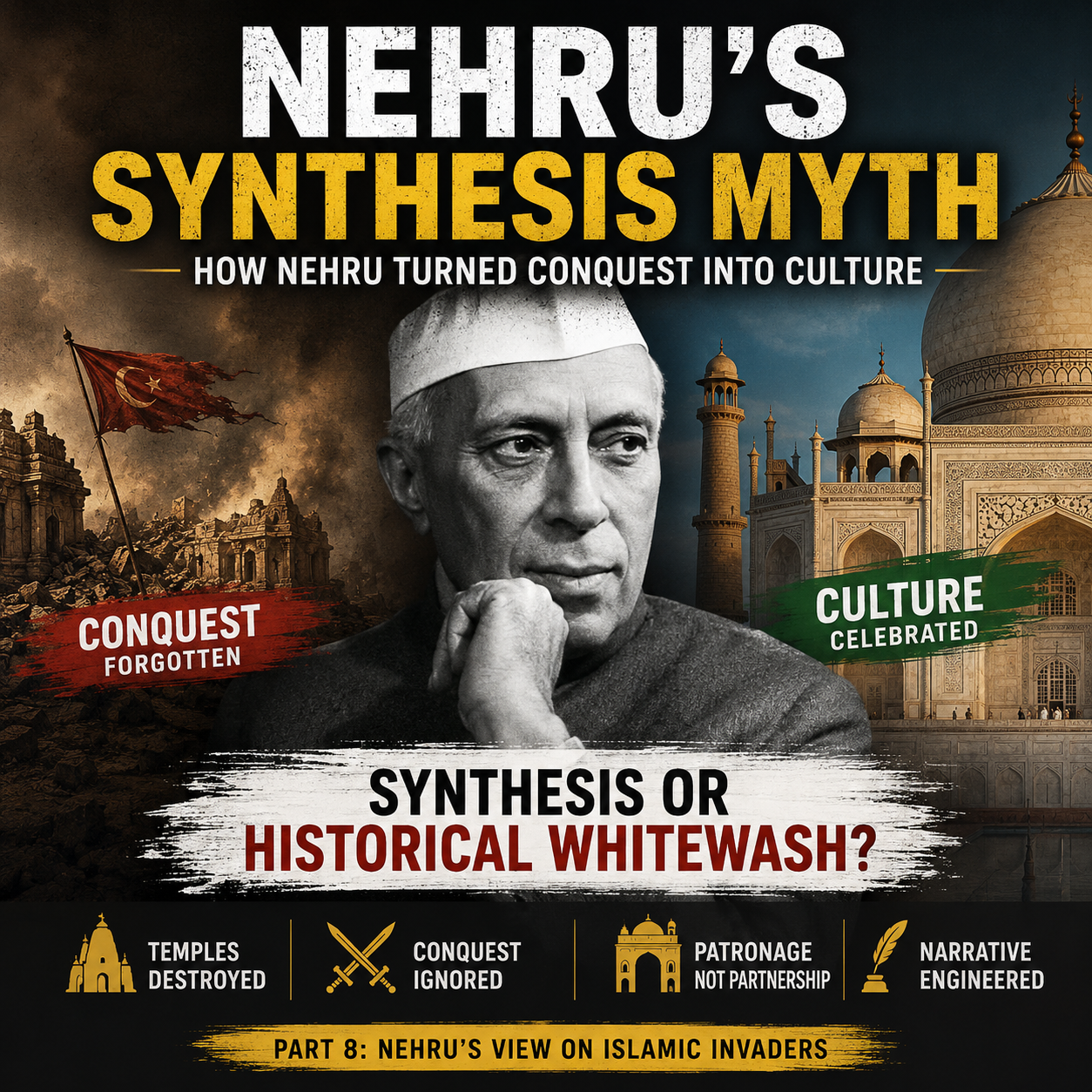
Nehru’s Synthesis Myth: How Nehru Turned Conquest Into Culture (08)
भारत / GB
Part 8: Nehru’s view on Islamic invaders
Nehru’s Synthesis Myth Exposed
At the end of our last post, we promised to examine what we’re calling Nehru’s Synthesis Myth — Nehru’s most durable and most dangerous rhetorical move. Across every case study in this series — Mahmud of Ghazni, Muhammad Ghori, and Aurangzeb — one word does the heaviest lifting in Nehru’s prose: synthesis.
Synthesis is the word that lets Nehru convert seven centuries of conquest into a story about culture. It is the pivot from “temples were destroyed” to “and yet look what beauty followed.” But synthesis, as a concept, assumes two willing partners meeting halfway — an exchange between equals, each contributing and each receiving. What actually happened across the medieval Indo-Islamic centuries was something structurally different: cultural production occurring under conditions of conquest, court patronage, and deeply unequal power.
Calling that “synthesis” is not describing history accurately. It is laundering it through a more flattering word.
This distinction matters because it changes the moral weight of everything that follows. If two civilizations truly blended as equals, then the resulting art, language, and architecture are a shared inheritance nobody need feel uneasy about. But if one civilization’s rulers commissioned, compelled, and controlled the cultural output of a conquered population, then admiring the output without naming the coercion behind it becomes its own kind of historical dishonesty — admiration used as an alibi.
What “Synthesis” Actually Means When Power Is Unequal
Genuine cultural synthesis happens between equals — trade routes, migration, intermarriage among peers, mutual borrowing where both sides retain the power to say no. What Nehru describes instead is court patronage: a conquering dynasty commissioning art, employing conquered artisans, and absorbing local motifs into an architecture built to glorify its own rule. That is not synthesis in any meaningful sense. It is what every empire in history has done with the cultures it subjugated. Rome absorbed Greek sculpture into its own visual language. Britain absorbed Mughal administrative systems into its colonial bureaucracy. Nobody describes either of those relationships as “beautiful blending.” Only in Nehru’s telling of Indo-Islamic history does subjugation get consistently rebranded as romance.
The tell is in what has to be erased to make the synthesis story hold together: the temple that stood where the mosque now stands, the artisan who built under compulsion rather than free commission, the fact that patronage flowed in one direction only — from ruler to subject, never the reverse. A relationship this asymmetric does not become symmetric just because its output happens to be beautiful.
The Taj Mahal Test: Patronage Is Not Partnership
Consider how Nehru’s synthesis narrative treats Mughal architecture more broadly. Indian masons, Indian marble, Indian craftsmanship — all absorbed into monuments commissioned to glorify Mughal rulers, not the civilization whose labor and materials actually made them possible. Calling this “Indo-Islamic synthesis” flattens an obvious asymmetry: the idea and the commission belonged to the conqueror; the execution belonged to the conquered. That is patronage, not partnership — structurally the same relationship a colonial power has with the labor it employs to build its own monuments.
Applied consistently, Nehru’s own framework would have to call the British Raj’s use of Indian civil servants and Indian regiments “British-Indian synthesis” as well. He never does — and the refusal to extend the same generous label to British rule, while extending it freely to Islamic rule, is itself revealing about what the synthesis narrative was actually built to accomplish.
Read the UNESCO post to know more about Taj Mahal.
Urdu, Music, and the Language of the Conquered
The same logic applies to Nehru’s treatment of Urdu, Hindustani classical music, and Mughal-era painting. These were real cultural developments — nobody disputes that a shared idiom emerged in courts, bazaars, and Sufi shrines over several centuries. But Nehru’s narrative consistently skips the mechanism by which that idiom actually emerged: the language of administration was Persian because the administration was foreign and imposed; the musical forms that survived into court patronage were the ones favored by whoever held power at a given darbar, not necessarily the ones most representative of the wider population’s own traditions.
Genuine cultural exchange did happen at the level of ordinary people — traders, neighbors, and Sufi and Bhakti poets speaking across communities without the mediation of a royal court. That exchange is real, and it deserves to be told as its own distinct story. But Nehru collapses that grassroots exchange into the same explanatory frame as elite court patronage, so that the violence of the Delhi Sultanate and the devotional poetry of ordinary saint-poets both get filed under the same reassuring heading of “synthesis.” This is the same virtue-first framing technique documented in our Aurangzeb posts, now applied at civilizational scale rather than to a single ruler’s biography: place the beautiful thing first, and the underlying asymmetry quietly disappears from view.
Why Nehru’s Synthesis Myth Survived Even Partition
Here is the strangest part of this story: the synthesis narrative did not die in 1947. By any honest historical reckoning, Partition should have been the moment Nehru’s synthesis thesis collapsed under its own weight — a nation had just divided along precisely the civilizational lines his history books had spent hundreds of pages insisting were superficial and secondary. Instead, Nehru doubled down. The Discovery of India went to press in the same political moment as the Lahore Resolution and the run-up to Direct Action Day, and rather than revise the thesis in light of what was unfolding around him, Nehru’s post-independence government made that same thesis the foundation of the national curriculum.
Why would a thesis survive the very event that should have falsified it? Because by 1947, Nehru’s Synthesis Myth had stopped functioning as a historical argument and had become a load-bearing political one. Admitting that conquest and coercion — rather than culture and consent — had built Indo-Islamic India would have meant admitting that Jinnah’s Two-Nation Theory rested on a real factual foundation, not merely on communal propaganda. Nehru’s government could not afford to make that admission, politically or psychologically, so the myth survived the collapse it should have caused, and instead hardened into official state policy for the next seven decades.
Culture Was the Alibi
None of this requires denying that magnificent art, architecture, and literature genuinely emerged from the Indo-Islamic centuries. It did, and that output deserves to be studied and appreciated on its own terms. The point being made here is narrower and more precise: beauty is not evidence of consent. A monument can be genuinely magnificent and still be the product of conquest rather than partnership. A musical tradition can be genuinely rich and still have developed under coercive court patronage rather than free cultural exchange between equals. Nehru’s sleight of hand throughout this series has been treating the first fact as if it proved the second — using the undeniable reality of cultural achievement as an alibi for the conquest that made it possible.
Once this pattern becomes visible, it is difficult to unsee it running through every ruler examined so far in this series: destruction, conceded briefly and in passing; culture, praised extensively and at length. The gap between those two paragraphs — the space Nehru never lingers in — is precisely where Nehru’s Synthesis Myth lives and does its quiet work.
Our next post turns from Nehru’s treatment of invaders to his treatment of the invaded — examining the sharply different, far harsher language he reserved for Hindu society itself, and what that asymmetry reveals about whose narrative was really being protected all along.
Feature Image: Click here to view the image.
Videos
Glossary of Terms
- Nehru’s Synthesis Myth: The central concept of this blog series, describing the claim that Jawaharlal Nehru portrayed centuries of Islamic conquest primarily as a process of cultural synthesis rather than emphasizing conquest and unequal power.
- Synthesis: A process in which two or more traditions merge through mutual participation and equal agency. The blog argues that this term does not accurately describe medieval Indo-Islamic political conditions.
- Court Patronage: Financial and institutional support provided by ruling courts to artists, architects, musicians, scholars, and craftsmen, often reflecting the preferences of the ruling elite.
- Indo-Islamic Civilization: The cultural and political order that developed in parts of the Indian subcontinent under successive Islamic dynasties through interactions between Indian and Islamic traditions.
- Power Asymmetry: An unequal relationship in which one side exercises political, military, or administrative dominance over another, influencing cultural production.
- Delhi Sultanate: A succession of Islamic dynasties that ruled large parts of northern India from the thirteenth to the sixteenth century before the Mughal Empire.
- Cultural Exchange: The voluntary sharing of ideas, traditions, languages, arts, and customs between communities without coercion or political domination.
- Grassroots Cultural Exchange: Cultural interaction among ordinary people, including traders, neighbours, and saint-poets, independent of royal or state patronage.
- Virtue-First Framing: A term coined in this series describing a narrative method that highlights admirable cultural achievements before mentioning or minimizing the coercive historical circumstances behind them.
- Alibi of Culture: A phrase coined in this blog referring to the use of genuine cultural achievements as a justification or distraction from the conquest and coercion under which they emerged.
- Two-Nation Theory: Muhammad Ali Jinnah’s political theory that Hindus and Muslims constituted separate nations requiring separate political destinies.
- Lahore Resolution: The 1940 resolution adopted by the All-India Muslim League that formally called for separate Muslim-majority states, eventually leading to Pakistan.
- Direct Action Day: The political mobilisation called by the Muslim League on 16 August 1946 that resulted in widespread communal violence, especially in Calcutta.
- The Discovery of India: Jawaharlal Nehru’s historical work written during imprisonment, presenting his interpretation of Indian civilization and national identity.
- Indo-Islamic Synthesis: A historical interpretation describing the interaction of Indian and Islamic cultures. The blog argues that the phrase overlooks the unequal political conditions under which much of the interaction occurred.
#Nehru #History #IndianHistory #Partition #Mughal #DelhiSultanate #Aurangzeb #TajMahal #Historiography #Civilization #Culture #Politics #India #HinduinfoPedia
Related Reading
List of Previous Blogs
- https://hinduinfopedia.in/nehrus-historical-narrative-how-he-shaped-indian-histography/
- https://hinduinfopedia.in/nehrus-intentional-omissions-mathura-massacre-and-appreciation/
- https://hinduinfopedia.org/nehrus-portrayal-of-muhammad-ghori-i/ https://hinduinfopedia.in/?p=24532
- https://hinduinfopedia.org/how-nehru-portrayed-muhammad-ghori/ https://hinduinfopedia.in/?p=24541
- https://hinduinfopedia.org/nehru-glorifying-islamic-invaders-the-vigorous-and-virile-narrative/ https://hinduinfopedia.in/?p=24676
- https://hinduinfopedia.org/aurangzeb-in-nehrus-writings-how-hardworking-and-sincere-neutralized-systematic-persecution/ https://hinduinfopedia.in/?p=24937
- https://hinduinfopedia.org/aurangzeb-in-nehrus-praise-political-necessity-and-70-year-whitewash/
https://hinduinfopedia.in/?p=25289
Historical Context – Aurangzeb Period:
- Political Islam vs Sanatan Dharma: Yogi Adityanath’s Lessons from Mughals
- Aurangzeb’s Early Life: Prelude to Power of Criminal Empire
- Aurangzeb’s Ascent: Governance and Policy Dynamics
- Aurangzeb’s Tyrannical Monuments: A Legacy of Despotism
- Guru Tegh Bahadur: Legacy of a Martyr
- Guru Arjan Dev Martyrdom: Consequence of Islamic Fundamentalism
Hindu Resistance to Aurangzeb:
- Chhatrapati Shivaji
- Chhatrapati Sambhaji Maharaj’s Attack on Burhanpur
- Battle of Sirhind: A Victory Shaping the Sikh Empire
- Maharana Pratap: History Unveiled
- Guru Tegh Bahadur: Legacy of Faith and Freedom
- Guru Har Rai Ji: A Legacy of Compassion and Diplomacy
Theological Framework:
- Hindu Haq Is Denied: The Theological Foundation That Normalizes Discrimination
- Islamic Doctrinal History: From Ridda Wars to Love Jihad
- Nazia’s Classification Crisis: Why Hindus Are ‘Kafir,’ Not ‘People of the Book’
- Islamic Texts and Polytheist Verdict on Hindu Muslim Interactions
Comparative Analysis:
- Yogi Adityanath On Hindu Safety vs Muslim Safety: A Civilizational Pattern
- Partition Demographic Catastrophe: Yogi Adityanath’s Statistical Proof (1800-1947)
- Yogi Adityanath on Coexistence: Historical Evidence- Early Islamic Encounters
Hindu Civilizational Achievements:
- Vijayanagar Dynasty: Among Ten Most Influential Dynasties in Bharat’s History
- Krishna Janmabhoomi Temple: A Spiritual Journey in Mathura
- Maha Kumbha Mela 2025: Analyzing Mad Rush of Hindus to Holy Waters-II
British Period Context:
- Gandhi’s Murder: Was Nehru Involved?
- British Loot and Industrialize: How India Funded Britain’s Rise
- Bengal Famine and British Genocides: How Colonial Policies Killed Millions
Follow us:
- English YouTube: https://www.youtube.com/@Hinduofficialstation
- Hindi YouTube: https://www.youtube.com/@HinduinfopediaIn
- X: https://x.com/HinduInfopedia
- Instagram: https://www.instagram.com/hinduinfopedia/
- Facebook: https://www.facebook.com/Hinduinfopediaofficial
- Threads: https://www.threads.com/@hinduinfopedia
Leave a Reply