

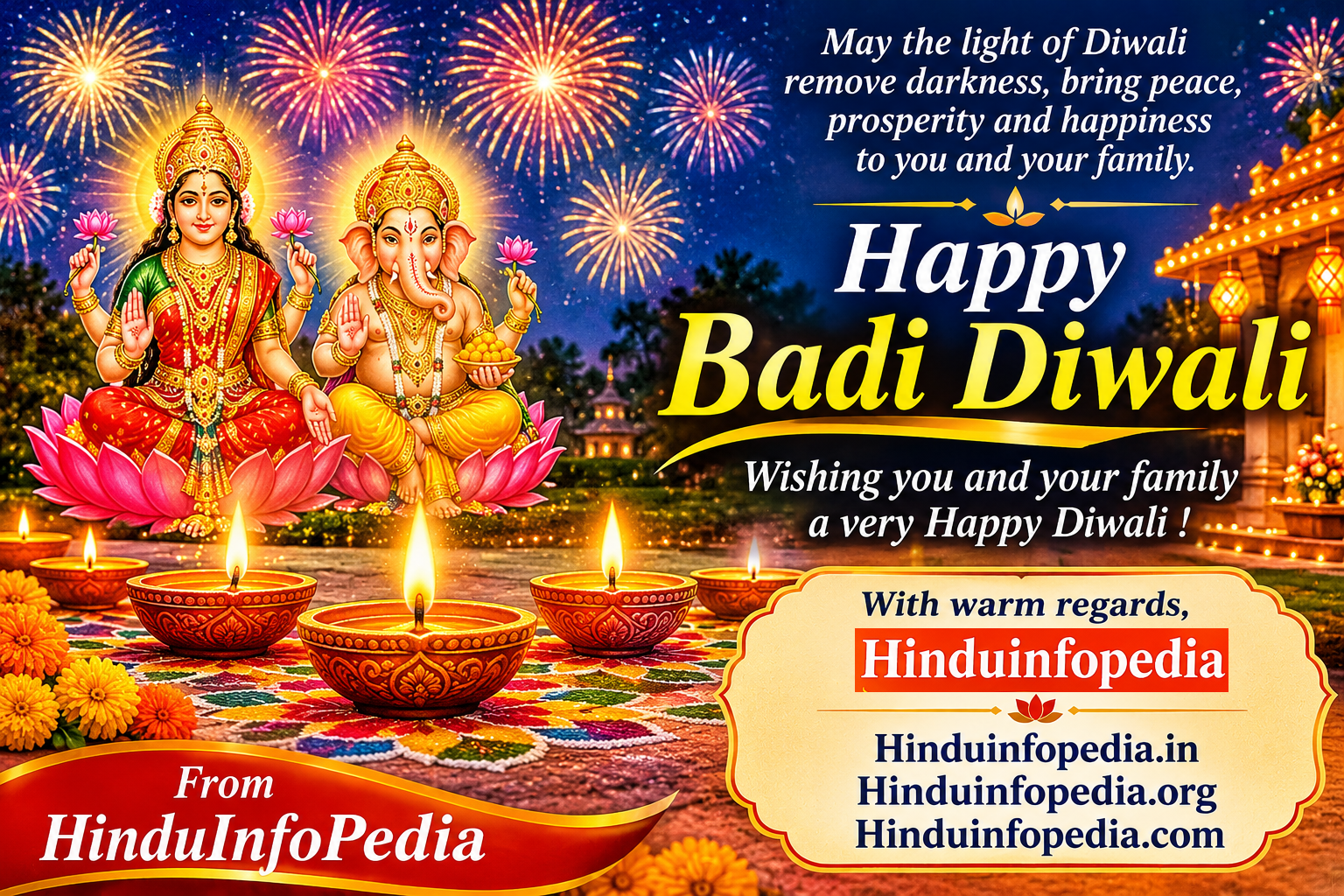
Deepavali and the Hindu Understanding of Divine Light: Dharma, Liberation, and the Sacred
Published by HinduinfoPedia.org • Theological Series • November 2026
Deepavali holds a sacred place in Hindu religious life because its purpose reaches far beyond seasonal celebration. Derived from the Sanskrit Dīpāvali (a continuous row or series of lamps), the festival’s illumination is fundamentally metaphysical. In Sanatana Dharma, light represents ontological truth: the conscious awakening of the self, the discernment of Rita (cosmic order), and the realization of Ultimate Reality.
Light and Knowledge in Hindu Philosophy
The philosophical core of festive illumination finds its classical formulation in the sacred aspiration from the Brihadaranyaka Upanishad (1.3.28):
“Asato mā sad gamaya,
Tamaso mā jyotir gamaya,
Mṛtyor mā amṛtaṁ gamaya.”
— Lead me from the unreal to the real, from darkness (ignorance) to light (spiritual knowledge), and from mortality to immortality.
In this schema, darkness signifies avidya—the ignorance that misidentifies the temporary, material vehicle with the eternal Self (Atman). The lighting of the lamp serves as an outward ritualization of inward contemplation, guiding the practitioner toward liberation (Moksha).
Goddess Lakshmi: Prosperity Governed by Dharma
The veneration of Goddess Lakshmi during the darkest night of Kartika Amavasya reveals the holistic Hindu view of human existence. In Sanatana Dharma, material well-being (Artha) is not deemed inherently sinful or spiritually opposed to righteousness. Rather, when guided by the four aims of life (Purusharthas), ethical wealth supports family welfare, hospitality, learning, and charity:
- Dharma: Ethical conduct, moral duty, and cosmic order.
- Artha: Legitimate material prosperity and security acquired honorably.
- Kama: Wholesome enjoyment and emotional fulfillment aligned with moral boundaries.
- Moksha: Final liberation from the cycle of rebirth.
Sri Tirupati Balaji Pure Vegetarian Rajasthani Bhojanalaya
Honoring traditional kitchen ethics and pure vegetarian preparation. Enjoy fresh, hygienically prepared North Indian and authentic Rajasthani fare on your travels along the Eastern highway corridor.
Find us on Google Maps
Comparative Theological Perspective: Divine Light Across Traditions
The spiritual metaphor of divine light is a universal constant across world religions, while each tradition anchors this symbolism within its own theological framework:
| Theological Dimension | Hindu Traditions (Deepavali) | Abrahamic Traditions |
|---|---|---|
| Understanding of the Divine | Brahman as Ultimate Reality; Saguna expressions (Rama, Krishna, Lakshmi) revealing divine order. | Monotheistic creator God; Judaism and Islam emphasize strict unity; Christianity teaches the Trinity. |
| Cosmology & Time | Cyclical time (Yugas); annual festivals reenact cosmic renewal. | Linear sacred history marked by specific covenants, historical revelations, and eschatology. |
| Symbolism of Light | Inherent spiritual illumination (Jyoti), self-knowledge, overcoming maya. | Commanded illumination (Menorah in Hanukkah), Christ as the Light of the World, Quranic Ayat an-Nur. |
Household Worship and Grihastha Dharma
Deepavali underscores that spiritual discipline is not confined to ascetic renunciation. Through the sanctification of the household (Grihasthashrama)—cleaning the premises, lighting brass lamps, preparing pure food offerings, and observing family prayer—the home is consecrated as a temple. In this manner, ordinary duties are aligned with transcendent spiritual purpose.
Glossary of Terms
1. Dīpāvali: A Sanskrit term meaning a continuous row or series of lamps, from which the name Deepavali is derived.
2. Sanatana Dharma: The eternal spiritual and ethical tradition of Hinduism, encompassing its philosophical teachings, religious practices, principles of righteous living, and understanding of ultimate reality.
3. Rita (Ṛta): The Vedic principle of cosmic order, truth, and universal harmony governing the natural, moral, and spiritual dimensions of existence.
4. Brihadaranyaka Upanishad: One of the principal and oldest Upanishads, belonging to the Shukla Yajurveda. It explores the nature of the Self, ultimate reality, consciousness, and liberation.
5. Asato Mā Sad Gamaya: A Sanskrit invocation from the Brihadaranyaka Upanishad meaning, “Lead me from the unreal to the real.” It expresses the spiritual aspiration to move from ignorance and illusion toward truth.
6. Avidya: Spiritual ignorance or lack of true knowledge, particularly the misunderstanding of one’s eternal spiritual identity and the nature of ultimate reality.
7. Atman: The eternal Self or innermost spiritual essence of an individual, understood in Hindu philosophy as distinct from the temporary physical body and mind.
8. Moksha: Spiritual liberation from Samsara, the cycle of birth, death, and rebirth, representing the ultimate goal of Hindu spiritual realization.
9. Kartika Amavasya: The new-moon night during the Hindu month of Kartika, traditionally associated with the principal Deepavali celebrations and the worship of Goddess Lakshmi.
10. Purusharthas: The four fundamental aims of human life in Hindu philosophy: Dharma (righteousness), Artha (legitimate prosperity), Kama (wholesome enjoyment), and Moksha (spiritual liberation).
11. Brahman: The Ultimate Reality in Hindu philosophy, the absolute and foundational principle underlying existence, consciousness, and the universe.
12. Saguna: A theological concept referring to the Divine understood with attributes, qualities, and recognizable manifestations, such as Rama, Krishna, and Lakshmi.
13. Yugas: The four traditional cosmic ages in Hindu cosmology—Satya Yuga, Treta Yuga, Dvapara Yuga, and Kali Yuga—representing successive phases in the cyclical progression of cosmic time.
14. Maya: The principle of appearance, illusion, or misperception through which the temporary and changing world may be mistaken for ultimate reality.
15. Grihasthashrama: The householder stage among the four traditional Ashramas of Hindu life, in which individuals fulfill family responsibilities, pursue legitimate prosperity, perform religious duties, and contribute to society.
#Deepavali #Diwali #Hinduism #SanatanaDharma #Vedic #Dharma #Moksha #Lakshmi #Brahman #Upanishads #HinduPhilosophy #HinduinfoPedia
Leave a Reply