

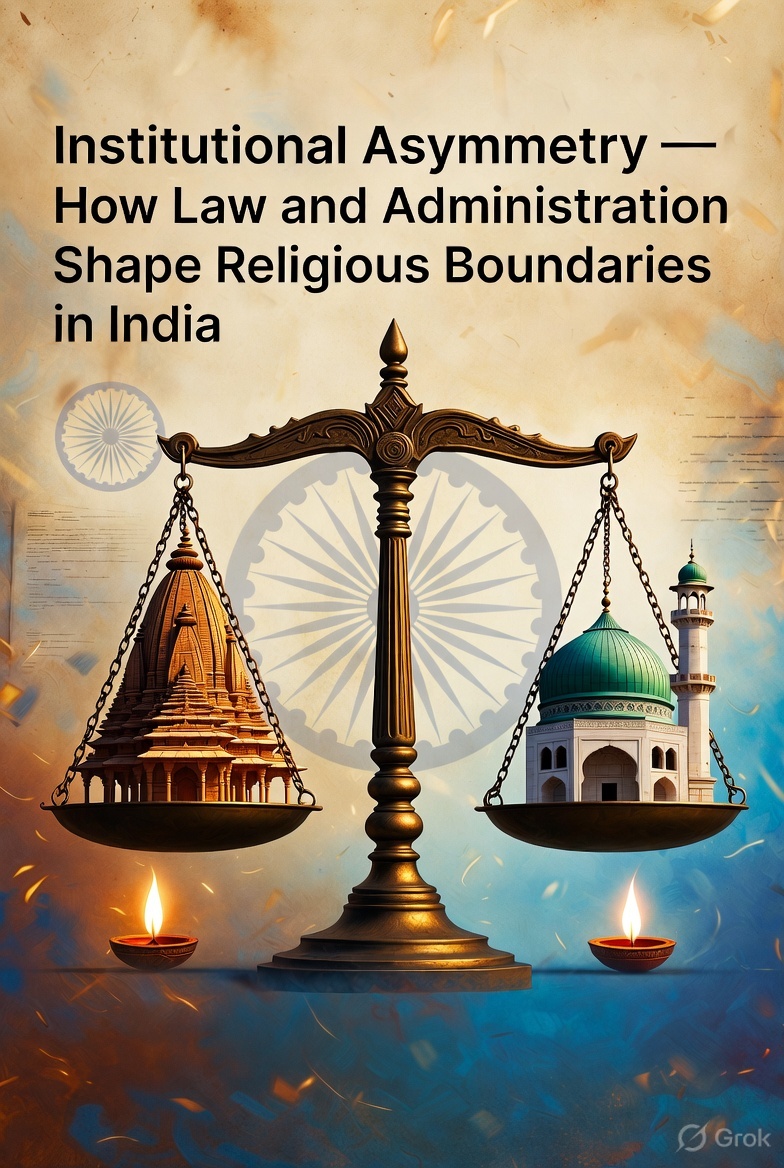
Institutional Religious Asymmetry — How Law and Administration Shape Religious Boundaries in India
Part 5A: Sacred Boundaries
भारत / GB
From Theology to Structure
The preceding blogs in this series have examined doctrinal foundations, historical implementation, and operational tactics of sacred boundary enforcement. Yet a critical dimension remains unexplored: the institutional and legal architecture that governs how different religious communities manage their sacred spaces, properties, and membership in contemporary India. Let us now examine Institutional Religious Asymmetry in India.
This blog examines four separable, empirically grounded domains:
1. Religious conversion law — history, judicial interpretation, and current application
2. Religious endowment administration — Waqf Boards vs. Hindu Religious & Charitable Endowment Boards
3. Comparative religious exclusivity — sacred-space restrictions across traditions
4. Demographic data — fertility trends and population dynamics
Each section presents verifiable facts, legal texts, and court rulings without building a coordination narrative. Readers may draw their own conclusions.
Part I: Religious Conversion Law in India — History, Statutes, and Judicial Interpretation
Institutional Religious Asymmetry: Historical Origins in Princely State Legislation
The regulation of conversion in India began in colonial-era princely states responding to missionary activity:
| Year | State | Action |
| 1936 | Raigarh | Enacted restrictions on conversion |
| 1942 | Patna | Similar Provisions |
These early laws framed conversion as a matter of public order rather than religious freedom.
Post-Independence State Legislation
After 1947, several states enacted “Freedom of Religion Acts”:
| Year | State | Action |
| 1967 | Odisha | Orissa Freedom of Religion Act |
| 1968 | Madhya Pradesh | Madhya Pradesh Freedom of Religion Act |
These laws prohibited conversions achieved through force, fraud, or inducement, while protecting voluntary conversions.
Recent Expansions (2020–Present)
| Year | State | Action |
| Uttar Pradesh | Prohibition of Unlawful Conversion of Religion Act (2020) | Prior notice to district authorities |
| Uttarakhand | Similar legislation | Police inquiry required |
| Multiple states | Various amendments | Reverse burden of proof on accused |
Constitutional Framework
| Provision | Guarantee | Limitation |
| Article 25 | Right to profess, practise, propagate religion | Subject to public order, morality, health |
Rev. Stanislaus v. State of Madhya Pradesh (1977)
| Aspect | Ruling |
| Forced conversion | Legitimate to regulate |
| Voluntary conversion | Protected under Article 25 |
This remains the foundational precedent.
The Hadiya Case (Shafin Jahan v. Ashokan K.M., 2018)
| Court | Ruling |
| Kerala High Court (2017) | Annulled marriage; invoked *parens patriae*; suggested “Love Jihad” connection |
| Supreme Court (April 2018) | Unanimously overturned High Court |
Supreme Court Holdings
| Error Identified | Explanation |
| Wrongful habeas corpus application | Hadiya testified she left voluntarily; no illegal confinement |
| Misapplication of parens patriae | Doctrine applies only to minors or mentally incapacitated |
| Transgression of constitutional rights | Court questioned her right to marry and choose religion |
Significance
The Hadiya case establishes that adult autonomy over religious choice and marriage cannot be overridden by courts, even in cases involving allegations of systemic coercion.
Institutional Religious Asymmetry: The Crypto-Christian Phenomenon
| Aspect | Detail |
|---|---|
| Definition | Individuals who practise Christianity privately but remain officially recorded as Hindus |
| Why it happens | SC/ST reservation benefits apply only to Hindus, Buddhists, and Sikhs — not Christians or Muslims (1950 Order) |
| Legal consequence | Supreme Court (March 2026, Chinthada Anand Case): Conversion to Christianity results in immediate loss of SC status; claiming SC protection while practising Christianity is legally invalid |
| Official Census (2011) | 28 million Christians (2.3%) |
| Alternative estimates | 58–71 million Christians, suggesting 2–3 times official figure |
| Crypto-Christian estimates | Some sources suggest up to 20 million hidden believers |
Recent Developments
| Aspect | Detail |
| VHP allegations | Churches exist in villages with zero recorded Christians — suggesting hidden conversions |
| Maharashtra government (2025) | Chief Minister Fadnavis announced legal action against crypto-Christians misusing SC status |
| Church response | Denounces term as misleading; some Dalit Christians voluntarily giving up SC status |
Current Legal Landscape
| Feature | Description |
| States with anti-conversion laws | 12 states have enacted Freedom of Religion Acts |
| Core prohibition | Conversions through force, fraud, or inducement |
| Procedural requirements | Prior notice, police inquiry, reverse burden of proof (varies by state) |
| Judicial scrutiny | Courts uphold regulation of forced conversion but protect adult voluntary choice |
| Crypto-Christian issue | Legal and political debate over converts retaining Hindu status for benefits |
Significance for the “Sacred Boundaries” Series
| Point | Implication |
| Official Christian population undercounts actual conversions | Demographic arguments must account for hidden believers |
| Conversion not always “voluntary” in a pure sense | Economic incentives function as inducement |
| Institutional capture dimension | Churches operating in villages with no recorded Christians |
Summary Table: Conversion Law Evolution
| Period | Key Development | Nature |
| 1930s–1940s | Princely state laws | Public order regulation |
| 1967–1968 | Odisha, MP Freedom of Religion Acts | Prohibition of force/fraud/inducement |
| 2020–present | UP, Uttarakhand, others | Expanded procedures; reverse burden |
| 2018 | Hadiya ruling | Upheld adult autonomy; rejected parens patriae |
| 2025 | Supreme Court crypto-Christian ruling | Practising Christians cannot hold SC status |
Part II: Religious Endowment Administration
Institutional Religious Asymmetry: Waqf Law – Historical and Legal Framework
A waqf (Arabic: وقف) is a donation of property in the name of Allah for religious or charitable purposes. Once declared waqf, property becomes inalienable.
Waqf Act, 1995 (Amended 2013, 2025)
Key features:
– Central Waqf Council — advisory body at the national level
– State Waqf Boards — administer waqf properties
– Survey Commissioner — conducts surveys to identify waqf properties
– Waqf Tribunals — adjudicate disputes
Waqf (Amendment) Act, 2025: Key Provisions
| Provision | Description |
| Practitioner of Islam requirement | Must have practised Islam for five years to create a waqf |
| District Collector role | Collector can determine whether disputed property is waqf or government land |
| Non-Muslim members | Waqf Boards and Council may include non-Muslim members |
| Abolition of “Waqf by User” | Undocumented properties can no longer be claimed as waqf |
| Composition changes | Central Waqf Council: 8 Muslim members out of 22 |
Government Defense
Home Minister Amit Shah argued:
– Waqf properties (reportedly 8 lakh acres) were being misused
– In 2013, 123 VVIP properties in Delhi’s Lutyens’ Zone were allegedly declared waqf
– Between 2013 and 2025, an additional 21 lakh acres was added to waqf
Supreme Court Intervention (September 2025)
The Supreme Court stayed several provisions:
| Provision | Status |
| Collector determining waqf status | Stayed — violated separation of powers |
| Five-year practising Muslim requirement | Stayed |
| Composition of Central Waqf Council | Modified — non-Muslim members reduced |
CJI Khanna’s Remark
During hearings, Chief Justice Sanjiv Khanna asked: *”Are you saying that from now on you will allow Muslims to be part of Hindu endowment boards? Say it openly.”* He further questioned: *”Why not have non-Hindus also in the advisory board of Hindu endowments then?”*
Hindu Religious & Charitable Endowments
No central legislation exists comparable to the Waqf Act. State laws govern Hindu endowments.
Key Differences in Governance
| Feature | Waqf Boards | Hindu Endowment Boards |
| Central legislation | Waqf Act, 1995 (amended 2025) | No central law |
| Survey powers | Survey Commissioner has powers of civil court; surveys mandatory | Varies; no equivalent |
| Property disputes | Waqf Tribunals with finality provisions | Civil courts; lengthy litigation |
| Encroachment removal | Executive Magistrate can enforce eviction orders | Civil suits required |
| Alienation | Transfer without Board sanction void; criminal penalties apply | No analogous criminal provisions |
The “Waqf by User” Controversy
Waqf by user refers to property used for religious/charitable purposes over a long period without formal documentation.
– 1995 Act: Recognized waqf by user
– 2025 Amendment: Abolished this concept
Opponents’ Argument
Kapil Sibal argued that “half of the eight lakh waqf properties are waqf by users” and requiring documentation for centuries-old properties is “impractical.”
CJI Khanna’s Concern
The Chief Justice questioned the fairness, noting that “Before the Britishers came, we did not have a land registration law or Transfer of Property Act. Many of the masjids were created in the 14th or 15th centuries. To require them to produce a registered deed is impossible.”
Part III: Comparative Religious Exclusivity
Universal Patterns
Anthropological research demonstrates that sacred spaces are rarely shared equally across traditions. Restrictions on participation are universal:
| Tradition | Restriction |
| Islam | Non-Muslims prohibited from Mecca/Medina; mosques generally not open to non-Muslim worship |
| Catholicism | Only baptized Catholics may receive Eucharist |
| Orthodox Judaism | Temple Mount access restricted; marriage requires conversion |
| Sikhism | Anand Karaj ceremony may be restricted to Sikhs |
| Hinduism | Temple access traditionally restricted by caste, a practice hardened during the British period who converted skill based varna into birth based rigid caste system; some rituals restricted to initiates |
Key Observation
Restrictions on sacred space are not unique to any single tradition. They are a near-universal feature of religious practice across civilizations.
Part IV: Demographic Data — Fertility and Religious Composition
Pew Research Center Study (2021)
Comprehensive Pew data on India’s religious composition since Partition.
Total Fertility Rates (1992–2015)
| Religious Group | TFR (1992) | TFR (2015) | Change |
| Muslims | 4.4 | 2.6 | -1.8 |
| Hindus | 3.3 | 2.1 | -1.2 |
| All India | 3.4 | 2.2 | -1.2 |
Key Finding: The gap in childbearing between India’s religious groups is much smaller than it used to be. Muslim fertility has declined at a faster rate than Hindu fertility, indicating convergence.
Regional Variation
Fertility varies more by region than by religion:
– Bihar: TFR 3.4
– Uttar Pradesh: TFR 2.7
– Tamil Nadu: TFR 1.7
– Kerala: TFR 1.6
Religious Composition (1951–2011)
| Religious Group | Percentage Change |
| Hindus | Declined by 4.3 percentage points (84.1% to 79.8%) |
| Muslims | Increased by 4.4 percentage points (9.8% to 14.2%) |
Sex-Selective Abortions
The Pew study noted:
– Sex-selective abortions have caused an estimated deficit of 20 million girls (1970–2017)
– The practice was noted as more common among Indian Hindus than among Muslims and Christians
Migration
– More than 99% of people living in India were born in India
– Muslims are more likely than Hindus to leave India
– Immigrants from Muslim-majority countries are disproportionately Hindu
Conversion Impact
Religious conversion has had a negligible impact on India’s overall composition:
– 98% of Indian adults identify with the religion in which they were raised
Separating Structure from Narrative
This blog has presented four distinct, empirically grounded domains:
1. Conversion law — historically rooted in princely state legislation, upheld by courts when regulating force/fraud/inducement, but protecting adult autonomy as affirmed in the Hadiya case
2. Endowment administration — Waqf Boards and Hindu Endowment Boards have different legal structures, procedures, and powers, with the Waqf Act providing certain authorities (survey powers, criminal penalties, executive enforcement) not uniformly available to Hindu endowments
3. Comparative religious exclusivity — restrictions on sacred space are universal across major traditions
4. Demographic trends — fertility rates are converging, migration has modest impact, conversion negligible
Reading Options
| Option | What it Means |
| Independent assessment | Each domain can be examined separately |
| Comparative reading | The differences in legal structure between Waqf Boards and Hindu endowments can be compared as a matter of legal analysis |
| Civilizational reading | The pattern of institutional religious asymmetry may be interpreted as reflecting broader historical dynamics |
Blog 9 in this series will synthesize these empirical domains into a proposed dharmic strategy for civilizational resilience, moving from diagnosis to prescription.
Disclaimer: This blog presents factual information about legal, historical, and demographic topics. The author does not endorse any form of discrimination or communal violence. All legal interpretations are based on publicly available court judgments and legislative texts.
Feature Image: Click here to view the image.
Videos
Glossary of Terms
- Waqf (वक्फ): A permanent dedication of property under Islamic law for religious or charitable purposes, governed in India by the Waqf Act and administered through Waqf Boards.
- Waqf (Amendment) Act, 2025: The legislation that revised the Waqf Act, 1995 by introducing changes relating to Waqf creation, administration, board composition, disputed properties, and governance.
- Religious Freedom Acts: State laws enacted in various Indian states to regulate religious conversions involving force, fraud, coercion, or inducement while recognising voluntary conversion.
- Parens Patriae: A legal doctrine allowing courts to protect persons unable to safeguard their own interests, discussed in relation to the Hadiya judgment.
- Hadiya Case (Shafin Jahan v. Asokan K.M.): A Supreme Court judgment affirming that a competent adult has the constitutional right to choose religion and marriage without judicial interference.
- Reverend Stainislaus Judgment: The Supreme Court’s 1977 decision upholding laws regulating conversions by force, fraud, or inducement while distinguishing them from voluntary conversion.
- Crypto-Christian Phenomenon: A term used in this blog series for individuals who allegedly practise Christianity privately while remaining officially recorded as Hindus for legal or administrative purposes.
- Endowment Administration: The legal and administrative framework governing the management of religious institutions and properties, including Waqf Boards and Hindu religious and charitable endowments.
- Waqf by User: A historical legal concept under earlier Waqf law whereby long-standing religious use of property could support Waqf status even without formal documentation; substantially altered by the 2025 amendment.
- Survey Commissioner: The statutory authority empowered to identify and survey Waqf properties under the Waqf Act.
- Waqf Tribunal: A specialised judicial forum constituted to adjudicate disputes concerning Waqf properties and administration.
- Institutional Religious Asymmetry: A key phrase in this blog series referring to differences in the legal powers, administrative structures, and statutory mechanisms governing different religious institutions.
- Sacred Boundaries: A key phrase in this series describing legal, religious, or customary restrictions governing access to sacred places, institutions, or religious participation.
- Religious Exclusivity: The principle that participation in particular religious spaces, rituals, or institutions may be limited according to the rules of individual faith traditions.
- Total Fertility Rate (TFR): The average number of children a woman is expected to have during her lifetime, used in demographic analysis to compare fertility trends among communities.
#Waqf #WaqfAct #ReligiousFreedom #Conversion #SupremeCourt #HinduTemples #Demography #Constitution #India #HinduinfoPedia #SacredBoundaries #DemographicWarfare
Further Reading
From This Series:
- https://hinduinfopedia.in/principle-of-sacred-exclusion-dharmas-right-to-boundaries/
- https://hinduinfopedia.in/islamic-texts-and-polytheist-verdict-on-hindu-muslim-interactions/
- https://hinduinfopedia.in/islamic-doctrinal-history-from-ridda-wars-to-love-jihad/
- https://hinduinfopedia.org/legal-asymmetry-against-hindus-how-secularism-enables-islamic-dominance/
- https://hinduinfopedia.org/salafists-trojan-technique-use-of-muslim-girls-in-hindu-festival-infiltration/
- https://hinduinfopedia.org/salafist-trojan-technique-in-practice-ii/
- https://hinduinfopedia.in/kota-muslim-girls-sacred-exclusion-drawing-global-parallel-with-boundaries-of-hindus/
Hindi Versions
Historical Context:
- Aurangzeb’s Early Life: Prelude to Power of Criminal Empire
- Aurangzeb’s Ascent: Governance and Policy Dynamics
- Aurangzeb’s Tyrannical Monuments: A Legacy of Despotism
Contemporary Analysis:
- Yogi Adityanath on Hindu Safety vs Muslim Safety
- Yogi Adityanath on Coexistence: Historical Evidence
Doctrinal Documentation:
- Nazia’s Classification Crisis: Why Hindus Are Kafir
- Nazia’s Daily Doctrine: How Azaan and Namaz Normalize Hindu Othering
- Nazia’s Doctrine Statement: Technological and Electoral Amplification
- Nazia’s Educational Expose: Classroom Manufacturing of Hindu Contempt
- Nazia’s Educational Expose: Institutional Capture Through Academic Credentials
Civilizational Resilience:
- Political Islam vs Sanatan Dharma: Lessons from Mughals
- Partition Demographic Catastrophe: Statistical Proof
- Maha Kumbha Mela 2025: Mad Rush of Hindus to Holy Waters – Part II
- Guru Tegh Bahadur: Legacy of a Martyr
- Islamic Influence and Jazia Tax in India
Follow us:
- English YouTube: https://www.youtube.com/@Hinduofficialstation
- Hindi YouTube: https://www.youtube.com/@HinduinfopediaIn
- X: https://x.com/HinduInfopedia
- Instagram: https://www.instagram.com/hinduinfopedia/
- Facebook: https://www.facebook.com/Hinduinfopediaofficial
- Threads: https://www.threads.com/@hinduinfopedia
Leave a Reply