

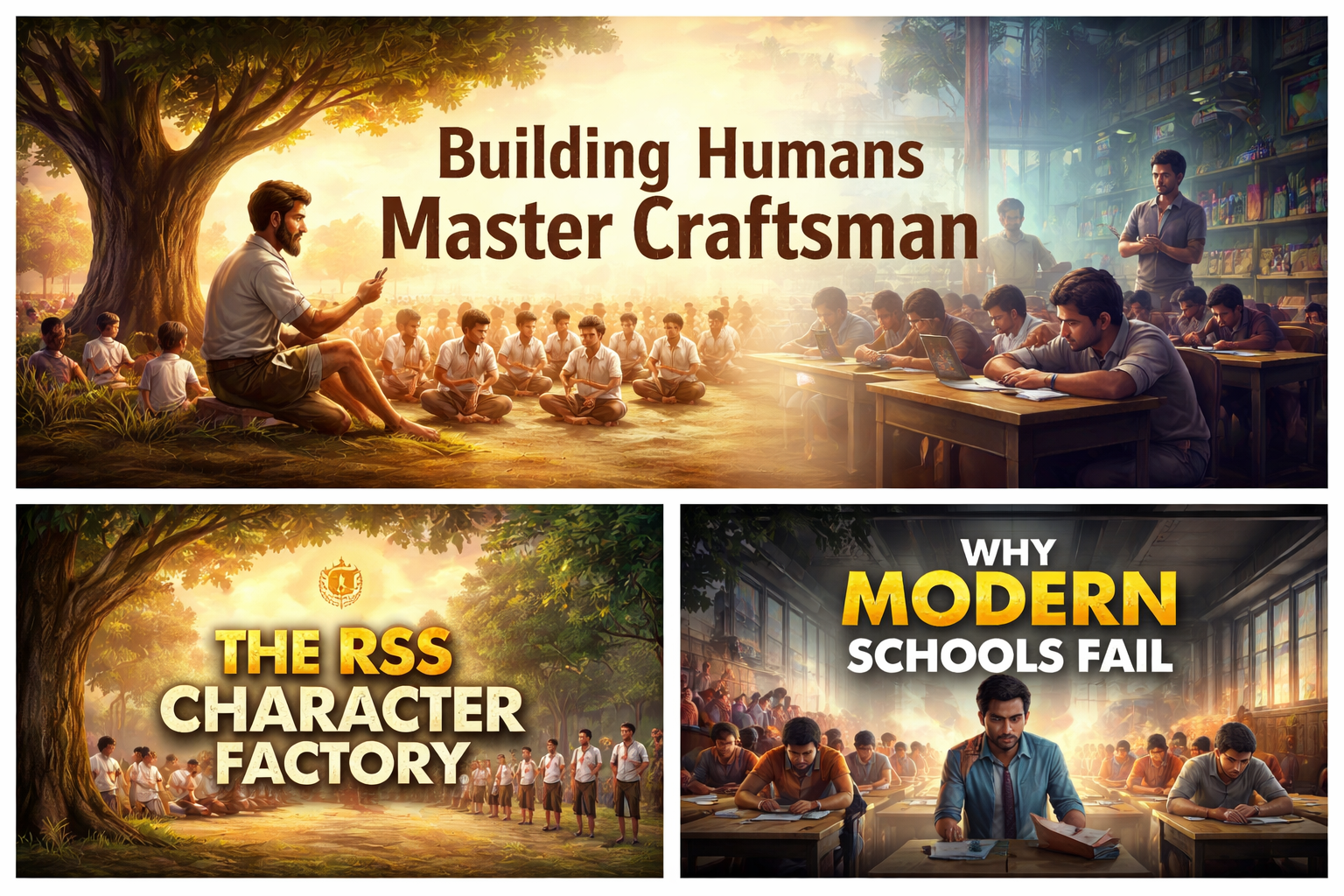
Building Without Master Craftsman: Compare with RSS Assembly
Part 5: Building Without Plumb and Line
भारत/GB
Building Without Master Craftsman: What KBC Results Suggest
Walk into any modern school and you’ll witness a tragedy unfolding in slow motion: building without master craftsman. Thousands of children, raw material brimming with potential, passing through an assembly line operated by technicians who’ve forgotten they’re supposed to be artisans. Teachers who can’t teach values because they’re forbidden to. Administrators who manage systems but can’t mold souls. Counselors who therapy-speak problems but can’t forge character.
We’re building without master craftsman – and the structures we produce collapse under the slightest pressure. A harsh word from a peer triggers emotional breakdown. A failed exam prompts thoughts of suicide. A denied smartphone request sparks violence against parents. These aren’t isolated incidents; they’re symptoms of systematic manufacturing failure.
But in a quiet corner of India, in tens of thousands of shakhas across the nation, a different kind of manufacturing continues. Here, master craftsmen still ply their ancient trade. Here, the art of human making hasn’t been forgotten. Here, RSS operates what might be the last functioning assembly line for character in the modern world.
The Assembly Line: Daily Shakha as Manufacturing Process
Harvard has its prestigious classrooms. Oxford its hallowed halls. IIT its cutting-edge labs. RSS has something far more powerful: the daily shakha. A simple gathering, often under trees or in rented halls, that runs like clockwork – and produces results that multimillion-dollar institutions can only envy.
The shakha isn’t impressive to modern eyes. No fancy buildings. No high-tech equipment. No certified degrees at the end. Just discipline, routine, and the accumulated wisdom of a century spent perfecting the art of human manufacturing.
Component One: Physical Discipline – The Forge’s Heat
Every morning, before the sun climbs high, shakha begins. Not with inspirational speeches or motivational videos. With exercise. Physical drill. The kind of demanding routine that Western educators abandoned decades ago in favor of “child-centered learning.”
Surya Namaskar. Dand. Baithak. Parade drills. Hour after hour, year after year. Not because RSS wants to produce athletes (though fitness is a welcome byproduct), but because they understand something modern schools forgot: you cannot build mental discipline without physical discipline.
The body is the first battleground where ego must be conquered. When muscles scream for rest but you continue because the Mukhya Shikshak hasn’t given the command to stop – that’s when character begins to form. When you want to skip shakha because it’s cold or raining but you go anyway – that’s when duty starts replacing comfort as your operating principle.
This isn’t PE class where participation trophies flow freely. This is old-school breaking-in, the kind traditional societies always understood was necessary. Modern schools producing soft children who can’t handle discomfort? They’re building without master craftsman. RSS still has the craftsman, and he knows: steel requires tempering, clay requires firing, humans require pressure.

narrative control, institutional pressure, and mass mobilization techniques.
Component Two: Mental Discipline – The Anvil’s Strike
After physical exercise comes the bauddhik – intellectual discourse. But don’t mistake this for Western-style “critical thinking” where students are encouraged to question everything and commit to nothing. This is structured learning with a clear purpose: manufacturing certain ways of thinking, certain frameworks for understanding reality.
Topics range from current events to ancient wisdom, from geopolitics to dharma. But the approach is consistent: teaching swayamsevaks to think through Hindu civilizational lenses. Not “here are some facts, make up your own mind.” But “here is our framework, internalize it, then apply it.”
Is this indoctrination? By Western standards, absolutely. By results? It produces individuals who can think deeply, argue effectively, and maintain civilizational consciousness across generations. Meanwhile, Western education – supposedly free from “indoctrination” – somehow produces graduates who all think identically, speak in the same progressive platitudes, and can’t defend their own civilization.
As documented extensively in our analysis of institutional capture, modern education isn’t neutral – it’s very effectively manufacturing specific worldviews. The difference? RSS is honest about its manufacturing goals. Western education pretends neutrality while systematically deconstructing traditional values.

within democratic systems while remaining largely unreported in mainstream media.
Component Three: Spiritual Discipline – The Craftsman’s Vision
The shakha closes with prayer. Simple Sanskrit shlokas that most participants don’t fully understand at first. But understanding isn’t the point – internalization is.
“सर्वे भवन्तु सुखिनः, सर्वे सन्तु निरामयाः।”
May all be happy, may all be healthy. Repeated thousands of times over years. It seeps into consciousness. Shapes how you see others. Transforms self-centeredness into civilizational consciousness.
This is the master craftsman’s secret that building without master craftsman misses entirely: repetition creates neural pathways, ritual builds identity, and spiritual practice literally rewires the brain. Modern neuroscience is finally catching up to what traditional cultures always knew.
Hindu traditions understood this deeply, which is why they built elaborate systems of samskaras – ritualized repetitions designed to manufacture specific character traits. RSS shakha is samskara formation compressed into daily practice.

long-term impact on democratic systems, governance, and civilizational continuity.
The Preserved Guru-Shishya Model: Master Craftsman at Work
In modern schools, the teacher-student relationship has been reduced to service provider and customer. As we explored in detail, this commercialization destroyed education’s transformative power. The teacher can’t shape the student because the student (or more accurately, the student’s parents) can get the teacher fired with a single complaint.
RSS shakhas preserved something the outside world abandoned: the guru-shishya relationship. The Mukhya Shikshak isn’t an employee providing services. He’s a master craftsman taking on apprentices. His authority isn’t contingent on student satisfaction. It’s absolute – because both parties understand that transformation requires surrender.
Absolute Respect: The Foundation
When the Mukhya Shikshak speaks, swayamsevaks listen. Not because of fear, but because that’s the contract. You don’t come to shakha to be entertained or even to be convinced. You come to be shaped. And shaping requires one party to wield the tools while the other submits to the process.
Try explaining this to modern educators. “Wait, the students don’t get to evaluate the teacher? They don’t have input into curriculum? They can’t opt out if they don’t like the methods?” No. They can’t. Because building without master craftsman is precisely what modern education does – and look at the results.
The Mukhya Shikshak commands absolute respect not because he’s perfect, but because the role itself is sacred. He represents something larger than his individual personality: the accumulated wisdom of the tradition, the authority of the organization, the civilizational continuity stretching back centuries.

continuity across generations without relying solely on formal structures.
Obedience First, Understanding Later
Here’s where modern sensibilities really rebel: in shakha, you obey first and understand later. If the Mukhya Shikshak gives an instruction, you don’t debate its merits. You execute. Reflection comes afterward, if at all.
This isn’t arbitrary authoritarianism. It’s recognition that some things can only be understood experientially. The apprentice blacksmith doesn’t understand why the master strikes the metal at specific temperatures until he’s made the same mistakes the master is helping him avoid. The martial arts student doesn’t understand why kata must be performed exactly as taught until muscle memory and combat experience reveal the wisdom embedded in traditional forms.
RSS’s organizational philosophy embodies this understanding. First you internalize through obedience and repetition. Only later, often years later, does the deeper wisdom reveal itself. Try to understand intellectually before embodying physically, and you’ll get neither understanding nor embodiment.
Western education inverts this. “First understand why, then maybe do.” Result? Generations that understand nothing but question everything. Theory without practice. Criticism without creation. Building without master craftsman produces architectural drawings that never become actual buildings.
Physical Correction: The Hammer’s Purpose
Here’s what most makes modern educators recoil: physical punishment in shakha is rare but not prohibited. Not abuse, not cruelty, but purposeful correction when warranted. The kind of measured response traditional societies always understood was necessary for character formation.
The master craftsman knows: sometimes the hammer must strike. Not in anger, always with love, but firmly when required. The wood that won’t bend must be steamed. The metal that won’t shape must be heated. The ego that won’t yield must be broken.
Modern schools, building without master craftsman, have only words. Gentle encouragement. Positive reinforcement. Appeals to future consequences. And when these predictably fail to shape recalcitrant material? They call parents. Refer to counselors. Maybe suspend or expel. They can’t manufacture because they lack the craftsman’s tools.
The Three-Stage Manufacturing Process: Breaking, Molding, Tempering
Every master craftsman knows: you can’t jump straight to the finished product. Raw materials must move through stages. Rush the process, and you get brittle results. Skip stages, and structural integrity fails. RSS understands this. Modern education, building without master craftsman, produces half-baked humans who crack under pressure.
Stage One: Breaking (Years 0-3 in Shakha)
The new swayamsevak arrives with ego intact. Modern society has spent years telling him he’s special, his feelings matter most, he deserves respect simply for existing. This ego must be broken. Not destroyed – broken like a wild horse is broken, redirecting rather than eliminating energy.
Breaking ego: Through countless small submissions. Coming to shakha on time even when you don’t feel like it. Continuing exercises when tired. Speaking only when given permission. Accepting correction without protest. Each submission chips away at ego’s dominance.
Learning obedience: Not as ends but as means. The master craftsman knows that humans who can’t obey can’t truly lead. You must first learn to follow the rhythm before you can conduct the orchestra. Traditional Hindu education systems built this understanding into every stage of development.
Physical discipline as foundation: The body learns faster than the mind. Muscle memory precedes cognitive understanding. By drilling physical obedience – standing at attention, maintaining parade positions, executing exercises in unison – the shakha imprints discipline at a level deeper than rational thought.
Surrendering individual will to collective: This is the hardest break for modern individuals raised on “be yourself” ideology. But the master craftsman knows: the self that insists on its own way is precisely the self that must be transcended for excellence to emerge. Not erasure of individuality, but its proper ordering within a larger whole.
Stage Two: Molding (Years 3-7)
The broken material is now ready for shaping. Like clay that’s been properly wedged, kneaded until air bubbles are removed, now it can take and hold form without cracking.
Leadership training: Not the Western kind where anyone can be a leader if they just “believe in themselves.” Real leadership – the kind that emerges from demonstrated character and earned respect. Junior swayamsevaks are given small responsibilities. Leading a single activity. Teaching a specific exercise. Managing a small team. Success brings more responsibility. Failure brings more training. Building without master craftsman produces leaders in name only. RSS produces leaders in substance.
Intellectual development: Now, years into shakha, comes deepening of bauddhik. Earlier stages focused on internalization through repetition. This stage introduces complexity, nuance, civilizational history. The foundation of obedience having been laid, critical thinking can now be safely developed. Thinking without foundation produces dangerous sophistry. Foundation without thinking produces dogmatism. RSS aims for the synthesis: grounded critical thinking.
Service projects: Theory meets practice. Swayamsevaks aren’t just lectured about seva – they perform it. Disaster relief, social service, community building. Not for resume padding or college applications. For character formation. The master craftsman knows: humans who serve others develop strength that self-focused individuals never achieve.
Stage Three: Tempering (Years 7+)
The shaped material now requires tempering – cooling and reheating cycles that give final hardness and flexibility. Too soft, and it bends uselessly. Too hard, and it shatters. Proper tempering produces steel that’s both strong and resilient.
Independent thinking within framework: Now the swayamsevak has earned the right to question. Not the adolescent questioning that’s really just ego assertion, but mature inquiry from within a shared worldview. The master craftsman kept the apprentice from philosophical debate in early years precisely so that such debate could be fruitful in later years. Building without master craftsman allows questioning from day one – and produces adults who question everything but believe nothing.
Teaching younger members: The best way to internalize teachings is to tach them. Senior swayamsevaks now guide juniors, replicating the guru-shishya chain that stretches back through generations. This isn’t just knowledge transfer – it’s civilizational transmission. Each generation teaching the next, each link in the chain maintaining strength through the discipline of passing on what was received.
Organizational roles: Tested, proven swayamsevaks now assume real responsibilities. Not token positions but actual authority matched with accountability. This is how RSS’s organizational genius manifests: a pipeline that continuously produces leaders not through elections or appointments, but through years-long manufacturing processes that separate wheat from chaff.
Lifelong commitment: The final stage isn’t graduation but recognition that you’ve become the thing itself. Not someone who attends shakha, but a swayamsevak. Not someone who learned the techniques, but someone who embodies the values. The master craftsman’s ultimate success: producing future master craftsmen.
Before and After: The Transformation
Let me paint two portraits.
Portrait One: The Untamed
Fifteen-year-old Rahul before shakha. Smart kid. Good grades. But self-centered in that casual way modern society normalizes. His convenience matters more than parents’ instructions. His comfort outweighs others’ needs. His rights dominate every conversation while duties never appear.
He argues with his mother about chores – “That’s unfair!” He negotiates with his father about screen time – “Everyone else gets more!” He debates with teachers about grades – “But I deserve better!” He’s not unusually bad. By contemporary standards, he’s normal. And that’s the tragedy.
Rahul operates on what I call “comfort calculus” – every decision runs through a single equation: Does this increase my comfort? If yes, do it. If no, avoid it. Service, duty, sacrifice – these aren’t even in his vocabulary.
This is what building without master craftsman produces. Not monsters – most of these kids aren’t evil. Just fundamentally incomplete humans. The kind that viral videos capture – intelligent but undisciplined, knowledgeable but characterless, capable but directionless.
Portrait Two: The Transformed
Now Rahul at twenty-two, after seven years in shakha. Still intelligent – more so, because discipline sharpened his mental faculties. Still capable – more so, because systematic training developed skills schools never touched.
But fundamentally different in orientation. He doesn’t calculate comfort. He calculates duty. “What should I do?” replaced “What do I want?” as his primary question. He serves his parents not because they demand it but because he’s internalized that this is dharma. He helps neighbors not because it benefits him but because that’s what swayamsevaks do. He leads not because he craves recognition but because responsibility was entrusted to him and he won’t betray that trust.
The master craftsman did his work. Took raw material – intelligent but undisciplined. Applied heat – regular physical challenge. Struck with hammer – firm correction when needed. Cooled and reheated – cycles of responsibility and guidance. Produced steel – strong, flexible, reliable.
This is RSS’s secret that drives critics mad: they can’t replicate the results because they lack the craftsman. Building without master craftsman, modern institutions produce Rahul version one. RSS produces version two. The difference isn’t curriculum or facilities. It’s the manufacturing process itself.

systematically weaken civilizational confidence and manufacture cultural self-doubt.
The Secret Sauce: Authority Retained
Here’s what really distinguishes RSS from modern institutions: they retained authority that others surrendered.
Authority to demand: RSS doesn’t ask swayamsevaks if they feel like attending shakha. Doesn’t plead for their participation. Demands it. And because the demand comes from recognized authority within a framework swayamsevaks voluntarily entered, the demand works.
Compare schools where teachers beg students to pay attention, plead with them to do homework, negotiate for basic respect. Building without master craftsman means lacking the authority that makes manufacturing possible.
Authority to discipline: When correction is needed, RSS provides it. Immediate, measured, purposeful. Not torture, not humiliation, but correction. The master craftsman’s hammer falls where needed. Modern institutions, stripped of authority to discipline, can only cajole, counsel, and eventually capitulate.
Authority to shape through pressure: RSS doesn’t apologize for applying pressure. Physical pressure through demanding exercise. Mental pressure through challenging material. Social pressure through peer expectations. Moral pressure through civilizational standards.
Pressure creates diamonds. Comfort creates coal that stays coal. Modern institutions, building without master craftsman, choose comfort and wonder why they produce soft humans.

service-oriented living contribute to societal stability and global harmony.
The Key Provocation: Results Speak
Let’s be completely clear about something that drives RSS critics to distraction: RSS has no degrees. No certificates. No placement records. No guarantees of career advancement.
What does shakha offer? Morning exercises nobody wants to do. Intellectual discussions without college credit. Service projects without resume value. Discipline without compensation. Obedience without promotion.
By every modern metric, shakha should fail to attract anyone. Yet tens of thousands operate across India. Millions have passed through. And those millions? They don’t just remember shakha fondly – many consider it the most formative experience of their lives.
Why? Because RSS manufactures what modern institutions can’t: character. Actual, genuine, tested-under-fire character.
A swayamsevak might not have an IIT degree. But drop him into a crisis – natural disaster, communal tension, organizational chaos – and watch him perform. He doesn’t panic. Doesn’t freeze. Doesn’t wait for someone else to act. He assesses, organizes, executes. Not because he studied crisis management, but because years of shakha manufactured those responses into his being.
Compare this to modern graduates with impressive degrees who crumble under pressure, who need therapy for minor setbacks, who can’t function without constant validation. Building without master craftsman produces résumés. RSS produces humans.
Harvard measures success by starting salaries. IIT by placements. Oxford by research output. RSS measures success by character – and by that metric, their manufacturing process is unmatched.
The secret isn’t complex. RSS retained what schools surrendered: the master craftsman’s authority to demand, to discipline, to shape through pressure. The old way of making humans. With heat, hammer, and patience.
While modern institutions abandoned manufacturing for customer service, RSS kept manufacturing. While others made education comfortable, RSS kept it transformative. While the world embraced building without master craftsman, RSS preserved the craftsman and his tools.
And now, as modern institutions’ failures become undeniable, as their graduates prove incapable of basic adult functions, as societies built on their products crumble – maybe, just maybe, people will ask: What does RSS know that we forgot?
The answer: How to make humans. Actually make them. Not process them through systems, not credential them with degrees, not graduate them with transcripts. Make them. The way master craftsmen always made things of value. With skill, with standards, with the authority to shape raw material into finished excellence.
That’s the RSS model. That’s what’s preserved in those humble shakhas. And that’s what the world desperately needs but refuses to admit: the return of the master craftsman to the manufacturing of humans.
Next Article: “The Elephant in the Room – Why Uncontrolled Humans Are Dangerous”
Feature Image: Click here to view the image.
Glossary of Terms
- Building Without Master Craftsman: A conceptual framework used in the blog to describe education and social systems that lack authority, discipline, and formative intent, resulting in incomplete human development.
- Master Craftsman: A metaphor for an authority figure who possesses both skill and legitimacy to shape character through discipline, repetition, and example.
- Shakha: The daily grassroots training unit of the Rashtriya Swayamsevak Sangh, focused on physical discipline, intellectual training, and character formation.
- Rashtriya Swayamsevak Sangh (RSS): A voluntary cultural organization in India that emphasizes discipline, service, and civilizational continuity through systematic training.
- Human Manufacturing: A recurring term in the blog referring to the deliberate formation of character, discipline, and responsibility in individuals.
- Assembly Line (Metaphor): Used to compare institutional education systems with mechanical processes that process individuals without shaping character.
- Mukhya Shikshak: The lead instructor of a shakha, responsible for enforcing discipline, instruction, and example-based correction.
- Bauddhik: Structured intellectual sessions conducted in shakhas to impart historical, cultural, and civilizational understanding.
- Guru–Shishya Model: A traditional Indian teacher-disciple relationship based on authority, respect, and long-term character formation.
- Authority Retained: The central thesis that RSS preserved the right to demand, discipline, and shape, unlike modern institutions.
- Physical Discipline: Systematic bodily training used to instill obedience, endurance, and mental strength.
- Mental Discipline: Structured cognitive training that develops thinking within a defined civilizational framework.
- Spiritual Discipline: Repetition-based practices that orient individuals toward collective well-being and long-term values.
- Samskara: Repetitive formative practices designed to imprint lasting character traits.
- Breaking, Molding, Tempering: A three-stage human formation process described in the blog, adapted from traditional craftsmanship.
- Comfort Culture: A modern educational mindset prioritizing ease, choice, and emotional comfort over discipline and resilience.
- Systematic Manufacturing Failure: A condition where institutions consistently fail to produce resilient, responsible individuals.
- Civilizational Consciousness: Awareness and internalization of historical continuity, cultural responsibility, and collective identity.
- Character Formation: The deliberate shaping of discipline, duty, restraint, and responsibility.
- Credentialism: Overreliance on degrees and certificates as substitutes for actual competence and character.
#RSS #शाखा #अनुशासन #चरित्र #अधिकारपतन #मानवनिर्माण #अनुशासन #पदानुक्रम #HinduinfoPedia #AuthorityCollapse #HumanManufacturing #SocialDiscipline #HierarchyMatters #HinduinfoPedia #बिनासाहूलऔरडोरीकानिर्माण #BuildingWithoutPlumbandLine
On Authority Structures:
Battle of Talikota Compared to Modern Conflicts
Nathuram Godse: Understanding Complex Moral Questions
On Social Decay:
Delhi Riots 2020: When Authority Collapses
Waqf Act Protests: From Governance to Anarchy
On RSS’s Alternative:
RSS: Century Vision for Global Harmony
Organizing Noble People: Collective Power of Values
Previous Blogs of The Series
- https://hinduinfopedia.org/manufacturing-defect-when-humans-stopped-making-humans/ https://hinduinfopedia.in/मानव निर्माण दोष
- https://hinduinfopedia.org/kbc-guru-to-guide-not-just-a-teacher/ https://hinduinfopedia.in/KBC गुरु से मार्गदर्शक
- https://hinduinfopedia.org/kbc-and-the-plumb-line-when-a-society-loses-its-moral-measure/ https://hinduinfopedia.in/KBC और साहूल
- https://hinduinfopedia.org/kbc-exposing-authority-collapse-in-human-manufacturing/ https://hinduinfopedia.in/kbc-%e0%a4%94%e0%a4%b0-%e0%a4%ae%e0%a4%be%e0%a4%a8%e0%a4%b5-%e0%a4%a8%e0%a4%bf%e0%a4%b0%e0%a5%8d%e0%a4%ae%e0%a4%be%e0%a4%a3/
Follow us:
- English YouTube: https://www.youtube.com/@Hinduofficialstation
- Hindi YouTube: https://www.youtube.com/@HinduinfopediaIn
- X: https://x.com/HinduInfopedia
- Instagram: https://www.instagram.com/hinduinfopedia/
- Facebook: https://www.facebook.com/Hinduinfopediaofficial
- Threads: https://www.threads.com/@hinduinfopedia
Leave a Reply