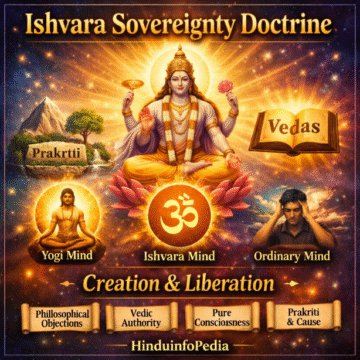

Even the most sublime yogic states—Videha and Prakriti-laya—are revealed to be subtle forms of bondage in Patanjali’s Yoga Sutra. This blog explores how these states, while appearing like liberation, still bind the yogi through attachment. It introduces three authentic post-death paths—Sadyo-mukti, Krama-mukti, and Avatāra—and explains the deeper role of Viveka-khyāti and Bhava-pratyaya.
Category: Dharma
KBC Guru to Guide: Not Just a Teacher
When the Guru became a teacher, and the teacher a tutor, the sacred science of human construction collapsed into content delivery. This blog analyzes how ancient traditions shaped character with friction and force, while modern systems fear discipline. The guru was a potter — today’s tutor is a performer. The result? Bricks without buildings.
Patanjali Yoga Sutra Terms Explained: Understanding Yoga Sutra Terms-II
This expanded glossary completes the essential vocabulary needed to fully understand Patanjali’s Yoga Sutra, especially the profound teachings of 1.18–1.19. Covering advanced sadhana, post-death paths, psychological pitfalls, and subtle distinctions, it clarifies how abhyasa, vairagya, samskaras, and liberation processes interconnect—revealing the entire spectrum from effort to Kaivalya.
Patanjali Yoga Sutra Glossary: Understanding Yoga Sutra Terms-I
Struggling with complex Sanskrit in the Yoga Sutras? This glossary simplifies 36 key terms from Patanjali’s Yoga Sutras 1.18–1.19, focusing on Samadhi, samskaras, kleshas, and Sankhya philosophy. Gain clarity on Nirbija, Viveka-khyati, and Purusha-Prakriti to unlock Asamprajnata Samadhi and deepen your spiritual understanding. Ideal companion for beginners and advanced yoga practitioners alike.
Rigvedic War-Host: The Maruts as Divine Shock Troops
The Rigvedic hymn 1.64 presents the Maruts as a unified storm-host embodying the protective power of ṛta. Far from mere poetic embellishment, traditional and modern commentaries show the Maruts functioning as guardians of order who remove obstacles, strengthen communities, support rightful authority, and provide the inner resilience needed for civilizational continuity and collective defense.
Practice of Para Vairagya – Yoga Sutra
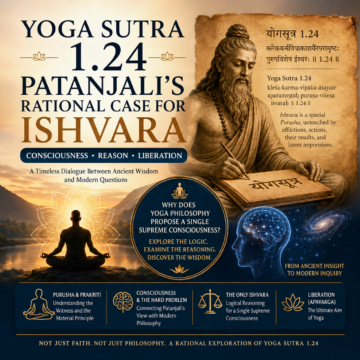
Patanjali’s Yoga Sutra 1.18 reveals the Practice of Para Vairagya—the supreme detachment that leads the yogi beyond all cognition into Asamprajnata Samadhi. Through Neti-Neti and repeated practice, the mind’s fluctuations cease, leaving only the subtle impressions of stillness. This process culminates in freedom, where consciousness rests in its own radiant nature.
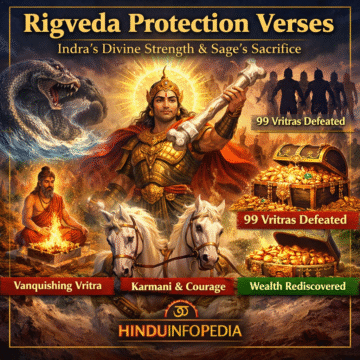
Rigvedic Fortress-Breakers: Indra’s Divine Arsenal Against Adharma 1.63
Rigvedic Fortress-Breakers reveal Indra’s battlefield doctrine — the divine authorization for self-defence rooted in Vedic dharma. Hymns 1.63.2–1.63.7 depict fortress-breaking, slaying of Dasyus, and divine protection for kings and sacrificers. Far from metaphor, these verses establish a Vedic right to resist annihilation and preserve sacred civilization against Adharmic conquest.
Beyond Cognitive Samadhi: Understanding Asamprajnata Samadhi
Asamprajnata Samadhi, described in Patanjali’s Yoga Sutra 1.18, is the transcendence of even the most refined meditative cognition. Through Para Vairagya—supreme detachment—every mental modification ceases, leaving only subtle impressions of cessation (Saṁskāra-Śeṣa). It marks a categorical shift from knowing to being, where pure consciousness abides in its own nature, beyond all thought.
Rigvedic Liberation of Light: When the Rock of Darkness Was Broken RV 1.62
The Rigvedic Liberation of Light interprets Rigveda 1.62.3–5 as the cosmic journey from ignorance to illumination. Bṛhaspati’s wisdom, Indra’s thunder, and Dawn’s radiance form a triad—revelation, liberation, illumination. Each hymn transforms protection into awakening, showing that the Veda’s ancient chants remain a living defense of truth, order, and spiritual clarity.
Future Vision: Path of the Coming Century
The RSS Centenary Sankalp Patra outlines a Future Vision for the next century, balancing tradition and modernity. From institutional growth and social transformation to global leadership, diaspora roles, AI ethics, education, Ayurveda, and cultural revival, the roadmap emphasizes dharma-based life, harmony, and world welfare. It envisions India as a moral, cultural, and spiritual guide.
Vasudhaiva Kutumbakam: Indian Vision for Global Welfare
The RSS centenary Sankalp Patra reaffirms Vasudhaiva Kutumbakam: the whole world as one family. From spiritual roots in Sanatana Dharma to practical visions for peace, justice, environment, economy, and culture, this vision contrasts with Western globalization by emphasizing harmony, cooperation, and universal brotherhood. It is not dominance, but India’s civilizational duty of sharing.
From Planning to Reality: RSS’ Practical Implementation
The blog From Planning to Reality: Practical Implementation explores how the Rashtriya Swayamsevak Sangh translates resolutions into action. It covers branch expansion, training, leadership development, institutional building, harmony, and technology, showing how clarity, discipline, and evaluation transform vision into tangible social change. This journey reflects the Sangh’s century-long experience of turning commitments into reality.
From Struggle to Solution: Facing Modern Challenges
Modern challenges span from information wars and judicial bias to environmental crises and cultural disintegration. The RSS centenary declaration reaffirms that solutions must rest on dharmic strength and national unity. By combining adaptation, innovation, and cooperation, Bharat can move from struggle to solution while offering the world a vision of harmony and resilience.
Spiritual Foundation: Power of Sarve Bhavantu Sukhinah
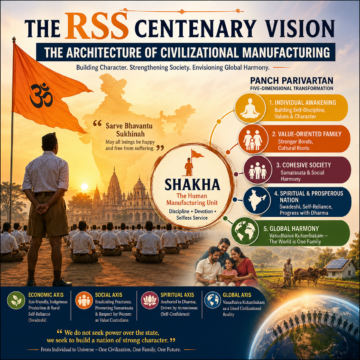
The centenary declaration of RSS makes clear that every program—shakha expansion, leadership, social change—rests on a deeper spiritual foundation. Expressed in the timeless prayer Sarve Bhavantu Sukhinah, this foundation guides individuals from self-discipline to world peace. It is not limited to ritual but extends into families, society, and Bharat’s global responsibility.
Panch Parivartan: The Five-Dimensional Transformation
Panch Parivartan represents the most comprehensive goal of the RSS Centenary Declaration—five layers of transformation from the self to the world. It begins with individual discipline, extends into family values, social harmony, and national strength, and culminates in global welfare. This five-dimensional model weaves unity, prosperity, and spirituality into one continuous process of renewal.
Social Metamorphosis: From Values to Culture
Social Metamorphosis: From Values to Culture is not just about reform, but a holistic transformation of society. It begins with individuals shaped by values, extends into families, education, and communities, and balances economic strength with cultural revival. Women, youth, technology, and even the global Hindu diaspora together create a living model of harmony and collective progress.
Organizing Noble People: Power of Social Transformation
The RSS centenary declaration emphasizes that progress cannot rest on numbers alone. The third goal, Organizing Noble People, calls for uniting value-driven individuals from education, culture, industry, and public life. By nurturing confidence, civic duty, and leadership, this organization builds harmony in society, strength in the nation, and a vision of global peace.
Striving for Character Excellence: Enhancing Shakha Quality
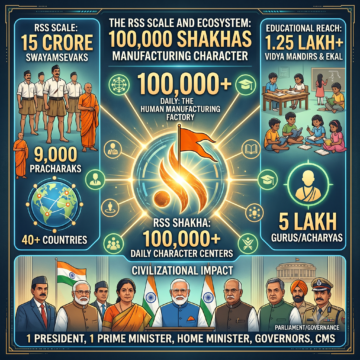
Striving for Character Excellence is not a matter of numbers but of depth—discipline, dharma, and duty. The RSS centenary resolution emphasizes that shakhas must nurture confidence, values, and responsibility through training, prayer, and collective living. From individuals to families and society, this pursuit builds the foundation of a harmonious Hindu society for global peace.
Centenary Resolution: From Shakha Expansion to Social Transformation
Centenary Resolution: From Shakha Expansion to Social Transformation Part 3: RSS Centenary Sankalp Blog Series Centenary Resolution And Role of Shakha Among the five goals established at the historic Centenary Resolution gathering in Bengaluru, the first and most fundamental objective is “Shakha Expansion.” This represents the transformation of Dr. Hedgewar’s 1925 vision into the reality...
Pledge for the World: The Vision of a Harmonious and Organized Hindu Society
Samras and Sangathan are more than words; they form the blueprint for civilizational renewal. Harmony ensures dissolution of caste, regional, and economic divides, while organization channels collective energy toward dharmic goals. The resolution insists that such a society, guided by sajjan shakti, can offer the world a practical path to enduring peace and cooperation.