

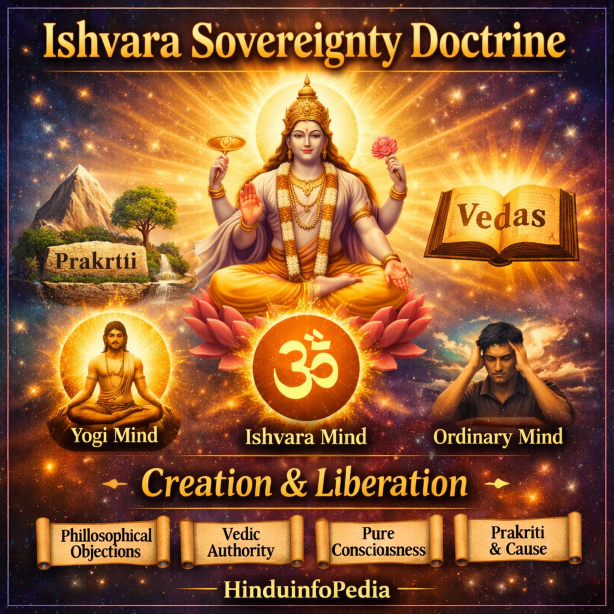
Ishvara Sovereignty Doctrine: The Philosophical Defense of Supreme Consciousness (Yoga Sutra 1.24)-II
Part 33: Patanjali Yoga Sutra Explained
भारत/GB
Ishvara Sovereignty Doctrine and the Objections That Strengthen It
No philosophical claim in the Indian tradition survives unchallenged — and the deeper the claim, the fiercer the challenge. This is the genius of the shanka-samadhan (objection-resolution) method: truth is not asserted into existence but forged through systematic confrontation with every possible counter-argument. This is true for the Ishvara Sovereignty Doctrine.
In our previous exploration of Sutra 1.24, we established the definition of Ishvara as Purusha Vishesha — eternally untouched by klesha, karma, vipaka, and ashaya, distinct from both ordinary and liberated souls. That was the what. This second part addresses the how and why — the deep philosophical defenses that the Patanjal Yog Pradip builds around the Ishvara Sovereignty Doctrine, resolving four major objections that any rigorous thinker would raise against the concept of an eternally sovereign consciousness.
The Circular Dependence Problem: Seed and Sprout
The first serious objection strikes at the logical foundation: Ishvara holds a vishuddha sattva chitta (purely sattvic mind) in order to uplift beings through teachings of dharma and jnana. But this implies a desire to uplift — and desire requires a chitta already in place. So which came first — the desire that necessitates the chitta, or the chitta that enables the desire?
This is the anyonyashraya dosha (mutual dependence fallacy), and it would collapse the entire Ishvara Sovereignty Doctrine if left unresolved.
The commentary resolves it through the bija-ankura (seed-sprout) analogy: just as no one can identify the first seed or the first sprout in an infinite regress — because the process is beginningless (anadi) — so too are Ishvara’s chitta and His intention to uplift beings. Neither preceded the other. Both are anadi. The desire is beginningless; the instrument is beginningless; their relationship is beginningless.
This is not evasion. It is a structural feature of anything that is truly eternal. Only that which has a beginning requires a prior cause. The Ishvara Sovereignty Doctrine asserts that Ishvara’s compassionate sovereignty never began — and therefore the question “what came first” is itself malformed.
Patanjali Yoga Sutra Commentary Series
A systematic, verse-by-verse exploration of Patanjali’s Yoga Sutras — from the foundational discipline of “Atha Yoganushasanam” through vritti analysis, samadhi gradations, and the nature of Ishvara.
Explore now:
Three Minds: Ordinary, Yogic, and Ishvara’s
The second deepening involves a three-level comparison that the commentary draws with remarkable precision. Not all chittas are equal, and understanding the Ishvara Sovereignty Doctrine requires mapping these differences.
Ordinary chitta: Reflected by purusha, it undergoes vishama parinama — uneven transformation. It oscillates between sukha (pleasure), dukha (pain), and moha (delusion/avidya). The afflictions of rajas and tamas dominate its operations. Through avidya-born identification, purusha mistakenly experiences these as its own states.
Yogic chitta: Also reflected by purusha, but through sustained sadhana it achieves nirmal sattvika jnana — purified sattvic knowledge. The yogi’s chitta progressively sheds rajas and tamas. Yet this purification has a starting point — the yogi was once afflicted and became purified through effort. The chitta’s purity is earned, not inherent.
Ishvara’s chitta: This is the critical distinction. Ishvara’s vishuddha sattva chitta undergoes only sattvic parinama — there is no vishama parinama, no oscillation between clarity and confusion. It is not rajas-tamas-shunya (emptied of rajas and tamas through effort) but natively, beginninglessly pure sattva. The commentary states it carries utkarsha reaching aishvarya-avadhi — excellence reaching the pinnacle of sovereign power. And within this chitta, the Vedas themselves reside.
| Attribute | Ordinary Chitta | Yogic Chitta | Ishvara’s Chitta |
| Dominant Guna | Mixed (Rajas/Tamas) | Purified Sattva | Vishuddha Sattva |
| Transformation | Vishama (Uneven) | Progressively refined | Nitya (Always Pure) |
| Origin of Purity | None (Afflicted) | Earned via Sadhana | Native/Beginningless |
| Experience | Pleasure/Pain/Delusion | Knowledge/Clarity | Eternal Sovereignty |
The relationship between Ishvara’s excellence and the Vedas within His chitta is described as anadi vachya-vachaka bhava — a beginningless signifier-signified relationship. The excellence exists; its expression as Veda exists; neither created the other.
Samadhi and Advanced Yoga Practice
The progressive stages of meditative absorption — from savitarka through nirbija — mapped through Patanjali’s systematic framework.
Explore now:
The Self-Validating Proof: Veda and Omniscience
A sceptic now asks: is Ishvara’s supreme excellence sa-nimitta (established through valid evidence) or nish-pramanaka (without proof)? If we accept shruti (Vedic revelation) and smriti (tradition) as evidence, what validates them?
The commentary constructs an elegant self-validating structure — not circular reasoning, but mutual establishment rooted in beginninglessness.
The Vedas, which are Ishvara’s svabhavika jnana (inherent knowledge), serve as pramana (valid evidence) for His supreme excellence. And Ishvara’s demonstrated sarvajna (omniscient) and nirashrantata (inexhaustible) nature — established through other pramanas — validates the Vedas’ authority. The Ishvara Sovereignty Doctrine holds because both elements — the excellence and its scriptural expression — exist within the same vishuddha sattva chitta in an anadi nimitta-naimittika-bhava (beginningless cause-effect relationship).
The vishuddha sattva itself is the nimitta-karana (efficient cause); the Vedas are its manifest expression. Neither was produced at a point in time. This framework avoids the circularity objection because in a beginningless system, mutual dependence is not a fallacy — it is a structural description.
Vritti Analysis Series
Before samadhi can be understood, the mind’s own operations must be mapped. This series dissects the five vrittis that constitute the entire field of mental modification.
Explore now:
The Chariot Without a Charioteer: Why Pradhana Alone Fails
The fourth objection comes from a materialist-adjacent position: why not eliminate Ishvara entirely and accept pradhana (mula-prakriti, primordial nature) as the sole cause of creation? If prakriti produces the universe for purusha’s bhoga (experience) and apavarga (liberation), why introduce a conscious director?
The commentary answers with a single devastating analogy: jada-padaartha (inert matter) cannot produce its effects without chetana’s direction, just as a chariot cannot move without a charioteer (sarathi). Pradhana is the material — the wheels, the body, the axle. But without a conscious intelligence directing its deployment toward purpose, it remains inert potential.
The Ishvara Sovereignty Doctrine therefore requires both: maya (prakriti) as upadana-karana (material cause) and Maheshvara as nimitta-karana (efficient cause). The Shvetashvatara Upanishad states this with finality: “मायां तु प्रकृतिं विद्यान् मायिनं तु महेश्वरम्” — know maya as prakriti, know its master as the Supreme Lord.
Without this conscious sovereign, the universe’s purposeful structure — its orientation toward both bhoga and apavarga for purushas — becomes inexplicable. Randomness does not produce systematic paths to liberation.
Vedic Science and Philosophy
How ancient Indian knowledge systems anticipated modern scientific discoveries — from cosmology to consciousness studies.
Explore now:
The Composite Picture: Nityamuktaishvara
The commentary’s summary pulls all four defenses into a single composite portrait. Ishvara is: nitya (eternal), niratiśaya (unsurpassable), anadi (beginningless), ananta (endless), sarvajna (all-knowing), sada-mukta (ever-liberated). His chitta is vishuddha sattva — native purity, not achieved purity. His aisvarya (sovereign power) and jnana (knowledge) are anadi — they do not arise through parinama (transformation) because the chitta itself never undergoes vishama parinama.
The three properties — nitya jnana (eternal knowledge), nitya iccha (eternal will/satya-sankalpa), and nitya kriya (eternal action) — reside in Ishvara through this vishuddha sattva association. His singular, permanent resolve: “तीनों तापों से दुःखित संसार-सागर में पड़े हुए जीवों का उद्धार ज्ञान और धर्म के उपदेश से करूँ” — to uplift beings drowning in threefold suffering through the teaching of jnana and dharma.
This is not a deity who intervenes capriciously. This is a consciousness whose very structure — beginningless, purely sattvic, self-validating — makes the upliftment of beings as natural and necessary as light emanating from fire.
Abhyasa and Vairagya Series
The twin pillars of yogic discipline — sustained practice and progressive detachment — forming the foundation upon which every advanced technique rests.
Explore now:
Toward Proof: The Transition to Sutra 1.25
These four philosophical defenses establish the Ishvara Sovereignty Doctrine as internally consistent and externally defensible. The circular dependence is resolved through beginninglessness. The chitta distinction is established through three-level comparison. The proof structure is self-validating without being circular. And the necessity of a conscious sovereign is demonstrated against the materialist alternative.
Toward Proof: The Transition to Sutra 1.25
These four philosophical defenses establish the Ishvara Sovereignty Doctrine as internally consistent and externally resilient. The circularity of cause is resolved through beginninglessness; the distinction of consciousness is mapped through a three-level hierarchy; the proof-structure is shown to be self-validating; and the necessity of a conscious director is maintained against purely materialist claims.
In an era where the pendulum of thought often swings between blind dogma and rigid materialism—the latter closely mirroring the Nirishvara (non-theistic) objections of antiquity—it is essential to analyze these “atheistic” counter-arguments on their own terms. Before moving to Patanjali’s formal proof of omniscience in Sutra 1.25, our next part will specifically deconstruct the non-theistic frameworks inherent in the era of the Yoga Sutras and how they compare to modern skepticism.
Yoga Foundations Series
Before advanced concepts can be grasped, the fundamentals must be solid — from the meaning of “Atha” through chitta-vritti-nirodha.
Explore now:
Credits
Primary Source: Patanjal Yog Pradip of Swami Omanand (Gita Press), Sutra 1.24 commentary (pp. 198–202)
Scriptural References: Yoga Sutra 1.24 (Patanjali); Shvetashvatara Upanishad 4.10; Brahma Sutra “janmady asya yatah”
Series Context: Part 33 of the Patanjali Yoga Sutra Commentary Series on HinduInfoPedia
Feature Image: Click here to view the image.
Videos
Glossary of Terms
- Anyonyashraya (अन्योन्याश्रय): Mutual Dependence Fallacy. The logical objection that occurs when “A” depends on “B” while “B” simultaneously depends on “A.” In the Sovereignty Doctrine, this is resolved by the Bija-Ankura (Seed-Sprout) logic, which posits that in an eternal (anadi) system, mutual relationship is a structural fact rather than a logical error.
- Nitya Iccha (नित्य इच्छा): Eternal will — Ishvara’s permanent satya-sankalpa toward the upliftment of beings, one of three eternal properties alongside nitya jnana and nitya kriya
- Vishuddha Sattva Chitta (विशुद्ध सत्त्व चित्त): A perfectly pure sattvic mind described as belonging to Ishvara, free from rajas and tamas and eternally clear.
- Aishvarya-Avadhi (ऐश्वर्यावधि): The pinnacle of sovereign power — the unsurpassable limit of excellence that characterizes Ishvara’s vishuddha sattva chitta
- Sattva, Rajas, Tamas (सत्त्व रजस् तमस्): The three fundamental qualities of prakriti that influence the behavior of mind and matter in Indian philosophy.
- Sadhana (साधना): Disciplined spiritual practice undertaken by yogis to purify the mind and attain higher states of knowledge.
- Pramana (प्रमाण): Valid means of knowledge in Indian philosophy used to establish truth or reliability of a claim.
- Sarvajna (सर्वज्ञ): The attribute of omniscience describing complete and perfect knowledge possessed by Ishvara.
- Prakriti (प्रकृति): The primordial nature composed of the three gunas and considered the material cause of the universe.
- Purusha Vishesha (पुरुष विशेष): A unique and supreme consciousness described by Patanjali that remains eternally untouched by klesha, karma, vipaka, and ashaya.
- Vishama Parinama (विषम परिणाम): Uneven or Fluctuating Transformation. This refers to the state of the ordinary mind where the Gunas (Sattva, Rajas, Tamas) are in constant conflict, leading to cycles of pleasure, pain, and delusion.
- Bhoga (भोग): The experience of worldly life through which beings encounter pleasure, pain, and learning.
- Apavarga (अपवर्ग): Liberation or freedom from the cycle of suffering and rebirth in Indian philosophical traditions.
- Shvetashvatara Upanishad: An important Upanishadic text that discusses the relationship between prakriti and the supreme conscious principle.
- Nitya Jnana, Nitya Iccha, Nitya Kriya: The three eternal attributes of Ishvara described in philosophical commentary as everlasting knowledge, will, and action.
- Nimitta-Naimittika Bhava (निमित्त–नैमित्तिक भाव): The relationship between a cause (nimitta) and its consequence or instrumental effect (naimittika). In this context, it describes how Ishvara’s beginningless purity naturally and eternally results in the manifestation of the Vedas.
- Yoga Sutra One Point Twenty Four: A foundational aphorism from the Yoga Sutras of Patanjali defining Ishvara as a special purusha distinct from ordinary and liberated beings.
- Ishvara Sovereignty Doctrine: The systematic philosophical defense (established in the commentary to Sutra 1.24) that asserts Ishvara as the eternally liberated, supreme consciousness. It is characterized by a natively pure Sattvic mind, absolute omniscience, and the role of “Efficient Cause” (Nimitta-Karana) in the purposeful direction of the universe.
- Bija-Ankura (बीज–अङ्कुर): Seed-sprout — the analogy used to resolve circular dependence by demonstrating that in beginningless processes, mutual causation is structural, not fallacious
- Shanka Samadhan (शंका समाधान): The classical Indian philosophical method where objections are raised and then resolved through systematic reasoning to establish the strength of a doctrine.
- Vachya-Vachaka Bhava (वाच्य–वाचक भाव): Signified-signifier relationship — the beginningless connection between Ishvara’s excellence and its expression as Veda within His chitta
- Bija Ankura Nyaya (बीज अंकुर न्याय): The seed and sprout analogy used in Indian philosophy to explain beginningless cycles where no first cause can be identified.
- Pradhana (प्रधान): Mula-prakriti, primordial nature — the material cause of creation, which requires Ishvara’s conscious direction to function purposefully
- Anadi (अनादि): A philosophical concept meaning beginningless, describing realities that exist without a starting point in time.
- Upadana-Karana (उपादान कारण): Material cause — prakriti’s role in creation, providing the substance from which the universe is fashioned
- Chitta (चित्त): The mental field or internal instrument in yoga philosophy that reflects consciousness and undergoes various transformations.
- Nimitta-Karana (निमित्त कारण): Efficient cause — Ishvara’s role as the conscious director who deploys prakriti toward the purpose of beings’ bhoga and apavarga
#YogaSutras #Ishvara #Patanjali #HinduPhilosophy #VedicWisdom #YogaPhilosophy #IndianPhilosophy #SanatanDharma #Consciousness #योगसूत्र #ईश्वर #पतंजलि #योगदर्शन #सनातनधर्म #वैदिकज्ञान #भारतीयदर्शन #चेतना #HinduinfoPedia
Past Blogs of The Blogs
- Vedic science and its legacy
- Hindu Sacred Texts: The Building Blocks of Hinduism
- Yoga Day and Ashtanga Yoga In Hindu Philosophy
- Patanjali and His Ashtanga Yoga
- Patanjali Yoga Sutras: Understanding “Atha Yoganushasanam”
- Patanjalis yoga sutra: Understanding Yogashchittavrittinirodhah
- Yoga Learning: Unraveling ‘Yogashchittavrittinirodhah’
- Yoga Rupe Vritti – Managing Mind Modifications through Yoga
- Yoga and Vritti Types: Navigating Mental Modifications
- Yoga Sutras’ Five Vrittis: Mastering Mind Through Ancient Wisdom
- Yoga Sutras’ Pramana Vritti: Exploring Sources of True Knowledge
- Yoga Sutras’ Viparyaya Vritti: Misconceptions and Clarity
- Yoga Sutras’ Vikalpa Vritti: Unraveling Mind’s Illusions
- Yoga Sutras’ Sleep Vritti: Unveiling the Depths of Conscious Rest
- Yoga Sutras’ Memory Vritti: Unraveling the Threads of Recall
- Yoga Sutra Practice Non-Attachment: Mastering Mind and Embracing Tranquility
- Yoga Vritti Restraint Method: Mastering Mindful Discipline
- Yoga Long Term Discipline: Mastering the Art of Sustained Practice
- Yoga Renunciation of Desires: A Path to Inner Peace
- Yoga Beyond Gunas Attachment: Unlocking the Secrets of Sutra
- Samadhi Stages Unfolded: Samadhi Practice- Yoga Sutra 1.17
- https://hinduinfopedia.org/beyond-cognitive-samadhi-understanding-asamprajnata-samadhi/
- https://hinduinfopedia.org/practice-of-para-vairagya-yoga-sutra/
- https://hinduinfopedia.org/patanjali-yoga-sutra-glossary-understanding-yoga-sutra-terms-i/
- https://hinduinfopedia.org/patanjali-yoga-sutra-terms-explained-understanding-yoga-sutra-terms-ii/
- https://hinduinfopedia.org/beyond-liberation-videha-prakriti-laya-yoga-sutras-1-18-1-19/
- https://hinduinfopedia.org/bhava-pratyaya-videha-yogis-spiritual-privilege-and-rebirth-yoga-sutra-1-19-2/
- https://hinduinfopedia.org/five-stage-path-to-samadhi-for-ordinary-yogis-sutra-1-20/ https://tinyurl.com/y8zwn6cf
- https://hinduinfopedia.org/yoga-practice-and-yogic-intensity/ https://hinduinfopedia.in/?p=24620
- https://hinduinfopedia.org/ishvara-pranidhana-the-direct-path-to-samadhi/ https://hinduinfopedia.in/?p=24777
- https://hinduinfopedia.org/ishvara-pranidhana-in-practice/ https://hinduinfopedia.org/?p=19061
- https://hinduinfopedia.org/purusha-vishesha-ishvara-the-supreme-consciousness-beyond-all-afflictions-yoga-sutra-1-24/ https://hinduinfopedia.in/?p=25160
Follow us:
- English YouTube: https://www.youtube.com/@Hinduofficialstation
- Hindi YouTube: https://www.youtube.com/@HinduinfopediaIn
- X: https://x.com/HinduInfopedia
- Instagram: https://www.instagram.com/hinduinfopedia/
- Facebook: https://www.facebook.com/Hinduinfopediaofficial
- Threads: https://www.threads.com/@hinduinfopedia
Leave a Reply