

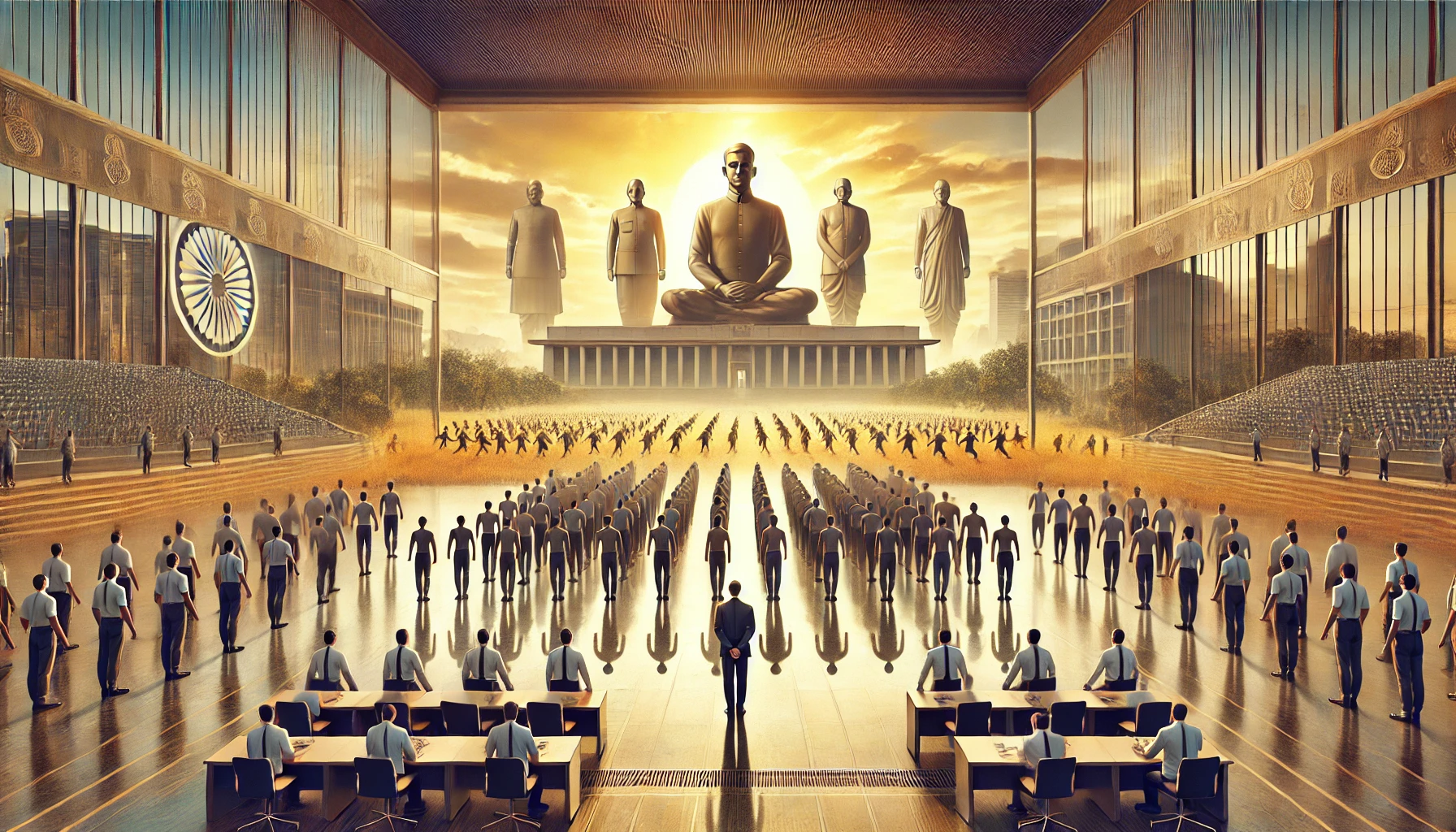
RSS Character Manufacturing System: Global Export Possibility
Part 7B: Building Without Plumb and Line: Human Manufacturing Crisis Series
भारत/BG
RSS Character Manufacturing System: From Workplace to Nation
Part 7A established how the RSS character manufacturing system restores character formation in schools and families – the foundational contexts where humans develop. But properly manufactured individuals must then create properly functioning institutions. This article examines how RSS principles scale to adult systems: corporations that develop rather than merely manage employees, and nations that make संस्कार (character formation) explicit policy rather than incidental hope. The load-bearing walls remain unchanged – तप, दंड, सेवा – but their application shifts from shaping youth to organizing civilization.
Corporations: From Human Resources to Human Development
The human manufacturing crisis extends into workplaces. Companies that treat employees as interchangeable units, that manage rather than mentor, that optimize for productivity while ignoring character – they contribute to civilizational decline just as much as failing schools.
The RSS Character Manufacturing System: global export possibility in corporate contexts offers an alternative that Western businesses desperately need, as documented in organizational analysis.
Mentorship Over Management
Management is transactional. Do X, receive Y. Meet metrics, get promoted. Fail targets, face consequences. This produces compliant workers but not developed humans.
RSS operates on mentorship principles: senior swayamsevaks guide juniors not through KPIs but through embodied wisdom. The relationship is guru-shishya, not boss-employee. This mirrors traditional Indian organizational models where skill transmission happened through close apprenticeship.
Corporate adaptation globally:
Formal mentorship programs where senior employees guide juniors in character development, not just career advancement. Mentors given authority to correct mentees’ character defects, not just professional errors. Some Japanese corporations maintain similar systems through their sempai-kohai relationships, which explains their lower employee turnover and stronger organizational loyalty.
Evaluation criteria including character alongside performance. The brilliant coder who’s arrogant and uncooperative? Lower overall rating than the competent coder who serves the team selflessly. This principle, standard in shakhas, revolutionizes corporate culture when implemented.
Promotion paths requiring demonstrated character. You don’t advance to leadership unless you’ve proven capable of service, humility, and duty – regardless of technical excellence. The RSS Character Manufacturing System: global export possibility prevents brilliant sociopaths from reaching positions where character defects cause systemic damage.
Character Development Programs
RSS shakhas manufacture character systematically. Corporations can adopt similar approaches: regular gatherings focused not on business but on values. Guest speakers on duty, service, sacrifice. Study of texts emphasizing civilizational values rather than merely professional skills.
Companies that ignore character development produce the brilliant sociopaths now dominating corporate leadership – maximizing profit while destroying communities, gaming systems while destroying trust, extracting value while producing nothing of lasting worth. Research on corporate malfeasance consistently shows character deficiency, not capability deficiency, as the root cause.
Discipline in Workplace
Modern HR departments spend vast resources on “employee engagement” – essentially bribing workers to care about their jobs. The RSS Character Manufacturing System: global export possibility shows the alternative: discipline makes engagement unnecessary. When you’re expected to serve, you serve. No motivation required.
Corporations globally can restore workplace discipline:
Punctuality enforced strictly. Meetings start on time. Those who arrive late face real consequences, not gentle reminders. This simple principle, standard in RSS operations, transforms organizational efficiency.
Dress codes maintained. Not because fashion matters, but because external discipline reinforces internal discipline. The shakha uniform serves this exact purpose.
Hierarchy respected visibly. Junior employees don’t casually call senior executives by first names. The outward markers of respect reinforce internal attitudes. Cultures that maintain this (Japan, Singapore) show measurably higher organizational effectiveness than Western “flat hierarchy” companies.
Service Mindset Over Salary Mindset
The ultimate shift required to address the human manufacturing crisis in corporations: employees viewing work as service, not just salary extraction. You work not because you’re paid, but because the work itself serves something larger.
This seems impossible in capitalist frameworks. But RSS proves it works: pracharaks receive minimal stipends yet work harder than any corporate executive. Why? Because they serve rather than earn, as documented in RSS organizational studies.
Corporations can move toward this model by emphasizing mission over compensation. Not naive “company loyalty” manipulated through pizza parties, but genuine understanding that the work matters beyond the paycheck. Companies producing essential goods or services have an easier path, but even luxury producers can emphasize craftsmanship, quality, service to customers.
The shift from salary mindset to service mindset transforms workers from resource units into developed humans. And that’s how corporations address their part of the human manufacturing crisis through the RSS Character Manufacturing System: global export possibility.
Nations: Character as National Policy
The most ambitious application: entire nations adopting systematic character manufacturing as policy. Sound utopian? Consider that universal education was once considered utopian. Mandatory literacy seemed impossible until nations made it policy.
Mandatory character development is no less feasible – and far more important for civilizational survival. The RSS Character Manufacturing System: global export possibility at national scale means treating संस्कार (character formation) as central to national purpose rather than incidental to education.
Mandatory National Service (Shakha Model)
Multiple nations already have mandatory military service. Israel’s model produces highly disciplined citizens. Switzerland’s system maintains social cohesion. South Korea’s service builds national unity.
RSS shakha offers a non-military alternative that manufactures character without requiring armed forces training. Imagine every citizen spending two years in intensive character development:
Year One: Physical discipline, mental development, service projects. Daily schedules mimicking shakha routine. Hierarchical structures with clear authority. Immediate correction for violations. Public recognition for excellence.
Year Two: Leadership training, teaching responsibilities, organizational roles. Graduates become trainers for next cohort. The manufacturing chain extends indefinitely.
Objections are predictable: “But that’s indoctrination!” Yes. So is current education. So is media. So is advertising. The question isn’t whether we manufacture citizens, but whether we do so consciously with positive values or allow random influences to produce defective humans, as we documented in institutional capture analysis.
Character Certification for Citizenship
Currently, citizenship requires passing basic civics tests. Why not character tests? Before voting, before holding office, before accessing certain privileges – demonstrate minimum character standards.
Not elaborate moral philosophy exams. Simple, practical demonstrations: Can you follow instructions without questioning every detail? Can you serve without complaining? Can you accept correction without becoming defensive? Can you lead without abusing authority?
Nations throughout history tied citizenship to character. Only in the modern era of universal suffrage divorced from any capability requirements did we pretend character doesn’t matter. The results? Democracies that elect demagogues, populations that can’t self-govern, citizens who demand rights while shirking duties.
Character certification wouldn’t prevent all problems. But it would establish the principle: citizenship is earned through demonstrated character, not automatic through birth. This principle, inherent in the RSS Character Manufacturing System: global export possibility, could transform democratic governance.
Guru-Shishya in Governance
Currently, politicians manage constituencies. Bureaucrats implement policies. Leaders lead nations. All transactional, all pragmatic, all focused on measurable outcomes while ignoring character.
The RSS Character Manufacturing System: global export possibility suggests alternatives: governance as guru-shishya relationships. Leaders who develop citizens’ character, not just manage their services. Officials who see themselves as teachers with authority to shape society, not just administrators implementing programs.
This requires fundamental shifts in how we conceive political authority. Not servants of the people (which makes leaders subservient to popular whims), but guides of the people (which makes leaders responsible for elevating public character). Traditional Hindu statecraft actually operated on such principles – rulers evaluated on whether they promoted dharma, not just whether they expanded territory or increased revenue.
Radical? Absolutely. But the human manufacturing crisis requires radical solutions. Half-measures that preserve current frameworks while hoping for better results will fail. We need structural transformation.
संस्कार as National Policy
The ultimate application of RSS principles to national governance: making संस्कार (character formation) explicit national policy. Not hidden in education standards or implied in civic programs, but central to national purpose.
What would this look like practically?
National character standards defining minimum expectations for citizenship. Not detailed moral codes, but basic requirements: respect for authority, capability for service, willingness to sacrifice for collective good. Traditional Indian systems provided such frameworks that produced stable societies for millennia.
Systematic character formation integrated throughout society. Schools primarily focused on character, with academics secondary. Workplaces evaluated on character development of employees alongside profit generation. Media regulated to support character formation rather than undermine it.
Government organized around character rather than merely administration. Ministries of character development with budgets matching defense spending. Character considerations in every policy decision. Economic policies evaluated not just for GDP impact but for character effects.
Sound impossible? Remember that nations have organized around stranger principles: racial purity, class struggle, religious orthodoxy. Why not character excellence? The RSS Character Manufacturing System: global export possibility provides a tested framework that has produced measurable results for a century.
International Examples: Where RSS Model Could Take Root
Not every nation is equally receptive to the RSS Character Manufacturing System: global export possibility. Cultural context matters. Here’s where adaptation stands the best chance:
Japan: Discipline Culture Meets Character Focus
Japan already maintains strong discipline culture. Schools enforce strict rules. Workplaces demand conformity. Society values collective harmony over individual expression.
What’s missing? Explicit character formation systems like RSS shakhas. Japanese education emphasizes academic performance and behavioral conformity but lacks the systematic character building that transforms discipline into virtue. Adding shakha-style character manufacturing could elevate Japan’s existing structure.
Japanese corporate culture already practices mentorship through sempai-kohai relationships. Families maintain hierarchical respect. The infrastructure exists – it needs only the explicit character focus that RSS provides.
Singapore: Authoritarian Receptivity to Discipline Models
Singapore’s governance model has long diverged from Western liberal norms. Lee Kuan Yew repeatedly argued that “Asian values” place greater emphasis on social order, discipline, and the collective good than on unrestricted individual rights — a view that shaped Singapore’s political and educational institutions.
Singapore could implement RSS-style national service (they already have military service) with explicit character formation components. Their education system already emphasizes discipline and respect for authority. Adding systematic character assessment and guru-shishya mentorship would be natural extensions.
Singapore’s meritocracy could benefit from RSS’s insight: merit includes character, not just capability. Their current system produces brilliant technocrats; adding character formation would produce wise leaders.
Israel: Mandatory Service Meets Character Element
Israel’s mandatory military service (IDF conscription) already provides infrastructure for systematic youth development. Every citizen serves 2-3 years developing discipline, hierarchy understanding, and service mentality.
What’s missing? Explicit character formation outside military context. RSS shakha model could provide civilian alternative for those ineligible for military service, maintaining character development while avoiding militarization. The kibbutz movement demonstrated Israeli receptivity to communal character-building systems.
Israel’s strong cultural identity and collective purpose align with RSS principles. Adding systematic character certification could strengthen social cohesion while addressing internal divisions.
Eastern Europe: Traditional Values Rejecting Western Liberalism
Poland, Hungary, and other Eastern European nations increasingly reject Western progressive ideology. They maintain traditional family structures, resist LGBT propaganda in schools, and emphasize national identity over multiculturalism.
These nations are actively searching for alternatives to failed Western models. The RSS Character Manufacturing System: global export possibility provides tested framework that aligns with their values while avoiding the excesses they’ve experienced under both communism and Western liberalism.
Hungary’s educational reforms already emphasize patriotism and traditional values. Adding systematic character formation through shakha-style daily gatherings could institutionalize what they’re attempting.
Why This Will Face Resistance – And Why It Will Succeed Anyway
The RSS Character Manufacturing System: global export possibility threatens powerful interests who benefit from the current human manufacturing crisis. Expect systematic opposition:
Western NGOs Will Call It “Authoritarian”
Organizations funded by Western foundations will attack any character formation system as authoritarian indoctrination. They’ll frame hierarchy as oppression, discipline as abuse, guru authority as exploitation.
This is predictable. These same NGOs promote ideology through educational capture, regime change through institutional subversion, and demographic engineering through unrestricted immigration. They can’t allow successful alternatives to emerge.
Liberal Media Will Call It “Fascist”
Western media will draw false parallels between RSS character formation and totalitarian youth indoctrination. They’ll ignore that shakhas are voluntary, that pracharaks are unpaid, that RSS has no political power to force participation.
The label “fascist” has lost meaning through overuse, as documented in contemporary political discourse. Parents whose children are failing, teachers who can’t maintain order, citizens watching civilization crumble – they’ll ignore media propaganda when they see RSS graduates demonstrating superior character.
Therapy Culture Will Call It “Traumatizing”
Psychological professionals built careers on treating “trauma” from normal childhood discipline. They can’t acknowledge that firmness produces resilience without admitting their entire framework is backwards.
Research contradicting therapy culture’s assumptions shows that controlled adversity builds strength, that hierarchy provides security, that clear boundaries reduce anxiety. The RSS Character Manufacturing System: global export possibility threatens professional interests invested in perpetual victimhood.
But Desperate Parents, Failing Schools, Chaotic Societies Will See Results
Ideology yields to necessity. When Western children can’t compete with Indian swayamsevaks in capability and character. When Western families collapse while Indian families remain stable. When Western corporations implode while Indian businesses thrive through character-based leadership. When the gap becomes undeniable, pride yields to pragmatism.
The demographic crisis in the West makes character formation urgent. Societies that abandoned human manufacturing face replacement by those who perfected it. The choice becomes stark: adopt successful models or accept civilizational decline.
The Global Question: Will the World Learn?
As Western education’s failures become undeniable, as societies built on its products crumble, as the human manufacturing crisis produces increasingly obvious dysfunction – will the world humble itself to learn from RSS?
Early signs are not encouraging. Pride prevents learning. Ideological capture prevents acknowledgment. The same forces that created the crisis benefit from its continuation, as documented in institutional analysis.
But necessity eventually overrides ideology. When the dysfunction becomes unbearable, when societies literally cannot function because their citizens lack basic character, when the human manufacturing crisis threatens civilizational collapse – then, perhaps, they’ll look East.
They’ll discover what we’ve documented across seven articles: RSS preserved what the world abandoned. The plumb bob ensuring vertical alignment (moral standards). The mason’s line maintaining horizontal structure (hierarchy and discipline). The master craftsman with authority to shape raw material into excellence. The manufacturing process that produces actual humans, not credentialed automatons.
The question isn’t whether the RSS Character Manufacturing System: global export possibility works. We’ve established that definitively. The question is whether the world has the humility to adopt it. To admit that “liberation” from traditional structures was actually liberation into chaos. To acknowledge that the human manufacturing crisis stems from abandoning time-tested human formation practices. To recognize that the solution exists not in Silicon Valley innovations or Harvard research, but in those humble shakhas where the ancient art of human manufacturing never ceased.
Conclusion: The Load-Bearing Walls Cannot Be Removed
भार-वहन दीवारें (Load-bearing walls) – the title of this article in Hindi – captures an essential truth about the RSS Character Manufacturing System: global export possibility. Certain elements cannot be compromised without structural collapse.
These load-bearing walls are:
तप (Tapa) – Discipline through pressure. You cannot manufacture proper humans through comfort and convenience. Heat, hammer, and patience – these are not optional refinements but essential tools. Any global adaptation that removes pressure removes the manufacturing process itself.
दंड (Danda) – Authority to correct. The guru must have the stick, even if rarely used. The teacher must have the authority to discipline. The parent must have the right to punish. Remove this authority, and you remove the ability to shape character. Western education removed this wall and the structure collapsed.
सेवा (Seva) – Service mentality. The shift from “what’s in it for me” to “how can I serve” transforms humans from consumers to contributors, from takers to makers. RSS produces pracharaks who work without salary. Shakhas produce swayamsevaks who serve without recognition. This principle, when removed, produces the entitled narcissism destroying Western civilization.
These three principles – pressure, authority, service – form the load-bearing walls that any global adaptation must preserve. Remove them to accommodate Western sensibilities, and the entire structure collapses. Maintain them despite Western resistance, and the RSS Character Manufacturing System: global export possibility transforms societies wherever implemented.
Time will tell. But one thing is certain: the human manufacturing crisis will not resolve itself. Either we consciously adopt systematic character manufacturing based on tested models like RSS, or we unconsciously accept civilizational decline. There is no third option.
The world is waking up to the failure of Western education models. Disrespectful children, incompetent adults, chaotic societies. RSS has quietly perfected what the world desperately needs: the art of manufacturing proper humans. Not through degrees or certificates, but through the ancient tools of discipline, authority, and character forging.
The question is: Will the world humble itself to learn from a 100-year-old Indian organization in khaki shorts? Or will pride prevent the adaptation that necessity demands?
Choose wisely. Choose soon. Because the clock is ticking, and civilizations that cannot manufacture proper humans do not survive.
Series Conclusion: Part A Complete
This concludes our seven-part examination of the human manufacturing crisis and the RSS solution. From the manufacturing defect to global applications, we’ve documented both the problem and the path forward. Part B will explore RSS’s organizational scale and structure – the massive ecosystem that proves the model works not just theoretically but practically at civilizational scale.
Series Progress: 7 of 7 Complete (Part A) | Part B begins next
Feature Image: Click here to view the image.
Videos
Glossary of Terms
- Rashtriya Swayamsevak Sangh (RSS): A Hindu volunteer-based cultural organization founded in 1925 in India, focused on character formation, discipline, and nation-building through daily shakhas.
- Shakha: A local daily gathering conducted by RSS where participants engage in physical drills, discipline routines, discussions, and character-building activities.
- Swayamsevak: A volunteer member of RSS who participates in shakhas and commits to disciplined service-oriented conduct.
- Pracharak: A full-time RSS worker who dedicates his life to organizational service, often receiving minimal financial compensation.
- Guru–Shishya Tradition: An ancient Indian mentorship model where a teacher (guru) shapes the character and wisdom of a disciple (shishya) through authority and guidance.
- Sanskar (संस्कार): A Sanskrit term referring to character formation, moral conditioning, and value imprinting through disciplined upbringing.
- Tapa (तप): Discipline developed through pressure, hardship, and sustained effort, considered essential for character forging.
- Danda (दंड): Legitimate authority and corrective discipline used to maintain order and moral alignment.
- Seva (सेवा): Selfless service performed without expectation of personal gain or recognition.
- Human Manufacturing Crisis: A conceptual framework describing the global decline in structured character formation in education, family, and institutions.
- Character Certification: A proposed governance model requiring demonstrated moral and civic discipline before accessing certain public responsibilities.
- Mandatory National Service (Shakha Model): A suggested adaptation of RSS-style structured character development at national scale, outside purely military training.
- Sempai–Kohai System: A Japanese hierarchical mentorship tradition where seniors guide juniors within educational and corporate environments.
- Meritocracy with Character: A governance or corporate framework where advancement depends on moral conduct alongside capability.
- Load-Bearing Walls (भार-वहन दीवारें): A metaphor used in the blog to describe non-negotiable civilizational pillars—Tapa, Danda, and Seva—that sustain institutional integrity.
#RSS #CharacterBuilding #Leadership #NationBuilding #Character #Discipline #Seva #Character #Education #Discipline #Society #UncontrolledChild #ChildDiscipline #CharacterCrisis #SocialDecay #शाखा #अनुशासन #चरित्र #अधिकारपतन #मानवनिर्माण #अनुशासन #पदानुक्रम #HinduinfoPedia #AuthorityCollapse #HumanManufacturing #SocialDiscipline #HierarchyMatters #HinduinfoPedia #बिनासाहूलऔरडोरीकानिर्माण #BuildingWithoutPlumbandLine
Related Reading
Previous Blogs of The Series
- https://hinduinfopedia.org/manufacturing-defect-when-humans-stopped-making-humans/ https://hinduinfopedia.in/मानव निर्माण दोष
- https://hinduinfopedia.org/kbc-guru-to-guide-not-just-a-teacher/ https://hinduinfopedia.in/KBC गुरु से मार्गदर्शक
- https://hinduinfopedia.org/kbc-and-the-plumb-line-when-a-society-loses-its-moral-measure/ https://hinduinfopedia.in/KBC और साहूल
- https://hinduinfopedia.org/kbc-exposing-authority-collapse-in-human-manufacturing/ https://hinduinfopedia.in/?p=24463
- https://hinduinfopedia.org/building-without-master-craftsman-compare-with-rss-assembly/ https://hinduinfopedia.in/?p=24580
- https://hinduinfopedia.org/uncontrolled-child-development-the-kbc-quiz-show-warning/ https://hinduinfopedia.in/?p=24745
- https://hinduinfopedia.org/rss-character-manufacturing-model/ https://hinduinfopedia.in/?p=24970
On Educational Reform:
- Gurukul: Truths of Hindu Wisdom
- Sixteen Sanskaras: Life’s Spiritual Journey
- Indian Education System and Its Legacy
On Civilizational Manufacturing:
On Global Patterns:
Follow us:
- English YouTube: https://www.youtube.com/@Hinduofficialstation
- Hindi YouTube: https://www.youtube.com/@HinduinfopediaIn
- X: https://x.com/HinduInfopedia
- Instagram: https://www.instagram.com/hinduinfopedia/
- Facebook: https://www.facebook.com/Hinduinfopediaofficial
- Threads: https://www.threads.com/@hinduinfopedia
Leave a Reply