

Yoga Ishvara Rational Case: When Ancient Logic Anticipates Modern Atheist Objections (Yoga Sutra 1.24)
Patanjali Yoga Sutra — The Rationalist Reading
भारत /GB
The Yoga Ishvara Rational Case That Atheists Never Encounter
Twenty-three centuries before the New Atheism declared consciousness a byproduct of matter, an Indian logician was already engaging that position — and dismantling it through formal philosophical debate, not faith, not revelation, not threats of divine punishment. His name was Patanjali, and his method was shanka-samadhan: state the strongest possible objection, then resolve it through reasoning alone.
Modern atheism’s engagement with Indian philosophy rarely gets past caricature. The assumption is that any system invoking “Ishvara” must operate on Abrahamic logic — an omnipotent creator-deity demanding worship, threatening punishment, existing outside rational inquiry. Patanjali’s framework is none of these. The Yoga Ishvara Rational Case in Sutra 1.24 is a technical argument about the necessary conditions for consciousness to be structured toward liberation — directly anticipating every major materialist objection.
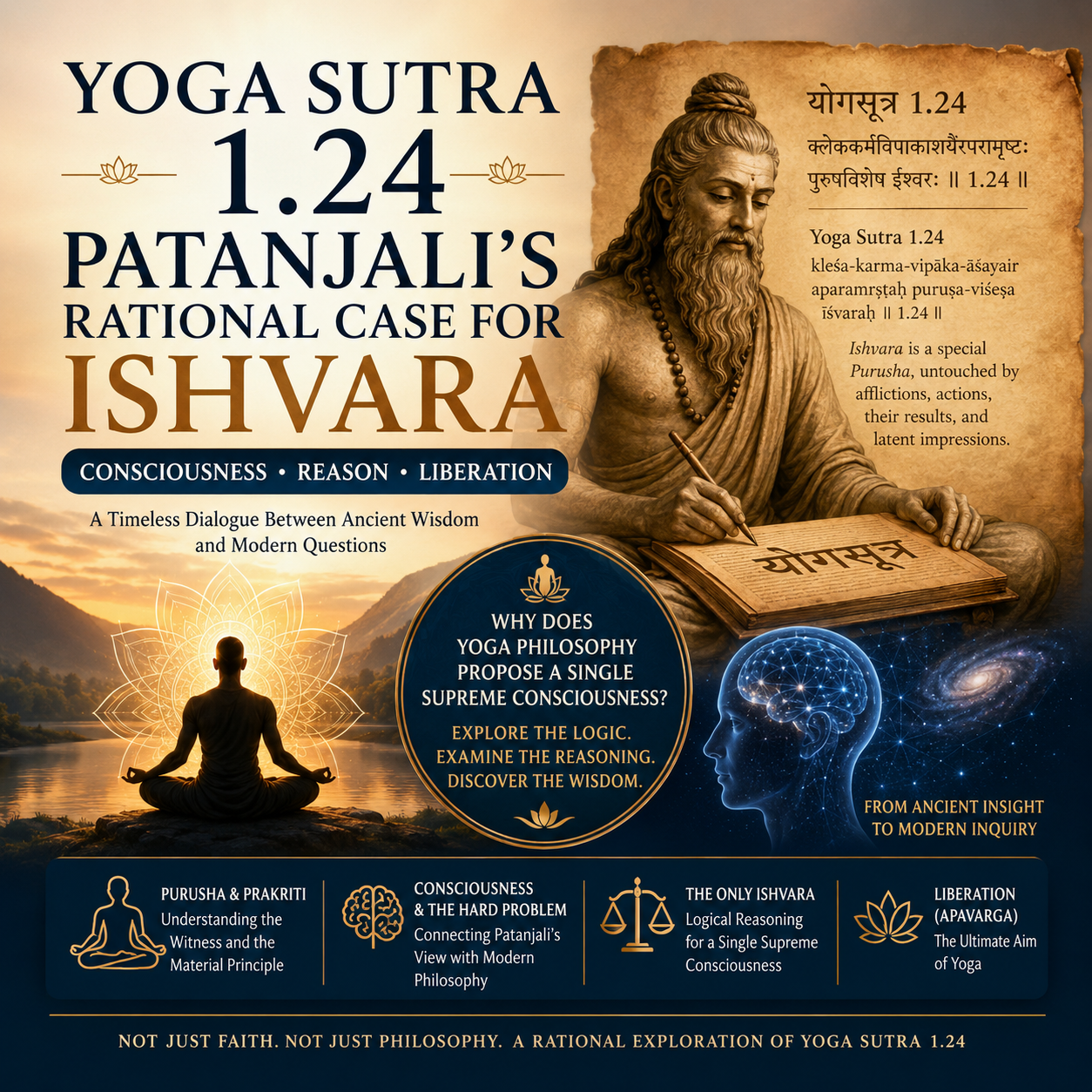
क्लेशकर्मविपाकाशयैरपरामृष्टः पुरुषविशेष ईश्वरः ॥ २४ ॥
kleśa-karma-vipāka-āśayaiḥ aparāmṛṣṭaḥ puruṣa-viśeṣaḥ īśvaraḥ
“Ishvara is that special consciousness (Purusha) untouched by afflictions, actions, their results, and latent impressions.”
No creation myth. No moral commandments. No worship demanded. A definition — arrived at through the elimination of alternatives.
What Patanjali’s Ishvara Is Not
Before examining the Yoga Ishvara Rational Case, it is essential to clear the Abrahamic debris that most Western-educated atheists unconsciously import into any discussion involving the word “God.”
Patanjali’s Ishvara does not create the universe ex nihilo. The Samkhya-Yoga framework posits prakriti (matter/nature) as the material cause — it has always existed. Ishvara does not reward or punish. There is no heaven, no hell, no judgment day in this system. Ishvara does not demand worship. Sutra 1.23 presents Ishvara Pranidhana (surrender) as one path among several — the word “va” (or/alternatively) explicitly preserves the practitioner’s choice. Ishvara does not intervene in human affairs through miracles. His operation is through the teaching of dharma and jnana — knowledge, not magic.
What Ishvara is, in Patanjali’s precise formulation: a consciousness that has never been subject to the four mechanisms — affliction, action, consequence, and latent impression — that trap every other conscious entity in cyclical existence. A “special Purusha” (purusha-vishesha) — not a different category of being, but the same type of consciousness (purusha) in a permanently unconditioned state.
An atheist who dismisses this without engagement is not rejecting religion. They are declining to examine a philosophical position about the nature of consciousness itself.
Patanjali Yoga Sutra Commentary Series
A systematic, verse-by-verse exploration of Patanjali’s Yoga Sutras following the original sutra sequence — from foundational discipline through vritti analysis, samadhi gradations, and the nature of Ishvara.
Explore now:
The Materialist Objection Patanjali Already Addressed
The strongest atheist position against Ishvara is the one Patanjali’s own commentary tradition raises and names: why not accept pradhana (mula-prakriti — primordial matter) as the sole cause of everything? If matter can self-organize into stars, planets, organisms, and brains, why introduce consciousness as a separate ontological category, let alone a supreme version of it?
The Patanjal Yog Pradip responds with an analogy that predates modern philosophy of mind by two millennia: inert matter (jada-padaartha) cannot produce purposeful effects without conscious direction, just as a chariot cannot move without a charioteer.
A modern materialist would counter: evolution provides purposeful-seeming direction through natural selection — no charioteer needed. But Patanjali’s argument operates deeper than biological design. His point is not about complexity but about orientation toward liberation. The Samkhya-Yoga system holds that prakriti’s entire structure is oriented toward two purposes: bhoga (experience) and apavarga (liberation) for purusha. Purposeful orientation toward a goal that matter itself cannot experience requires a conscious principle that understands both the goal and the process.
This is the core of the Yoga Ishvara Rational Case: not “who created the world” but “why is the structure of reality oriented toward the liberation of consciousness from matter, if consciousness is merely a byproduct of matter?”
Vedic Science and Philosophy
How ancient Indian knowledge systems anticipated modern scientific discoveries — from cosmology to consciousness studies.
Explore now:
The Hard Problem — 2,300 Years Early
In 1995, David Chalmers formulated what philosophers now call the “Hard Problem of Consciousness” — why does subjective experience exist at all? Why is there “something it is like” to be conscious, rather than complex information processing occurring in the dark?
Patanjali’s Samkhya framework had already built its architecture on this distinction. Purusha (consciousness) witnesses but does not act. Prakriti (matter, including mind) acts but does not experience. The mind processes; purusha knows it processes. This is an observation about the irreducibility of first-person experience to third-person material description.
The Yoga Ishvara Rational Case extends this: if consciousness is fundamental — not reducible to material processes — then permanently unconditioned consciousness becomes genuinely possible. Patanjali argues it must exist, because otherwise liberation is logically impossible. If every purusha is necessarily conditioned by chitta’s kleshas, then yoga’s goal (chitta-vritti-nirodha) becomes unreachable. Liberated yogis demonstrate temporary freedom — they were once bound and became free. Ishvara represents the limiting case: consciousness that was never bound.
Samadhi and Advanced Yoga Practice
The progressive stages of meditative absorption mapped through Patanjali’s systematic framework — from savitarka through nirbija.
Explore now:
Why “Yoga Without God” Is Philosophically Incomplete
The modern yoga industry has performed a remarkable surgery: extracting asana and pranayama from a comprehensive philosophical system and marketing them as secular wellness products. Commercially successful, physically beneficial — and philosophically decapitated.
Patanjali’s Yoga Sutra 1.2 defines yoga as chitta-vritti-nirodha — the stilling of mental modifications. When he introduces the fastest method (Sutra 1.23), it is Ishvara Pranidhana. When he defines what makes it work (Sutra 1.24), he constructs the Yoga Ishvara Rational Case.
Remove Ishvara from the Yoga Sutras and you do not get “secular yoga.” You get a system with its most direct path amputated, its logical foundation for liberation removed, and its account of why reality is structured toward consciousness left unexplained. You get physical exercise with Sanskrit terminology.
An intellectually honest atheist does not need to accept Ishvara. But dismissing the concept without engaging the argument is not rationalism. It is the very avidya (ignorance through non-examination) that Patanjali identifies as the root of all suffering.
Vritti Analysis Series
Before samadhi can be understood, the mind’s own operations must be mapped. This series dissects the five vrittis that constitute the entire field of mental modification.
Explore now:
The Antimatter Analogy: Why Singular Sovereignty Is Logical
The commentary raises a question that resonates with contemporary physics: can there be multiple Ishvaras? The answer uses pure logic. If two sovereign consciousnesses held conflicting intentions — one willing creation, another willing dissolution — the result would be cosmic cancellation. Nothing would manifest.
This echoes a puzzle in cosmology: at the Big Bang, matter and antimatter should have annihilated each other completely. A tiny asymmetry allowed matter to survive. Similarly, multiple Ishvaras with conflicting wills would annihilate into cosmic inaction. Only singular, unequalled consciousness ensures coherent manifestation.
If you posit a hierarchy among multiple candidates — one greater, one lesser — only the unsurpassed one qualifies. The concept converges logically on singularity. The Shvetashvatara Upanishad captures it: “None is seen equal to Him, none greater. His supreme power is heard of as manifold and inherent — knowledge, strength, and action are His very nature.”
This is not an appeal to mystery. It is a logical deduction from the requirements of coherent sovereignty.
Abhyasa and Vairagya Series
The twin pillars of yogic discipline — sustained practice and progressive detachment — forming the foundation upon which every advanced technique rests.
Explore now:
The Honest Atheist’s Dilemma
The Yoga Ishvara Rational Case does not ask an atheist to believe. It asks them to engage three questions honestly:
First: Is consciousness reducible to matter? If yes, explain why subjective experience exists — the Hard Problem no materialist framework has resolved. If no, non-material consciousness is at least philosophically possible.
Second: If non-material consciousness exists, can it exist unconditioned? If liberation from mental afflictions is possible — and every meditator who has experienced even momentary stillness has tasted a fragment of this — then permanent unconditioned consciousness is logically coherent.
Third: If reality’s structure includes a path from conditioned to unconditioned consciousness, what accounts for that structure? Random material processes do not generate systematic paths to their own transcendence. Patanjali’s answer: a consciousness that has never been conditioned provides both the proof of possibility and the structural ground.
You may reject these answers. But rejecting them after engagement is philosophy. Rejecting them without engagement is the very ignorance (avidya) that Patanjali identifies as the first and deepest klesha.
The Yoga Ishvara Rational Case has waited twenty-three centuries for serious materialist engagement. The question is whether modern atheism is rigorous enough to provide it — or whether it will continue dismissing what it has never examined.
Yoga Foundations Series
Before advanced concepts can be grasped, the fundamentals must be solid — from the meaning of “Atha” through chitta-vritti-nirodha.
Explore now:
Credits
- Primary Source: Patanjal Yog Pradip of Swami Omanand (Gita Press), Sutra 1.24 commentary (pp. 198–202)
- Scriptural References: Yoga Sutra 1.24 (Patanjali); Shvetashvatara Upanishad 6.8; Samkhya Karika
- Modern References: David Chalmers, “Facing Up to the Problem of Consciousness” (1995); Big Bang matter-antimatter asymmetry (standard cosmological model)
- Series Context: Patanjali Yoga Sutra Commentary Series on HinduInfoPedia — Rationalist Reading
Feature Image: Click here to view the image.
Videos
Glossary of Terms
- Yoga Sutra 1.24: A foundational aphorism of Maharshi Patanjali defining Ishvara as a unique Purusha untouched by afflictions, actions, their results, and latent impressions.
- Ishvara: In Classical Yoga, the special Purusha who is eternally free from afflictions, karma, karmic results, and latent impressions, serving as the highest object of meditation.
- Purusha: Pure witnessing consciousness, distinct from matter, eternal, unchanging, and central to the Samkhya-Yoga philosophical system.
- Prakriti: The primordial material principle from which the physical universe, mind, and all changing phenomena evolve.
- Samkhya-Yoga: The classical philosophical framework combining Samkhya metaphysics with Patanjali’s Yoga system to explain consciousness, matter, and liberation.
- Klesha: Mental afflictions such as ignorance, egoism, attachment, aversion, and fear that bind beings to suffering.
- Karma: Intentional actions that generate consequences influencing future experiences and the cycle of rebirth.
- Ashaya: The latent impressions or subconscious karmic deposits accumulated through past actions.
- Apavarga (Liberation): Complete freedom from suffering and the cycle of bondage through realization of the distinction between Purusha and Prakriti.
- Hard Problem of Consciousness: A modern philosophical question introduced by David Chalmers concerning how subjective conscious experience arises from physical processes.
- Materialism: The philosophical view that reality consists solely of matter and physical processes, with consciousness arising entirely from them.
- Supreme Consciousness: The blog’s key concept describing Ishvara as the singular, eternally unconditioned consciousness within the Yoga tradition.
- Rational Case for Ishvara: The key phrase of this blog, referring to Patanjali’s logical and philosophical presentation of Ishvara based on reason rather than blind belief.
- Matter-Antimatter Analogy: A modern explanatory analogy used in the blog to illustrate why the Yoga tradition argues for a single supreme consciousness.
- Reason Before Belief: A distinctive expression used throughout the blog to describe Patanjali’s method of inviting philosophical examination before acceptance.
#Yoga #YogaSutra #Patanjali #Ishvara #Meditation #Consciousness #Philosophy #Hinduism #Spirituality #HinduinfoPedia
Past Blogs of The Blogs
- https://hinduinfopedia.org/vedic-science-and-its-legacy/
- https://hinduinfopedia.org/the-hindu-sacred-scripts-the-building-blocks-of-hinduism/
- https://hinduinfopedia.org/yoga-day-and-ashtanga-yoga-in-hindu-philosophy/
- https://hinduinfopedia.org/patanjali-and-his-ashtanga-yoga/
- https://hinduinfopedia.org/patanjali-yoga-sutras-understanding-atha-yoganushasanam/
- https://hinduinfopedia.org/patanjalis-yoga-sutra-understanding-yogashchittavrittinirodhah/
- https://hinduinfopedia.org/yoga-learning-unraveling-yogashchittavrittinirodhah/
- https://hinduinfopedia.org/yoga-rupe-vritti-managing-mind-modifications-through-yoga/
- https://hinduinfopedia.org/yoga-and-vritti-types-navigating-mental-modifications/
- https://hinduinfopedia.org/yoga-sutras-five-vrittis-mastering-mind-through-ancient-wisdom/
- https://hinduinfopedia.org/yoga-sutras-pramana-vritti-exploring-sources-of-true-knowledge/
- https://hinduinfopedia.org/yoga-sutras-viparyaya-vritti-misconceptions-and-clarity/
- https://hinduinfopedia.org/yoga-sutras-vikalpa-vritti-unraveling-minds-illusions/
- https://hinduinfopedia.org/yoga-sutras-sleep-vritti-unveiling-the-depths-of-conscious-rest/
- https://hinduinfopedia.org/yoga-sutras-memory-vritti-unraveling-the-threads-of-recall/
- https://hinduinfopedia.org/yoga-sutra-practice-non-attachment-mastering-mind-and-embracing-tranquility/
- https://hinduinfopedia.org/yoga-vritti-restraint-method-mastering-mindful-discipline/
- https://hinduinfopedia.org/yoga-long-term-discipline-mastering-the-art-of-sustained-practice/
- https://hinduinfopedia.org/yoga-renunciation-of-desires-a-path-to-inner-peace/
- https://hinduinfopedia.org/yoga-beyond-gunas-attachment-unlocking-the-secrets-of-sutra/
- https://hinduinfopedia.org/samadhi-stages-unfolded-samadhi-practice-sutra-1-17/
- https://hinduinfopedia.org/beyond-cognitive-samadhi-understanding-asamprajnata-samadhi/
- https://hinduinfopedia.org/practice-of-para-vairagya-yoga-sutra/
- https://hinduinfopedia.org/patanjali-yoga-sutra-glossary-understanding-yoga-sutra-terms-i/
- https://hinduinfopedia.org/patanjali-yoga-sutra-terms-explained-understanding-yoga-sutra-terms-ii/
- https://hinduinfopedia.org/beyond-liberation-videha-prakriti-laya-yoga-sutras-1-18-1-19/
- https://hinduinfopedia.org/bhava-pratyaya-videha-yogis-spiritual-privilege-and-rebirth-yoga-sutra-1-19-2/
- https://hinduinfopedia.org/five-stage-path-to-samadhi-for-ordinary-yogis-sutra-1-20/ https://tinyurl.com/y8zwn6cf
- https://hinduinfopedia.org/yoga-practice-and-yogic-intensity/ https://hinduinfopedia.in/?p=24620
- https://hinduinfopedia.org/ishvara-pranidhana-the-direct-path-to-samadhi/ https://hinduinfopedia.in/?p=24777
- https://hinduinfopedia.org/ishvara-pranidhana-in-practice/ https://hinduinfopedia.org/?p=19061
- https://hinduinfopedia.org/purusha-vishesha-ishvara-the-supreme-consciousness-beyond-all-afflictions-yoga-sutra-1-24/ https://hinduinfopedia.in/?p=25160
- https://hinduinfopedia.org/ishvara-sovereignty-doctrine-the-philosophical-defense-of-supreme-consciousness-yoga-sutra-1-24-ii/
Follow us:
- English YouTube: https://www.youtube.com/@Hinduofficialstation
- Hindi YouTube: https://www.youtube.com/@HinduinfopediaIn
- X: https://x.com/HinduInfopedia
- Instagram: https://www.instagram.com/hinduinfopedia/
- Facebook: https://www.facebook.com/Hinduinfopediaofficial
- Threads: https://www.threads.com/@hinduinfopedia
Leave a Reply