

Ugadi Panchanga Precision: Hindu New Year Scientific Facts
भारत / GB / US
Celebration Series
Ugadi Panchanga Precision: The Astronomical New Year
Ugadi Panchanga Precision is not a phrase of cultural pride — it is a statement of astronomical fact. Today, Chaitra Shukla Pratipada, the first tithi of the bright fortnight of Chaitra, marks the beginning of Shaka Samvat 1948. While the world measures its year by the arbitrary decree of a Roman calendar reformed under Julius Caesar, the Hindu new year begins at a precise, calculable, verifiable celestial coordinate. That difference is not cosmetic. It is civilizational.
What the Panchanga Actually Is
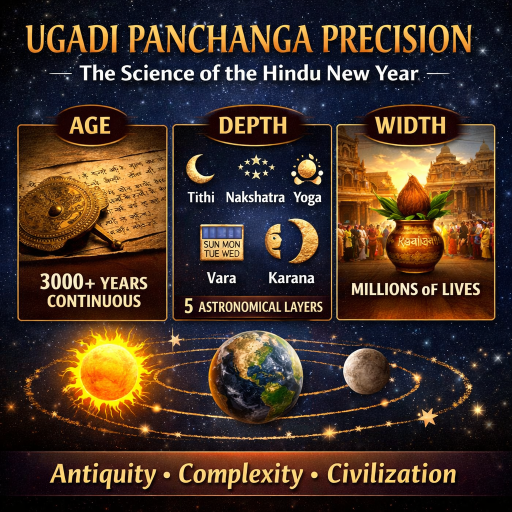
The word Panchanga means five limbs — Tithi (lunar day), Vara (weekday), Nakshatra (lunar mansion), Yoga (a luni-solar angular relationship), and Karana (half a tithi).
Every single day in the Hindu calendar is defined by the simultaneous position of five celestial variables. No other calendar system on Earth operates at this level of multi-parameter precision.
The Gregorian calendar tracks one variable: Earth’s revolution around the Sun. It ignores the Moon entirely, correcting for its drift only through the crude mechanism of a leap year every four years. Unlike the Gregorian system, the Hindu luni-solar calendar integrates both solar and lunar cycles simultaneously, producing a precision no single-parameter system can replicate. Our deep analysis of Hindu calendar scientific timekeeping establishes in detail why the luni-solar model is superior in precision to every modern Western equivalent.

Chaitra Pratipada: The Astronomical Anchor
Ugadi falls on Chaitra Shukla Pratipada — the first tithi of the waxing Moon that begins immediately after the new moon (Amavasya) when the Sun is in the Pisces (Meena) segment of the sidereal zodiac. In Panchanga terms, a tithi is defined by the angular separation between the Sun and Moon; Shukla Pratipada starts as this separation begins to increase from conjunction, marking the start of a new lunar cycle. This placement aligns the calendar with the seasonal transition of spring, which is why Ugadi occurs close to the vernal equinox, though it is not tied to the Sun’s ingress into Aries (Mesha Sankranti).
The Surya Siddhanta provides the mathematical basis for this calculation. Its mathematical tools include sine tables, planetary longitude calculations, and eclipse prediction algorithms — all of which feed into the Panchanga that determines Ugadi’s date each year. This is not tradition operating on faith. It is tradition operating on mathematics.
The Adhik Maas Correction: Precision That Gregorian Lacks
The intercalary month — Adhik Maas — is added approximately every 32.5 months. This is not an error being patched. It is a built-in correction mechanism that keeps the lunar calendar perpetually synchronised with the solar year to within minutes of accuracy over centuries.
The Gregorian calendar adds one day every four years to approximate a 365.25-day solar year. The Hindu Panchanga adds an entire month on a precisely calculated cycle to synchronise lunar months with solar seasons — a correction that is astronomically more sophisticated by an order of magnitude.
The foundational concepts of Vedic astronomy explain how Nakshatra-based sky mapping provided the observational data that made this correction possible. Aryabhata formalised much of this computational infrastructure in the 5th century CE — one of the most underappreciated scientific achievements in world history.
Ugadi Panchanga Sravanam: A Living Science Broadcast
On Ugadi, the Panchanga Sravanam — the public reading of the year’s almanac — takes place across temples and households in Andhra Pradesh, Telangana and Karnataka. The Panchanga Sravanam communicates the astronomical forecast for Shaka 1948: planetary positions, eclipse dates, solstices, equinoxes, rainfall predictions based on predictive models used in agrarian planning, and agricultural timing. It is a publicly broadcast scientific calendar derived from live celestial computation, verified today against live astronomical data on Drik Panchang and cross-referenced with NASA’s eclipse prediction database.
A Global Comparison: Age, Depth, and Civilizational Scope
The Panchanga system underlying Ugadi stands among the oldest continuously used astronomical frameworks in the world, with roots traceable to the Vedic period and later formalized in texts like the Surya Siddhanta. With over three millennia of uninterrupted development, it matches or exceeds the antiquity of other major calendar traditions such as the Chinese and Hebrew systems. This continuity reflects not just preservation, but the sustained application of astronomical knowledge across generations.
What distinguishes the Panchanga most decisively is its computational depth. Unlike other calendars that primarily track one or two celestial cycles, it integrates five simultaneously computed astronomical parameters — Tithi, Vara, Nakshatra, Yoga, and Karana — into daily timekeeping. This framework encodes lunar phases, solar motion, stellar positions, and angular relationships into a single system. While the Chinese and Hebrew calendars demonstrate strong luni-solar coordination and mathematical elegance, and the Persian calendar achieves exceptional solar precision, none combine as many real-time astronomical variables at the daily level with comparable granularity.
Equally significant is its civilizational breadth. The Panchanga is not confined to ritual observance but extends into agriculture, seasonal cycles, social organization, and astronomical computation, influencing the lives of hundreds of millions even today. In contrast, other systems tend to be either culturally widespread but simplified in practice, mathematically refined but narrower in application, or highly precise yet single-dimensional. Taken together — its antiquity, multi-parameter depth, and broad societal integration — the Panchanga stands out as one of the most sophisticated calendrical systems in continuous human use.

Ugadi Panchanga Precision: The Civilizational Proof
The Hindu calendar is not simply a way of tracking time — it is a continuous, unbroken demonstration of Hindu civilizational continuity in astronomical knowledge, from the Vedic period through the Surya Siddhanta to the live Drik Panchang computations of today. The astronomical genius encoded in Hindu temples is the architectural companion to this knowledge — the same calculations that produce the Panchanga are built into stone alignments at equinoxes and solstices across thousands of temple sites in Bharat.
The Gregorian new year falls on January 1st because Julius Caesar’s advisors chose a date associated with the Roman god Janus. Chaitra Shukla Pratipada falls when it falls because the Moon and Sun reach a calculable celestial position that has been observed, recorded, and computed for over five thousand years. Ugadi Panchanga Precision is not a matter of cultural assertion — it is a demonstrable outcome of a system that has combined antiquity, computational depth, and civilizational continuity at a level rarely matched in human history. Shaka Samvat 1948 Shubhakankshalu.
Feature Image: Click here to view the image.
Glossary of Terms
- Ugadi: The new year festival celebrated by Telugu, Kannada, and Marathi communities on Chaitra Shukla Pratipada — the first day of the Hindu lunisolar calendar month of Chaitra. The name derives from the Sanskrit Yuga (age/era) and Adi (beginning). Celebrated in Andhra Pradesh, Telangana, Karnataka, and Maharashtra. Coincides with Gudi Padwa, Cheti Chand, and Chaitra Navratri.
- Panchanga: Sanskrit compound meaning five limbs — Pancha (five) and Anga (limb). The Hindu almanac that defines each day by five simultaneously computed celestial parameters: Tithi, Vara, Nakshatra, Yoga, and Karana. Produced annually by trained astronomers and read publicly on Ugadi. The most multi-parameter daily calendar system in continuous use anywhere on Earth.
- Tithi: The lunar day in the Hindu calendar system. Defined not by clock time but by the angular separation between the Sun and Moon — each tithi covers 12 degrees of angular separation. A tithi can be shorter or longer than a solar day depending on the Moon’s velocity. There are 30 tithis in a lunar month — 15 in the waxing fortnight (Shukla Paksha) and 15 in the waning fortnight (Krishna Paksha).
- Vara: The weekday element of the Panchanga. The seven-day week in the Hindu system corresponds to the seven classical planets — Surya (Sun/Sunday), Soma (Moon/Monday), Mangala (Mars/Tuesday), Budha (Mercury/Wednesday), Guru (Jupiter/Thursday), Shukra (Venus/Friday), Shani (Saturn/Saturday). The Hindu week is among the oldest seven-day week systems in documented history.
- Nakshatra: One of the 27 (or 28) lunar mansions into which the Hindu system divides the sky. Each Nakshatra covers 13 degrees 20 minutes of the ecliptic. The Moon transits one Nakshatra approximately every 24 hours. The Nakshatra of the Moon at the time of an event determines its astrological and ritual significance in the Panchanga system.
- Yoga: The fifth element of the Panchanga. Calculated by adding the longitudes of the Sun and Moon and dividing by 13 degrees 20 minutes. Produces 27 Yogas named for their traditional significance. Distinct from the philosophical/physical practice of Yoga — in Panchanga usage it is a precise luni-solar angular computation.
- Karana: Half a Tithi — each tithi is divided into two Karanas. There are 11 types of Karana, four of which are fixed and seven of which recur in a defined cycle through the lunar month. Used in determining auspicious timing for specific activities.
- Chaitra Shukla Pratipada: The first tithi of the bright fortnight (Shukla Paksha) of the month of Chaitra in the Hindu lunisolar calendar. The astronomical new year marker. Occurs when the Moon begins waxing after Amavasya (new moon) while the Sun is in the Meena (Pisces) segment of the sidereal zodiac. The date of Ugadi, Gudi Padwa, and the start of Chaitra Navratri.
- Shaka Samvat: The Indian national calendar era. Begins in 78 CE — the year 2026 CE corresponds to Shaka Samvat 1947–1948. Adopted as India’s official civil calendar alongside the Gregorian calendar by the Government of India in 1957. Used in official communications, the Gazette of India, and All India Radio.
- Surya Siddhanta: The foundational Sanskrit astronomical treatise of the Hindu tradition. Estimated to have reached its current form between the 4th and 6th centuries CE, though it claims older origins. Contains sine tables, planetary longitude algorithms, eclipse prediction methods, and a calculation of the sidereal year accurate to within 3 minutes 26 seconds of modern atomic-clock values. The mathematical engine underlying the Panchanga.
- Adhik Maas: The intercalary — extra — month inserted into the Hindu lunisolar calendar approximately every 32.5 months to synchronise the lunar calendar with the solar year. Also called Purushottam Maas. The mechanism prevents the drift that accumulates in purely lunar calendars such as the Islamic Hijri. More astronomically sophisticated than the Gregorian leap day as it corrects for the full accumulated lunar-solar drift rather than a single fractional day.
- Panchanga Sravanam: The annual public reading of the Panchanga almanac conducted on Ugadi across temples and households in Andhra Pradesh, Telangana, and Karnataka. The Sravanam communicates the astronomical forecast for the incoming year — planetary positions, eclipse dates, solstices, equinoxes, and agricultural timing. The tradition transforms astronomical computation into public civic communication.
- Amavasya: The new moon day in the Hindu calendar — the fifteenth tithi of the waning fortnight (Krishna Paksha) when the Sun and Moon are in conjunction (zero angular separation). Chaitra Shukla Pratipada begins immediately after Amavasya when the Moon begins to wax. Amavasya is considered significant for ancestral rites (Pitru Tarpan) across Hindu traditions.
- Mesha Sankranti: The Sun’s ingress into the sidereal zodiac sign of Aries (Mesha). A solar new year marker in the Hindu tradition — used as the new year in Tamil (Puthandu), Bengali (Pohela Boishakh), and Kerala (Vishu) calendars. Distinct from Ugadi, which is determined by the lunar Chaitra Shukla Pratipada and occurs close to but not precisely at Mesha Sankranti.
- Aryabhata (476–550 CE): Indian mathematician and astronomer whose Aryabhatiya — composed in 499 CE — formalised computational methods for planetary motion, eclipses, and the length of the sidereal year. Proposed Earth’s rotation on its axis. His value for the length of the sidereal year — 365 days 6 hours 12 minutes 30 seconds — was more accurate than contemporary Greek or Roman calculations. The mathematical infrastructure he formalised underpins the Panchanga computation system.
- Gregorian Calendar: The solar calendar introduced by Pope Gregory XIII in 1582 as a reform of the Julian calendar. Tracks only Earth’s revolution around the Sun — 365 days with a leap day every four years (with century exceptions). Ignores the Moon entirely. The current international civil standard. Its new year on January 1 is historically arbitrary — chosen by Roman convention, not astronomical calculation.
- Drik Panchang: A modern computational platform that calculates Panchanga data — Tithi, Vara, Nakshatra, Yoga, Karana — in real time using precise astronomical algorithms for any date and location globally. Cross-referenced with NASA eclipse data and astronomical databases. Demonstrates that the Panchanga system is not historical artifact but live, verifiable, computationally active science.
- Luni-Solar Calendar: A calendar system that tracks both the lunar cycle (months defined by Moon phases) and the solar cycle (year defined by Earth’s revolution around the Sun) simultaneously, using intercalation mechanisms to keep them synchronised. The Hindu Panchanga is the most parameter-rich luni-solar calendar in continuous use. Other luni-solar systems include the Hebrew and Chinese calendars.
#UgadiPanchangaPrecision #HinduCalendarScience #ChaitraShuklaPratipada #ShakaKamvat #SuryaSiddhanta #AdhikMaas #HinduNewYear #PanchangaSravanam #LuniSolarCalendar #VedicAstronomy #HinduCivilizationalContinuity #Ugadi #Panchanga #Aryabhata #VedicScience #NotAMyth #HinduinfopediaVedic #HinduCivilization #Hinduinfopedia #Ugadi1948
Other Blogs on Festivals
- https://hinduinfopedia.in/ganesh-festival-in-vadodara-eggs-hurled-peace-tested/
- https://hinduinfopedia.in/hindu-festivals-and-fastings-the-essence-of-dharma/
- https://hinduinfopedia.org/festivals-of-lord-shiva-a-devotional-journey-i/
- https://hinduinfopedia.org/festivals-of-lord-shiv-a-devotional-journey-ii/
- https://hinduinfopedia.org/holi-2025-a-festival-of-colors-amid-social-tensions/
- https://hinduinfopedia.org/festivals-for-hindu-female-deities-a-journey-through-tradition/
- https://hinduinfopedia.org/festivals-and-celebrations-of-hindu-female-deities-a-journey-through-tradition-i/
- https://hinduinfopedia.org/vishnu-avatars-celebrating-five-divine-festivals/
- https://hinduinfopedia.org/avatars-in-revelry-exploring-the-spiritual-festivals-of-divine-forms/
- https://hinduinfopedia.org/pandharpur-palkhi-festival-a-journey-of-devotion-and-unity/
- https://hinduinfopedia.org/krishna-avatar-divine-festivals-of-joy-and-devotion-i/
- https://hinduinfopedia.org/krishna-avatar-divine-festivals-of-joy-and-devotion-ii/
- https://hinduinfopedia.org/radha-rani-celebrating-the-divine-festivals-of-love-and-devotion/
- https://hinduinfopedia.org/durga-festival-celebrations-of-divine-femininity-and-power/
- https://hinduinfopedia.org/festivals-of-triumphcelebrating-divine-victory-and-spiritual-renewal/
Follow us:
- English YouTube: https://www.youtube.com/@Hinduofficialstation
- Hindi YouTube: https://www.youtube.com/@HinduinfopediaIn
- X: https://x.com/HinduInfopedia
- Instagram: https://www.instagram.com/hinduinfopedia/
- Facebook: https://www.facebook.com/Hinduinfopediaofficial
- Threads: https://www.threads.com/@hinduinfopedia
Leave a Reply