

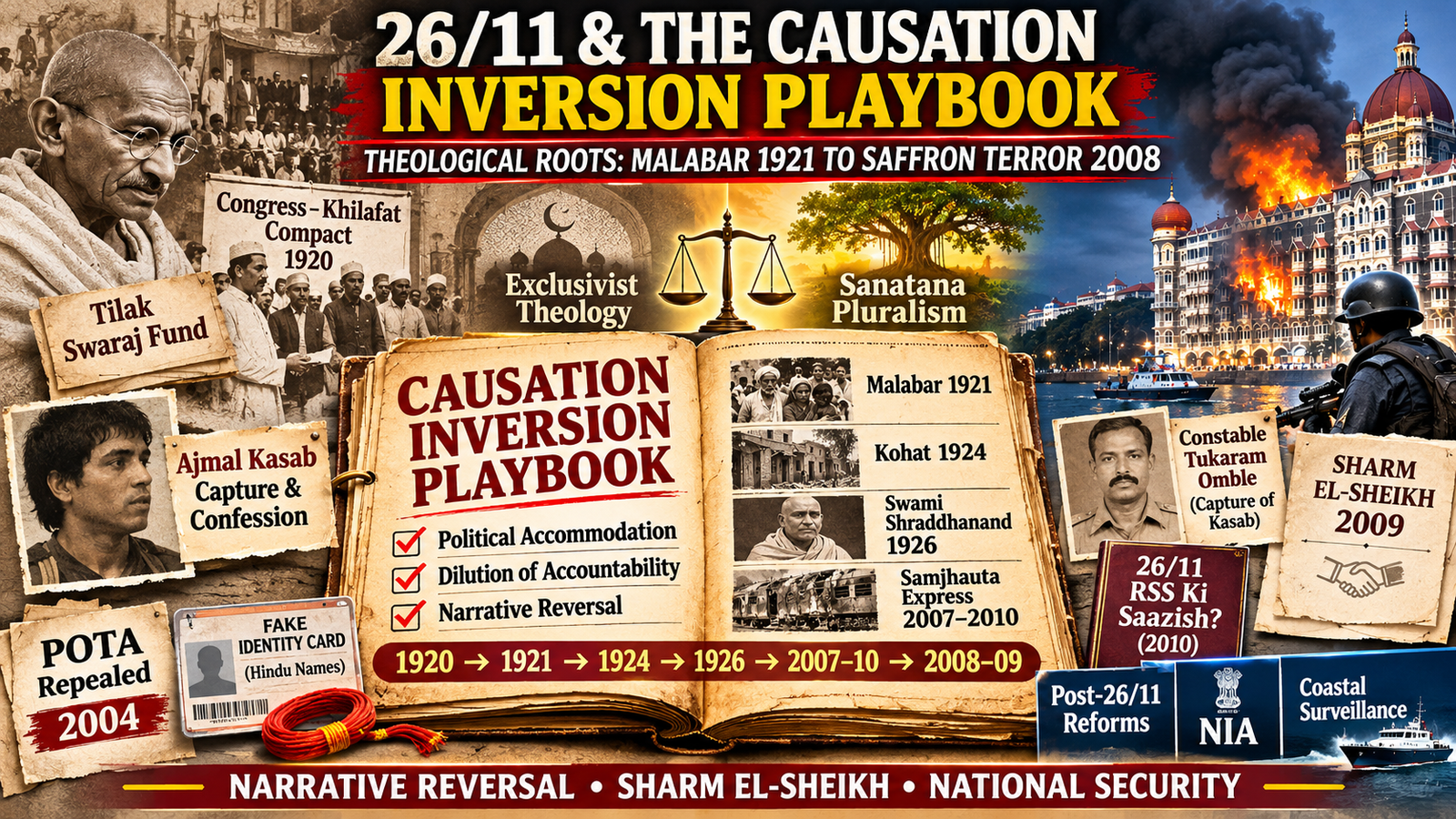
26/11 and the Causation Inversion Playbook: Theological Roots from Malabar 1921 to Saffron Terror 2008
Today marks 18 years since 26 November 2008, when ten Lashkar-e-Taiba (LeT) operatives trained in Pakistan landed by sea in Mumbai and attacked the Taj Mahal Palace, Oberoi Trident, Nariman House, and Chhatrapati Shivaji Terminus. More than 170 people were killed during the four-day siege. While the nation pays tribute to the victims and security forces on this anniversary, remembering 26/11 also requires confronting the ideological narrative that followed it. Ajmal Kasab’s live capture and subsequent confession established Pakistan’s state-backed involvement beyond reasonable doubt. Yet within months of the attack, prominent political voices and sections of the media deployed a familiar causation inversion playbook—attempting to link the assault to domestic Hindu organizations, most visibly at the 2010 launch of the book 26/11 RSS Ki Saazish? attended by senior Congress leader Digvijaya Singh.
The reflex that permitted lax coastal security, returned to diplomatic concessions at Sharm el-Sheikh less than eight months after the carnage, and inverted the narrative by floating “saffron terror” or “Hindu terror” framing was not invented in 2008. Nor was it merely a tactical electoral miscalculation. This causation inversion playbook is the political manifestation of a deeper theological asymmetry—one that sets exclusive scriptural brotherhood against civilizational pluralism, and which was institutionalized in Indian politics in 1920.
The Theological Asymmetry Driving the Causation Inversion Playbook
To understand why causation is repeatedly inverted after episodes of jihadist violence, one must examine the underlying theological frameworks rather than treating events as isolated law-and-order failures. As detailed in our coverage of Yogi Adityanath’s commentary on the Indian environment and its theological interpretation of Islam, political accommodations in India have consistently ignored how exclusivist religious doctrine operates when translated into public mobilization.
At the core of the conflict lie two incompatible conceptions of humanity and the sacred:
- Exclusivist Theology: Classical orthodox doctrine divides humanity into believers and non-believers (kafirs), treats brotherhood as an exclusive bond restricted to co-religionists, and denies the theological validity of other forms of worship. When violence is committed under this banner, orthodox institutional reflexes shield the doctrine itself from scrutiny.
- Sanatana Pluralism: India’s indigenous civilizational traditions affirm universal brotherhood (Vasudhaiva Kutumbakam) and recognize multiple valid paths to the divine. Lacking a doctrinal category of religious exclusivity or scriptural mandate against non-believers, Hindu society has no theological mechanism for holy war—yet it is precisely this tradition that gets branded with the “terror” label whenever political establishments seek false moral parity.
Our investigative essays in the HinduInfopedia Media Watch series—including Wall of Truth, The Palestine Vote, The Raktbeej, and The Ummah Delusion—document how this theological blind spot shapes modern media narratives, elevates transnational solidarity over national interest, and sustains the refusal to name ideological drivers accurately.
How the 1920 Compact Institutionalized the Causation Inversion Playbook
Primary records from the Khilafat era show how the Indian National Congress converted this theological asymmetry into a permanent political template. Between 1919 and 1920, Mahatma Gandhi placed Congress organization, the Tilak Swaraj Fund, and national political capital behind the pan-Islamic Khilafat movement—a mobilization rooted explicitly in extra-territorial Ummah solidarity rather than Indian territorial nationalism.
As Dr. B.R. Ambedkar later observed in Pakistan or the Partition of India, this compact lacked reciprocal commitments and effectively granted a veto to organized religious demands. What began as an anti-colonial alliance hardened into the modern causation inversion playbook, built on two simultaneous moves: exoneration of exclusivist aggression through external contextualization, and reversal of guilt onto the pluralistic majority.
1. Malabar, 1921: Shielding Religious Mobilization
During the Moplah rebellion in Malabar, thousands of Hindus were killed, forcibly converted, or driven from their homes in an uprising explicitly framed around Khilafat religious authority. Despite detailed contemporary accounts—including appeals from Annie Besant and survivor testimonies—the Congress session at Ahmedabad in December 1921 under Gandhi’s authority diluted wholesale condemnation of the perpetrators. The official resolution attributed the outbreak primarily to British repression and the exclusion of non-cooperation leaders, erasing the explicit theological motive behind the forced conversions and massacres.
2. Kohat, 1924: Equating Aggressor and Victim
In September 1924, anti-Hindu and anti-Sikh violence in Kohat (in the North-West Frontier Province) resulted in the mass expulsion of the city’s minority population. The crisis followed specific institutional and religious pressures assembled between 1920 and 1922: the Hijrat movement’s distress property sales, returning muhajirin, the 1921 Karachi Khilafat conference fatwa declaring police and army service haram, and targeted commercial boycotts. Yet the political response emphasized mutual “communal passion” on both sides, refusing to confront the doctrinal exclusivity driving the expulsion.
3. Swami Shraddhanand, 1926: Absolving the Assassin
On 23 December 1926, Abdul Rashid assassinated Swami Shraddhanand, the Arya Samaj leader active in the Shuddhi (reconversion) movement, while the Swami was recovering from illness in Delhi. Three days later at the Gauhati Congress, Gandhi referred to the killer as “Brother Abdul Rashid” and stated that he did not hold him guilty of the murder—placing blame instead on newspapers and public figures who had generated hostility. Ambedkar later documented the pattern of targeted assassinations against Hindus involved in Shuddhi. By absolving an act aimed directly at halting reconversion to Hinduism, political leadership cemented a core rule of the causation inversion playbook: exclusivist violence would be excused while Hindu self-preservation would be faulted.
4. Samjhauta Express and the “Saffron Terror” Pivot (2007–2010)
This pre-Partition reflex survived intact into independent India, resurfacing sharply during the Congress-led UPA government’s tenure. Following the February 2007 Samjhauta Express bombing that killed 68 people, initial investigative leads pointed toward Lashkar-e-Taiba and SIMI operatives. Over time, however, the official narrative pivoted toward alleging a “saffron terror” or “Hindu terror” network across cases including Samjhauta, Malegaon, and Ajmer.
Former Home Ministry officials, including former undersecretary R.V.S. Mani, subsequently alleged institutional pressure to construct a Hindu-terror narrative to manufacture equivalence with Islamist militancy. In 2019, a special NIA court acquitted the accused in the Samjhauta case for lack of admissible evidence. By introducing “saffron terror” into official vocabulary—explicitly articulated by Home Minister P. Chidambaram in 2010—the causation inversion playbook reached its modern form: shielding an ideology rooted in religious exclusivity from primary attribution while affixing the terror label to Sanatana Dharma.
26/11 and Sharm el-Sheikh: The Cost of Ideological Blindness
By November 2008, operating within this inherited political environment produced severe vulnerabilities in both national security and diplomacy. Repeated intelligence warnings regarding sea-borne infiltration routes circulated prior to the assault, yet coastal surveillance remained fragmented, compounded by the 2004 repeal of POTA and political caution against measures that could be portrayed as targeting a specific community.
Crucially, Lashkar-e-Taiba designed the 26/11 operation to exploit this exact theological and political fault line. The ten attackers carried fake Indian identity cards bearing Hindu names—such as Samir Dinesh Chaudhari—and wore sacred red threads (kalava) on their wrists. Had the terrorists been killed without a survivor, the operation was calibrated to trigger an immediate narrative blaming domestic Hindu extremists. Only the capture of Ajmal Kasab by Mumbai Police Constable Tukaram Omble prevented that deception from succeeding.
Yet even with Kasab’s confession in hand, the reflex of bilateral accommodation and narrative inversion persisted—most glaringly at the July 2009 Non-Aligned Movement summit in Sharm el-Sheikh, Egypt. Less than eight months after Mumbai was besieged, the India–Pakistan joint statement signed under Prime Minister Manmohan Singh delinked composite dialogue from Pakistan’s action against terrorism and inserted an explicit reference to Pakistani allegations regarding Balochistan. Allowing the state that launched 26/11 to place Indian conduct onto an official bilateral document while simultaneously amplifying domestic “saffron terror” theories diluted Pakistani culpability internationally while shifting ideological blame inward.
Dismantling the Causation Inversion Playbook
The 26/11 attacks forced critical institutional reforms, including the creation of the National Investigation Agency (NIA) and upgraded coastal surveillance, as examined in our reflection on November 26th’s impact on India’s path. Yet institutional upgrades alone cannot safeguard a nation if its political and media classes refuse to confront the theological drivers of exclusivist violence.
From Malabar in 1921 and Kohat in 1924 to the response to Swami Shraddhanand’s murder, the “saffron terror” fabrication, and the Sharm el-Sheikh joint statement, the causation inversion playbook has followed one consistent rule: protect exclusivist doctrine from accountability by indicting pluralistic Hindu society. On this 18th anniversary of 26/11, dismantling that narrative template remains as vital as securing India’s coastlines.
Related Posts
- Mumbai Attacks: Reflections on November 26th’s Impact on India’s Path
- Mumbai Terror Attacks 1993: Impact and Legacy
- Bombay Riots 1992: An Analysis
- Mumbai Terrorist Attack: Year 2000 to 2020
- Yogi Adityanath on the Indian Environment and Theological Interpretation of Islam
- HinduInfopedia Media Watch (Wall of Truth, The Palestine Vote, The Raktbeej, The Ummah Delusion)
Leave a Reply