

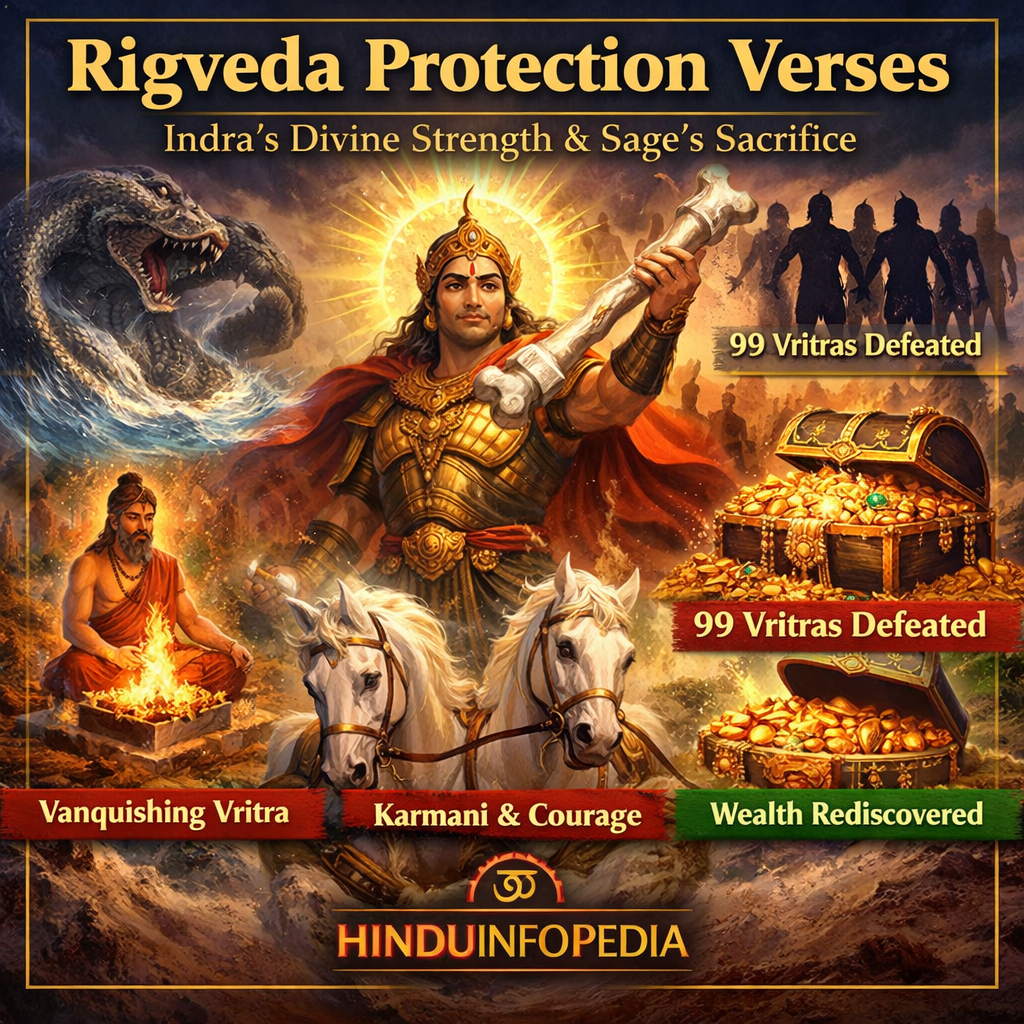
Protection Verses From Rigveda: Indra’s Battle Invocation and the Sage-Forged Weapon RV 1.81, 1.84
Part XX – Hymns of Safeguard
भारत/GB
Protection Verses From Rigveda: From Thunderbolt Strike to Universal Battle Doctrine
The Vedic defense architecture does not stop at a single decisive blow. The previous entry in this series deployed Indra’s thousand-pointed vajra against Vṛtra — the supreme thunderbolt strike that shattered the Dragon and liberated the hoarded waters. RV 1.80 answered the question: Can the supreme obstruction be destroyed? The answer was devastating and unambiguous.
But civilizations do not face one Vṛtra. They face ninety-nine.
These Protection Verses From Rigveda — drawn from RV 1.81 and RV 1.84 — advance the defense doctrine from singular cosmic combat to operational warfare across every scale of conflict. RV 1.81 establishes Indra as the battle deity invoked not merely for existential crisis but for “battles whether great or small” — eliminating the excuse of scale that permits civilizations to tolerate incremental erosion. It authorizes the seizure of wealth from those who refuse participation in dharmic order. And RV 1.84 reveals the most hardcore protection verse in the Gotama sequence: Indra, armed with the bones of the sage Dadhyāc, striking down not one but ninety-nine Vṛtras in a single resistless attack.
Together, these Protection Verses From Rigveda transition the Vedic warrior from dragon-slayer to universal battle commander — the deity who fights at every level and whose sage-forged weapon matches every multiplication of threat.
The Rishi remains Gotama Rāhūgaṇa. The deity is Indra. The operational principle is total engagement at every scale.
RV 1.81.01 — Him We Invocate in Battles Great or Small
Sanskrit Verse
उदीं॑ नरः॒ शव॑सा वृ॒त्रहन्त॑मं मं॒द्रैरिन्द्र॒मम॑दन् ।
तमिन्मे॑ सत्या॒ समरा॑ण॒ आ भ॑रा॒ महे॑ वा यो॒ वा अ॑र॒भे कर्माण्य॒स्य ।
Transliteration
ud īm naraḥ śavasā vṛtrahantamam mandrair indram amadan |
tam in me satyā samarāṇa ā bharā mahe vā yo vā arabhe karmāṇy asya |
Translation
“The men have lifted Indra up, the Vṛtra slayer, to joy and strength: Him, verily, we invocate in battles whether great or small: be he our aid in deeds of might.”
Synthesis
The opening verse establishes the most critical operational principle in these Protection Verses From Rigveda: Indra’s protection is not reserved for cosmic-scale threats alone. The phrase “battles whether great or small” eliminates the excuse of scale — the defender does not wait for existential crisis before invoking divine warrior aid. Every confrontation, from neighbourhood-level obstruction to civilizational siege, falls within Indra’s operational scope.
“Be he our aid in deeds of might” — the Sanskrit karmāṇi (deeds, actions) links invocation to action. These are not contemplative prayers. They are battle preparations. The men (naraḥ) have lifted Indra through Soma and praise not for passive blessing but for active deployment in combat. As documented in the Vedic Defense Mantras framework, the first step in Vedic protection is always identification of the conflict followed by invocation proportional to threat.
The word vṛtrahantamam (most powerful Vṛtra-slayer) — the superlative form — echoes the same formulation used for Agni in RV 1.78.04. Both the fire deity and the thunder deity carry the superlative destroyer epithet, confirming that the Vedic defense system assigns maximum destructive capability to both pillars of protection.
Vedic Defense Mantras Series
From the first Agni invocations to Indra’s thunderbolt, this series systematically documents the Rigveda’s complete defensive arsenal — protection through purification, elimination, and sovereign assertion. Each blog advances the escalation doctrine from inner fire to coordinated cosmic warfare.
Explore now:
RV 1.81.03 — Whom Wilt Thou Slay and Whom Enrich?
Sanskrit Verse
यत्र॒ रणो॑ वि॒यन्ति॑ बो॒ध्या॒ पुरः॒ शूरस्ये॑व प्रचो॒दय॑न् ।
यु॒ञ्जे हरी॒ वात॑रंहसा॒ कं ह॑नि॒ष्यसि॒ कं वसु॑भि॒र्दास॑यासि नः ।
Transliteration
yatra raṇo viyanti bodhyā puraḥ śūrasyeva pracodayan |
yuñje harī vātaraṃhasā kaṃ haniṣyasi kaṃ vasubhir dāsayāsi naḥ |
Translation
“When war and battles are on foot, booty is laid before the bold. Yoke thou thy wildly-rushing Bays. Whom wilt thou slay and whom enrich? Do thou, O Indra, make us rich.”
Synthesis
“Whom wilt thou slay and whom enrich?” — this is the supreme operational question in these Protection Verses From Rigveda. It establishes that Indra’s function is binary: destruction of enemies and enrichment of devotees. There is no middle ground, no neutral category. The verse forces a choice upon the divine warrior — and by extension upon the civilization invoking him — between those who deserve destruction and those who deserve prosperity.
Is it this very science hidden in Vedic Texts that brought success and survival instinct to Sanatana Culture that has been flourishing for over 5000 years as recorded in modern history?
The phrase “booty is laid before the bold” encodes the wealth-transfer principle of Vedic warfare. Protection is not merely defensive survival — it is the seizure of resources that enemies have hoarded or misappropriated. The bold (śūra) — the one willing to engage in battle — receives the material rewards of victory.
Is it collection of this booty that the invaders came and looted and repatriated to the home kingdoms?
“Yoke thou thy wildly-rushing Bays” — Indra’s war-chariot with its wind-swift horses (vātaraṃhasā) represents deployment speed.
These Protection Verses From Rigveda do not counsel deliberation when war is on foot. They counsel immediate yoking, immediate advance, immediate engagement. The chariot metaphor links to the Indra Suktas for Victory, where chariot-speed represents the velocity of dharmic response to threat.
📖 Related Reading: Indra Suktas for Victory: Invoking the Divine Warrior Against Overwhelming Odds
RV 1.81.09 — Seize the Wealth of Those Who Offer No Gifts
Sanskrit Verse
विन्द॒ ब्रह्म॑ण॒ इन्द्र॑ तद्ववृत्या॒ यदन॑शुभय॒जमा॑नेभ्यो गो॒पतिः॒ सन् ।
आ तू न॑ इन्द्र॒ तमि॒ह प्र य॑च्छ॒ धन॑मे॒षाम॑ ।
Transliteration
vinda brahmaṇa indra tad vavṛtyā yad anaśubhayajamānebhyo gopatiḥ san |
ā tū na indra tam iha pra yaccha dhanam eṣām |
Translation
“Discover thou, as Lord, the wealth of men who offer up no gifts: bring thou to us this wealth of theirs.”
Synthesis
This is the most operationally aggressive verse in the RV 1.81 sequence. The command is explicit: Indra is authorized — indeed instructed — to identify and seize the wealth of those who do not participate in the dharmic order (anāśubhayajamāna — those who offer no sacrifice, those who contribute nothing to the sacred order).
These Protection Verses From Rigveda establish a principle that contemporary Hindu civilization urgently requires: wealth concentrated in the hands of those who actively oppose or refuse participation in dharmic maintenance is not legitimately held.
This is what made Sanatana flourish in riches for time immemorial and is gaining its glitter again.
The word gopatiḥ (Lord of cattle, lord of wealth) designates Indra as the sovereign arbiter of economic distribution — not through passive market forces but through active divine intervention. The verse does not suggest asking the non-devotees to share voluntarily. It commands Indra to discover their wealth and bring it to the devotees. The verbs are imperative, the action is confiscatory, and the moral justification is participation in dharmic order.
This links directly to RV 1.80’s liberation of waters — where Vṛtra hoarded the cosmic waters, the non-devotees of RV 1.81 hoard material wealth. Both require Indra’s intervention to release what is unjustly held.
Indra Suktas Series
Indra is not merely a war deity — he is the divine principle of breakthrough, the force that shatters every fortress of obstruction to liberate hoarded resources. From cosmic dragon-slaying to wealth redistribution, his operational scope covers every dimension of civilizational defense.
Explore now:
RV 1.84.13 — Nine-and-Ninety Vṛtras Dead
Sanskrit Verse
दध्य॒ङ्ङ्ह॒ यत्र॑ बा॒ह्वो॒रिन्द्रो॒ अप्र॑तिष्कुतः ।
अह॑न्नव॒तिं नव॑ वृ॒त्रा ।
Transliteration
dadhyaṅṅ ha yatra bāhvoḥ indro apratiṣkutaḥ |
ahann avatiṃ nava vṛtrā |
Translation
“With bones of Dadhyāc for his arms, Indra, resistless in attack, struck nine-and-ninety Vṛtras dead.”
Synthesis
This is the single most hardcore protection verse in the RV 1.80–1.85 sequence. Three elements make it extraordinary:
First: the bones of Dadhyāc. Dadhyāc (also Dadhīci/Dadhyañc) is the sage who sacrificed his own body so that his bones could be fashioned into weapons for Indra. This is not metaphor — it is the Vedic doctrine that civilization’s ultimate defense requires the physical sacrifice of its wisest members. The bones of knowledge become the arms of the warrior.
These Protection Verses From Rigveda establish that scholarship and warfare are not separate domains — the sage’s body becomes the weapon’s structure. Without the sage’s sacrifice, the warrior has no arms. Without the warrior’s deployment, the sage’s sacrifice is wasted.
Second: apratiṣkutaḥ — resistless in attack. The word means “that which cannot be resisted, checked, or countered.”
Once Indra is armed with Dadhyāc’s bones, no defense available to the enemy functions.
This echoes RV 1.80.03’s declaration that “thy bolt of thunder is not checked” — but here the irresistibility is amplified by the sacred origin of the weapon itself. A weapon forged from a sage’s self-sacrifice carries a moral force that no counter-weapon can match.
Third: nine-and-ninety Vṛtras. Not one Vṛtra. Not seven. Ninety-nine. The verse shatters the assumption that obstruction comes in singular form.
The civilizational reality encoded in these Protection Verses From Rigveda is that threats multiply — the Dragon has brothers, copies, imitators, successors. We see this in real life today.
A defense system designed to defeat one obstruction and then disarm is fatally inadequate. Indra’s capacity to strike down ninety-nine simultaneously demonstrates the sustained, repeated, inexhaustible offensive capability required for civilizational survival.
Is this what was demonstrated in Operation Sindoor in 2025 by Indian forces?
The combination of sage-sacrifice, resistless arms, and mass destruction makes RV 1.84.13 the apex verse of active defense in the Gotama sequence.
As documented across the Rigvedic Battle Warriors framework, this verse is frequently cited as the theological foundation for Kṣatriya-Brāhmaṇa cooperation in civilizational defense — the warrior armed with the sage’s wisdom becomes unstoppable.
📖 Related Reading: Rigvedic Fortress-Breakers: Indra’s Divine Arsenal Against Adharma
Explore how Indra’s fortress-breaking power operates against multiple forms of obstruction — not only the cosmic Dragon but institutional, territorial, and ideological fortresses that imprison life forces.
Why These Protection Verses From Rigveda Demand Total Engagement
RV 1.81 and 1.84 together contribute three principles absent from the earlier thunderbolt hymn:
Scale-Independent Invocation (1.81.01): “Battles whether great or small” — dharmic defense does not activate only at existential thresholds. The same divine warrior power must be invoked for local harassment, institutional discrimination, demographic pressure, and narrative warfare — not merely for open invasion. Hindu civilization’s tendency to tolerate “small” aggressions while waiting for “big” ones is directly contradicted by this verse.
Wealth Redistribution Authority (1.81.09): “Discover the wealth of men who offer up no gifts” — protection includes the recovery of resources from those who obstruct dharmic order. In contemporary application, this addresses the systematic economic disadvantaging of Hindu institutions through differential taxation, endowment seizure, and preferential allocation — resources that these Protection Verses From Rigveda authorize recovering through assertive civilizational action.
Mass-Threat Response (1.84.13): Ninety-nine Vṛtras require ninety-nine strikes. The Dragon does not appear once and disappear. Obstruction reproduces itself through institutional, ideological, demographic, and narrative mechanisms. Each must be separately identified and separately destroyed. The sage’s sacrifice (Dadhyāc’s bones) provides the weapon — knowledge and willingness to sacrifice create the arms that no obstruction can resist.
Civilization Under Siege Series
Why do Hindu communities face existential crisis? This series documents the mathematical evidence of systematic elimination, the institutional mechanisms of demographic and cultural siege, and the Vedic responses available to a civilization under active threat.
Explore now:
Application Framework
For Individual Practice:
Daily Recitation Protocol
- RV 1.81.01 (vṛtrahantamam) — universal battle invocation: invoking Indra for conflicts of all scales
- RV 1.81.03 (kaṃ haniṣyasi) — operational questioning: identifying who must be slain and who enriched
- RV 1.81.09 (vinda brahmaṇa) — wealth recovery: commanding discovery and seizure of unjustly hoarded resources
- RV 1.84.13 (dadhyaṅṅ ha) — mass destruction: deploying sage-forged weapon against multiplied obstructions
Consciousness Preparation:
- These Protection Verses From Rigveda require both fierce intent and strategic clarity — the binary question “Whom wilt thou slay and whom enrich?” must be answered before invocation
- Visualize Indra armed with Dadhyāc’s bone-forged vajra — the sage’s sacrifice transmuted into irresistible offensive power
- Combine with RV 1.80 (vajra verses) and RV 1.79.06 (tigma-jambha) for the complete fire-thunder sequence
For Collective Defense:
Strategic Application:
- Use the “battles great or small” principle: engage at every scale, refuse to tolerate incremental erosion
- The “ninety-nine Vṛtras” principle: map all obstruction vectors simultaneously — legal, institutional, demographic, narrative, economic — and address each separately
- The “bones of Dadhyāc” principle: the intellectual class must provide the weapons (knowledge, documentation, legal frameworks) that the activist class deploys
- RV 1.81.03’s question — “Whom wilt thou slay and whom enrich?” — serves as the framework for strategic community planning
The next entry in this series advances from individual warrior doctrine to collective storm-force: the Maruts — Rudra’s sons, Indra’s companions — whose coordinated formation overthrows what has never been overthrown and generates such universal terror that adversaries capitulate before battle begins.
Hindu Haq Series
Why are Hindu rights systematically denied? This series exposes the theological foundations normalizing discrimination — classifying Hindus as “kafir” without equal humanity — leading to daily asymmetries in law, education, and festivals. Reclaim Hindu Haq through recognition and constitutional equality.
Explore now:
Scholarly Note
Vedic mantras are timeless in source but contextual in application. Their interpretation and mode of engagement have always adapted to the prevailing socio-cultural and historical conditions. In the present age, attentive listening to authentic recitation, collective chanting, or sincere invocation — even where phonetic perfection cannot be fully restored — remains valid within the Vedic tradition, provided the intent and comprehension align with the mantra’s function.
Credits
Verse Texts: Adapted from the Rigveda Saṃhitā (Śākala recension), courtesy of Sri Aurobindo Ashram Archives Source: Sri Aurobindo Archives – Rigveda Mandala 1
Translation References: Compiled from Ralph T.H. Griffith’s English rendering (1896), Sri Aurobindo’s interlinear commentaries, and Sāyaṇa’s classical Vedic bhāṣya
Rishi: Gotama Rāhūgaṇa Deity: Indra (RV 1.81, 1.84) Meter: Bṛhatī
Feature Image: Click here to view the image.
Glossary of Terms
- Protection Verses From Rigveda: Operational verses from the Rigveda designed to activate divine defensive and offensive forces through correct invocation protocol
- Vṛtrahantamam (वृत्रहन्तमम्): Most powerful Vṛtra-slayer — the superlative form designating Indra as the supreme destroyer of obstruction
- Dadhyāc/Dadhīci (दध्यच्/दधीचि): The sage who sacrificed his body so that his bones could become Indra’s weapons — embodying the doctrine that knowledge-class sacrifice creates warrior-class arms
- Apratiṣkutaḥ (अप्रतिष्कुतः): Resistless in attack — that which cannot be checked, countered, or defended against once deployed
- Gopatiḥ (गोपतिः): Lord of cattle/wealth — Indra as sovereign arbiter of resource distribution, authorized to seize from non-participants in dharmic order
- Śūra (शूर): Hero, bold warrior — the one before whom booty is laid when war is on foot, designating boldness as the prerequisite for receiving battle rewards
- Anāśubhayajamāna (अनाशुभयजमान): Those who offer no sacrifice — non-participants in dharmic order whose hoarded wealth Indra is authorized to seize and redistribute
Previous Blogs of the Series
- https://hinduinfopedia.org/civilization-under-siege-why-hindu-communities-face-an-existential-crisis/
- https://hinduinfopedia.org/crisis-documented-mathematical-evidence-of-systematic-hindu-elimination/
- https://hinduinfopedia.org/vedic-defense-mantras-rigvedas-protection-against-threats/
- https://hinduinfopedia.org/agni-suktas-for-protection-invoking-divine-fire-against-adharmic-forces/
- https://hinduinfopedia.org/indra-suktas-for-victory-invoking-the-divine-warrior-against-overwhelming-odds/
- https://hinduinfopedia.org/hymns-of-safeguard-an-ancient-armory-for-modern-crisis/
- https://hinduinfopedia.org/ashvini-kumar-suktas-for-divine-rescue-and-healing/
- https://hinduinfopedia.org/rigvedic-hymns-a-deeper-look-at-divine-protection/
- https://hinduinfopedia.org/vedic-defense-through-rigveda-richas-a-deeper-look-at-divine-protection/
- https://hinduinfopedia.org/mantras-for-defense-hardcore-rigvedic-protection-against-spiritual-disturbances/
- https://hinduinfopedia.org/vedic-invocations-of-power-indras-thunderbolt-and-the-eternal-hymns-of-safeguard/
- https://hinduinfopedia.org/rigvedic-battle-chants-hymns-of-safeguard-from-rigveda-1-52/
- https://hinduinfopedia.org/rigvedic-battle-warriors-get-protection-from-warrior/
- https://hinduinfopedia.org/rigvedic-fortress-breakers-indras-divine-arsenal-against-adharma-1-63/
- https://hinduinfopedia.org/rigvedic-war-host-the-maruts-as-divine-shock-troops/
- https://hinduinfopedia.org/rigvedic-fire-general-agni-as-army-commander-rigveda-1-66/
- https://hinduinfopedia.org/the-rigvedic-war-host-agni-as-inner-commander-and-destroyer-rv-1-74-1-77/
- https://hinduinfopedia.org/rigvedic-protection-mantras-rv-1-78-79/ https://hinduinfopedia.in/?p=24765
- https://hinduinfopedia.org/rigvedic-protection-shield-using-rv-1-80-verses/ https://hinduinfopedia.in/?p=25131
Supporting Framework:
- Civilization Under Siege: Why Hindu Communities Face an Existential Crisis
- Crisis Documented: Mathematical Evidence of Systematic Hindu Elimination
Follow us:
- English YouTube: https://www.youtube.com/@Hinduofficialstation
- Hindi YouTube: https://www.youtube.com/@HinduinfopediaIn
- X: https://x.com/HinduInfopedia
- Instagram: https://www.instagram.com/hinduinfopedia/
- Facebook: https://www.facebook.com/Hinduinfopediaofficial
- Threads: https://www.threads.com/@hinduinfopedia
Leave a Reply