

Ram Navami Astronomy: Valmiki’s Sky Map Decoded
Table of Contents
ToggleRam Navami Astronomy: Precise Description of Time by Shri Valmiki
Ram Navami is not merely revered as an auspicious day in the Hindu calendar; it also presents a direct link between Sanatana texts and cosmology. This connection is clearly reflected in Ram Navami Astronomy, which represents a unique intersection of observation, recording, and lived tradition within Sanatana Dharma. It reflects a knowledge system where internal seeking and external observation move together, producing structured understanding that extends from individual awareness to cosmic order. The same framework that refines human conduct also records celestial patterns with precision.
This is not treated as isolated symbolism but as part of a broader continuity where experience, observation, and recording operate together as presented in Ugadi Panchanga Precision: Not a Myth. The description of Rama’s birth in the Valmiki Ramayana stands within this continuum, linking inner realization with observable cosmic alignment.
Internal Realization as Foundation
Sanatana Dharma begins with direct inquiry into one’s own thoughts, behavior, and actions. This process is not theoretical. It is practiced and verified in daily life. As awareness expands, the individual learns to create harmony within family and surroundings, gradually extending this understanding outward.
This expansion is not merely social. It extends to nature, seasons, and the movement of celestial bodies. Observation becomes a natural extension of awareness. The same discipline that refines conduct also refines perception, allowing patterns in the environment and sky to be recognized and recorded.
Over time, this produces structured knowledge systems. These systems are not separated from life but emerge from repeated observation, alignment, and continuity across generations. This continuity is reflected in the cultural history of Sanatana Dharma, where knowledge is preserved through both practice and tradition.
The Divine Birth in Cosmic Context
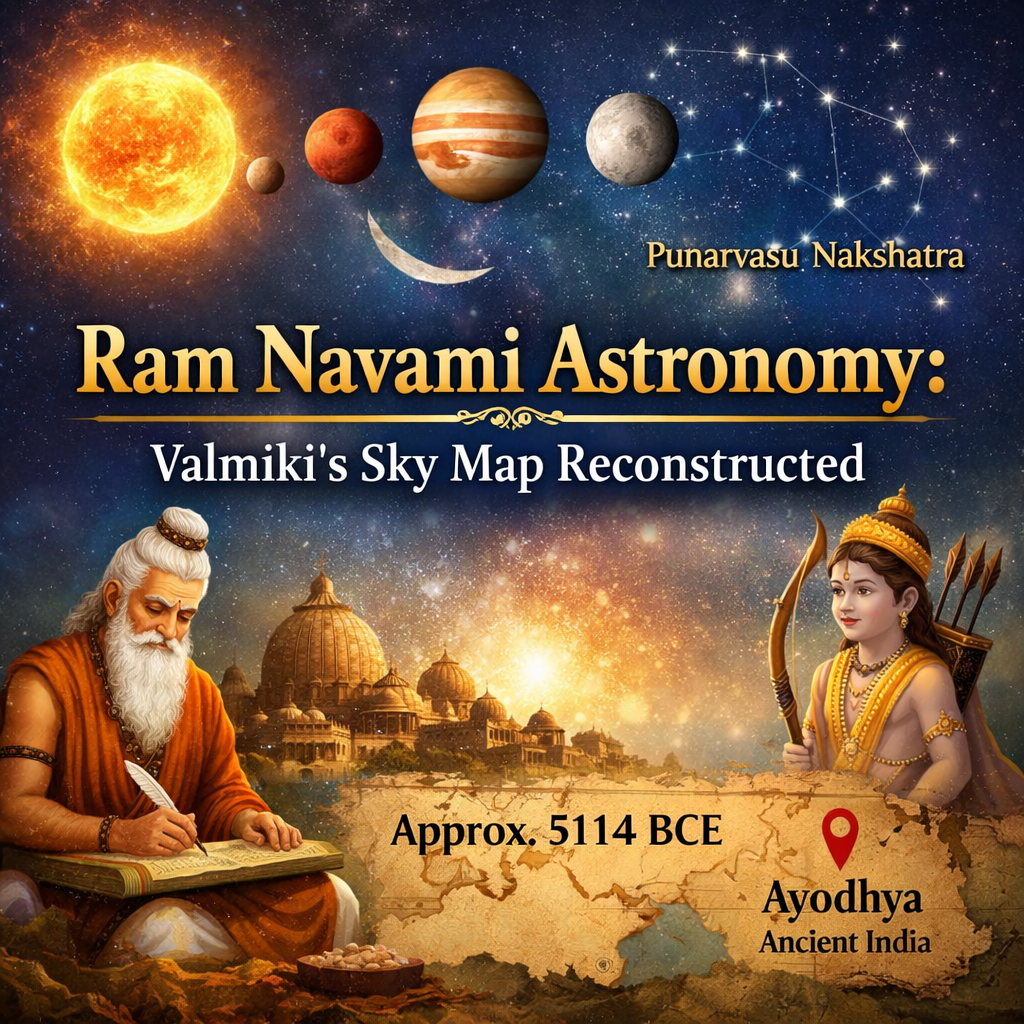
Within this framework, the birth of Rama is described with specific astronomical detail. The Valmiki Ramayana records that this event occurred on Chaitra Shukla Navami, during Madhyahna, under Punarvasu nakshatra.
The text further describes a precise planetary configuration:
the Sun in Aries, Mars in Capricorn, Jupiter in Cancer, Venus in Pisces, and Saturn in Libra. Jupiter is placed in conjunction with the Moon in Cancer lagna.
This is not a general narrative description. It is a structured celestial snapshot.
Modern computational tools can take these parameters and reconstruct the sky for ancient timeframes. Based on such reconstructions, dates such as approximately five thousand one hundred fourteen BCE have been proposed, using coordinates corresponding to Ayodhya.
For the devotee, this alignment is not only astronomical. It also represents the appearance of Maryada Purushottama, where dharma is expressed through conduct, discipline, and balance. Rituals such as nama japa, abhishekam, and collective remembrance serve as supports that align inner practice with this ideal.
Panchanga: Preserving Sacred Time
The same principles visible in this recorded alignment continue in the Panchanga system. Panchanga integrates lunar and solar cycles through five components: tithi, vaara, nakshatra, yoga, and karana.
Rather than imposing rigid adjustments, it maintains alignment through natural synchronization such as adhika masa. This ensures continuity with celestial rhythms without breaking the flow of time.
This system is not limited to calculation. It represents continuity of observation. The same patterns described in ancient texts are tracked and applied in present practice. Ram Navami observance each year follows this framework, linking past recording with present experience.
Towards Vasudhaiva Kutumbakam Consciousness
As the sphere of “me” expands through internal practice, narrow distinctions of “mine” and “not mine” begin to dissolve. The Maha Upanishad captures this realization in the profound vision of Vasudhaiva Kutumbakam — the world as one family.
This is not mere philosophy. It arises directly from disciplined inner observation and lived practice. As the sense of separation diminishes, actions naturally reflect balance, restraint, and responsibility toward the larger “me.”
The life of Rama perfectly embodies this alignment. As Maryada Purushottama, he performs duty with unwavering steadiness across all circumstances — offering a living example of how personal conduct integrates with the wider cosmic order.
Celebrating with Depth
Ram Navami celebrations include temple gatherings, recitations, and processions. These are not ends in themselves. They function as supports for remembrance and alignment.
The astronomical description associated with this day adds another dimension. It connects celebration with observation. It reminds that the same system that guides ritual also records celestial patterns.
This integration brings together devotion, observation, and continuity. It allows practice to move beyond repetition into understanding.
On this Ram Navami, the focus can extend from external observance to internal alignment. Observing the sky, reflecting on conduct, and practicing discipline all become part of the same process.
Ram Navami Astronomy thus stands as a point where recorded celestial configuration, living calendar systems, and devotional practice intersect—forming a continuous framework that remains active across time.
Feature Image: Click here to view the image.
Glossary of Terms
- Ram Navami Astronomy: The study of celestial configurations described in the Valmiki Ramayana related to the birth of Rama and their reconstruction through modern tools.
- Sanatana Dharma: An ancient Indian knowledge tradition based on lived practice, observation, and continuity, often referred to as the eternal way.
- Panchanga: A traditional Indian luni-solar calendar system that tracks five elements—tithi, vaara, nakshatra, yoga, and karana—for timekeeping.
- Chaitra Shukla Navami: The ninth day of the bright lunar phase in the month of Chaitra, observed as the birth day of Rama.
- Madhyahna Muhurat: The midday time window considered significant for rituals and observances in Hindu tradition.
- Punarvasu Nakshatra: A lunar constellation under which Rama’s birth is described in the Ramayana, associated with the deity Aditi.
- Uccha (Exaltation): A positional state where a planet is considered strongest within a specific zodiac sign in Indian astronomy.
- Lagna (Ascendant): The zodiac sign rising on the eastern horizon at a given time and place, used to define a celestial chart.
- Celestial Configuration: The specific arrangement of planets and stars at a particular moment in time.
- Cosmic Snapshot: A recorded description of a precise celestial arrangement that can be reconstructed using astronomical methods.
- Adhika Masa: An additional lunar month inserted in the Panchanga to maintain alignment between lunar and solar cycles.
- Maryada Purushottama: A title of Rama representing the ideal of disciplined conduct within defined boundaries.
- Nama Japa: The practice of repetitive chanting of a divine name as part of spiritual discipline.
- Abhishekam: A ritual practice involving ceremonial bathing of a deity’s idol with sacred substances.
- Vasudhaiva Kutumbakam: A concept from the Maha Upanishad expressing the idea that the entire world is one family.
#RamNavami #Astronomy #Ramayana #Valmiki #Panchanga #Ayodhya #Vedic #Dharma #Cosmos #HinduinfoPedia
Related Blogs of Navami And Shri Rama
Related Blogs of “Not a Myth” Series
Not a Myth Series: A Living Archive of Sanatana Knowledge Systems
Follow us:
- English YouTube: https://www.youtube.com/@Hinduofficialstation
- Hindi YouTube: https://www.youtube.com/@HinduinfopediaIn
- X: https://x.com/HinduInfopedia
- Instagram: https://www.instagram.com/hinduinfopedia/
- Facebook: https://www.facebook.com/Hinduinfopediaofficial
- Threads: https://www.threads.com/@hinduinfopedia
Leave a Reply