

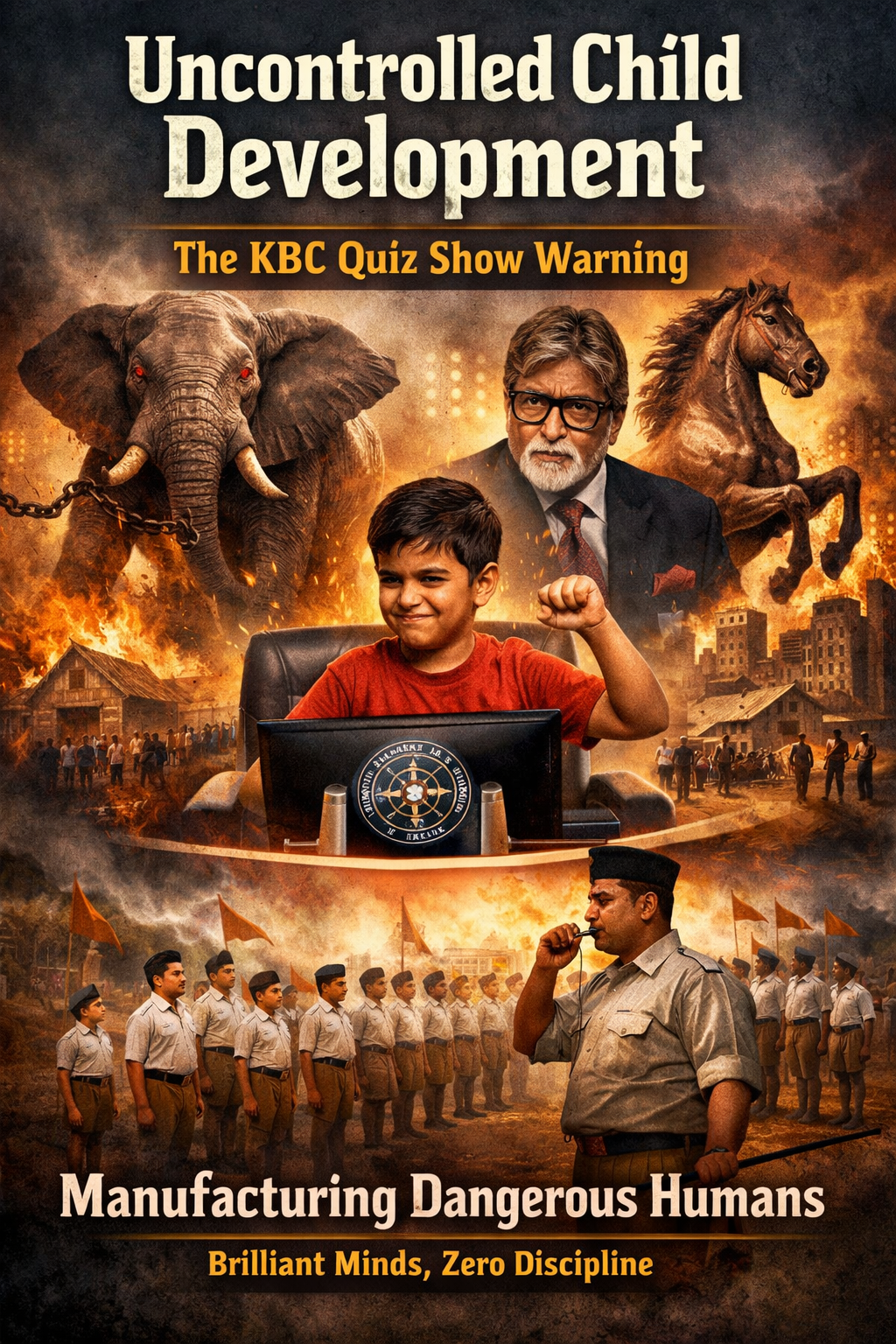
Uncontrolled Child Development: The KBC Quiz Show Warning
Part 6: Building Without Plumb and Line
भारत/BG
KBC Quiz Demonstrating Uncontrolled Child Development
Uncontrolled Child Development that modern society refuses to acknowledge: we’re manufacturing dangerous humans. Not criminals. Not psychopaths. Ordinary, intelligent, well-educated individuals who lack the most basic character control. They’re the viral quiz show child who disrespects Amitabh Bachchan. The brilliant college graduate who can’t handle constructive criticism. The young professional who considers every boundary as oppression. And society celebrates them as “confident” and “empowered” while civilization quietly crumbles.
We’ve spent five articles documenting the human manufacturing crisis – the lost art of forging character through discipline and authority. We’ve examined how the guru became a mere teacher, how societies lost their moral plumb bob, how hierarchy collapsed into chaos, and how RSS preserved the master craftsman model when everyone else abandoned it.
But here’s Uncontrolled Child Development that makes this crisis urgent rather than merely academic: uncontrolled humans aren’t just incomplete – they’re actively dangerous. To themselves, to others, and to civilization itself. Just as an uncontrolled elephant tramples villages and an uncontrolled horse bolts into traffic, an uncontrolled human becomes a weapon aimed at social coherence.
The Robb Elementary School shooter was an 18-year-old—legally an adult, educated within modern systems, and not clinically insane—who murdered 19 children and two teachers. This was not a failure of intelligence or access to information, but the catastrophic end-product of a system that produces individuals with capability but without restraint, impulse control, reverence for life, or submission to any moral authority beyond the self.
Because until we acknowledge the danger, we’ll never muster the will to restore the discipline, authority, and pressure required to properly shape humans.
The Elephant Trainer’s Ancient Wisdom: Control is Compassion
Walk through the elephant camps of Kerala or Rajasthan, and you’ll witness something that horrifies modern sensibilities: the mahout (elephant trainer) using an ankush (spear) – a sharp goad – to control these magnificent creatures. Animal rights activists call it cruelty. Social media erupts with outrage. Western tourists demand it be banned.
But ask any mahout who’s worked with elephants for decades, drawing on traditional Indian knowledge systems, and you’ll learn a different truth: the ankush saves lives. Not just human lives – the elephant’s life too.
The Mahout’s Ankush Paradox reveals what modern society denies:
An uncontrolled elephant:
- Kills people during musth (temporary madness)
- Destroys property worth millions
- Cannot be used for productive work
- Eventually must be isolated or destroyed
- Suffers itself from lack of purpose and connection
The ankush appears cruel in the moment of application—a sharp prod causing immediate discomfort. But the alternative is far worse: an elephant that runs wild, injures itself, tramples villages, and is ultimately shot when it becomes unmanageable. The ankush does not exist to torture the elephant; it exists to teach obedience, establish hierarchy, and prevent neglect from turning into catastrophe.
Science confirms that elephants possess high intelligence, emotional memory, and social awareness—yet intelligence alone does not make them safe or functional. The ankush works precisely because intelligence without restraint is not wisdom. Short-term, controlled pain prevents long-term disaster. The mahout who refuses to apply discipline out of misplaced compassion condemns the elephant to a far crueler fate. This is Uncontrolled Child Development that modern activists miss: control, exercised with skill and purpose, is the highest form of compassion.
The mahout understands principles that ancient Indian systems codified:
- Never punish in anger (the ankush applies pressure, not rage)
- Never punish without explanation (the elephant learns cause-effect)
- Reward immediately, correct immediately (timing is everything)
- Consistency builds trust (arbitrary punishment breeds resentment)
- The tool prevents greater harm (the goad hurts less than the bullet that follows unchecked rampage)
Compare this to modern parenting, examined through the lens of institutional capture. Every correction is trauma. Every boundary is abuse. Every firm word requires apology. The predictable result? Children who’ve never learned that actions have consequences, that authority exists for their protection, that short-term discomfort enables long-term flourishing.
A mother does not abandon discipline because a child cries. While bathing an infant, the child cries—she continues. During a haircut, the child resists—she holds him firmly while the barber finishes the job. At the doctor’s clinic, the syringe pricks, the baby wails, yet the mother does not intervene to stop the injection. In none of these moments is the mother cruel. She is decisive, calm, and unmoved by temporary distress because she understands something deeper: immediate discomfort is sometimes necessary for the child’s well-being.
The mother does not act out of malice, anger, or domination. She acts out of responsibility. Her authority is unquestioned not because it is gentle, but because it is purposeful. The child’s crying does not invalidate the act; it confirms that development often requires passing through discomfort.
For the same reason, the ankush exists. Not to harm the elephant, but to guide it. Not to break its spirit, but to make its strength usable. Remove the ankush in the name of misplaced compassion, and the elephant does not become freer—it becomes dangerous, lost, and ultimately doomed.
We’re manufacturing human elephants without mahouts. Powerful, intelligent, potentially magnificent – and completely uncontrolled.
The Horse Breaker’s Truth: Wildness Serves No Purpose
The second metaphor comes from another ancient art: breaking horses. And yes, the terminology itself triggers modern sensibilities. “Breaking” sounds violent. “Dominance” sounds oppressive. So we’ve invented euphemisms: “gentling,” “partnering,” “natural horsemanship.”
But ask anyone who actually works with horses: you can gentle all you want, but eventually, the horse must learn that the human is in charge. Not through cruelty, but through consistent, firm establishment of hierarchy.
An uncontrolled horse:
- Runs wild, endangering itself and others
- Injures itself through panicked reactions
- Wastes enormous potential energy on aimless activity
- Cannot be approached safely, let alone ridden
- Cannot serve any productive purpose
- Eventually becomes a burden requiring constant containment
A controlled (broken/trained) horse:
- Carries riders safely across terrain
- Works farmland, enabling cultivation
- Builds muscle and health through directed exercise
- Forms deep bonds with trainers and riders
- Fulfills purpose, gaining visible contentment
- Becomes valuable, cherished, protected
And in return, the horse receives food, care, shelter, and protection—not as charity, but as the natural outcome of disciplined usefulness.
Notice: the controlled horse isn’t diminished. It’s elevated. The breaking process doesn’t destroy spirit – it channels spirit toward purpose. A wild horse might seem “freer,” but it’s freedom to waste potential. A trained horse experiences the deeper freedom of capability, purpose, and connection.
Modern education, as documented in our analysis of character formation, has completely inverted this wisdom. We tell children they’re perfect as they are. We celebrate “wild spirits.” We praise “refusing to conform.” We build entire pedagogical philosophies around never constraining natural impulses.
The result? Human colts who bolt at the slightest pressure, who can’t be directed toward any productive end, who waste brilliant potential on self-indulgent chaos. Uncontrolled Child Development: we’re so afraid of “breaking their spirit” that we’re producing broken humans.
FEATURED INVESTIGATIONS: Pattern Recognition Across Domains
Uncontrolled Child Development manifests globally – the systematic manufacturing of uncontrolled humans isn’t limited to one culture or nation. These six investigations reveal the pattern:
1. Nazia’s Educational Expose: The Institutional Capture Through Academic Credentials
Educational institutions aren’t just failing to manufacture proper humans – they’re actively captured to produce specific dysfunction. This exposé reveals deliberate strategy: seize control of human manufacturing systems, replace character formation with ideology insertion, create credentialed fools who serve political agendas while believing they’re independent thinkers.
2. Demographic Reality Exposed: High-Fertility Clusters Reshape Democracies
The human manufacturing crisis has civilizational consequences. Societies that stopped manufacturing disciplined children – while certain groups maintained both high birthrates AND systematic character formation – face demographic replacement. This analysis documents the strategic implications of manufacturing humans versus merely producing them.
3. Muslim Brotherhood France: Intelligence Report Media Ignored
While Western education collapsed, alternative character manufacturing systems expanded. This intelligence analysis reveals parallel networks that recognized what the West denied: humans require systematic manufacturing. The battle isn’t just educational – it’s civilizational. Those who abandon human manufacturing lose to those who perfect it.
4. Regime Change Playbook: Color Revolution Operations Manual
Destabilizing educational systems is standard regime-change doctrine. Understanding this playbook reveals why the human manufacturing crisis emerged when it did and why it’s so difficult to reverse – powerful interests benefit from the chaos. Uncontrolled humans are easier to manipulate than disciplined citizens.
5. Striving for Character Excellence: RSS’s Centenary Vision for Global Harmony
RSS didn’t stumble into successful character manufacturing – they refined it systematically across a century. This vision document reveals the philosophical depth underlying practical shakha methods. While the West manufactures uncontrolled humans, RSS manufactures civilization-builders through ancient principles applied with modern rigor.
6. Organizing Noble People: The Collective Power of Values
Character manufacturing requires organizational coherence across generations. This analysis explores why values-based organizations maintain integrity while management-focused institutions dissolve. Uncontrolled Child Development: you can’t manufacture proper humans through corporate management techniques – you need civilizational wisdom.
Why Society Needs “Tamed” Humans
The modern resistance to human “taming” stems from fundamental misunderstanding. Critics hear “tamed” and imagine broken spirits, crushed individuality, robotic conformity. They picture oppressive systems documented throughout history.
But this conflates taming with torture, discipline with destruction, control with cruelty. The mahout taming an elephant, the horseman breaking a colt, the guru shaping a disciple – none of these aim to destroy. All aim to elevate through directed development.
Consider what untamed humans actually produce:
Untamed Intelligence = Dangerous Weapon
Intelligence without character is like giving a loaded gun to a toddler. The quiz show child demonstrates this perfectly: brilliant mind, capable of answering complex questions, zero respect for authority or elders. He’ll grow up believing his intelligence exempts him from basic social norms. He’ll use his capabilities not for civilizational service but for self-aggrandizement.
We see this pattern everywhere, reflected in contemporary political movements: tech entrepreneurs who disrupt societies without accepting responsibility. Academics who craft policies affecting millions while living in ivory tower isolation. Journalists who wield narrative power without moral accountability. All intelligent. All educated. All dangerous precisely because their capabilities lack character foundation.
Untamed Freedom = Social Chaos
Freedom without responsibility is chaos with a philosophical veneer. Modern societies granted unprecedented freedom to individuals – freedom from family authority, from community standards, from religious guidance, from traditional hierarchies. The assumption: freed individuals would naturally choose wisely.
The reality, documented across failing Western institutions: freedom without formation produces narcissism, hedonism, and social atomization. People don’t automatically choose what’s good for them or for society. They choose what feels good in the moment. They demand rights without accepting duties. They expect benefits without contributing effort.
Uncontrolled Child Development: freedom only works when people are first trained to use it wisely. You don’t hand a wild horse complete freedom and expect it to plow fields. You don’t release an untamed elephant and expect it to help with construction. Why do we think untamed humans will use freedom productively?
Untamed Ambition = Exploitation
Ambition channeled by character becomes service. Ambition untethered from moral constraints becomes exploitation. Consider the patterns emerging in corporate behavior, in political manipulation, in economic gaming. Brilliant individuals using their capabilities not to build but to extract, not to serve but to dominate, not to create but to capture.
The most dangerous humans aren’t the unintelligent or uneducated – they’re the brilliant and accomplished who lack basic character. They’re the corporate executives maximizing quarterly profits while destroying communities. The politicians gaming systems while abandoning constituents. The intellectuals crafting theories that sound sophisticated but produce suffering.
Untamed Ego = Civilization Destruction
Ego controlled by discipline becomes healthy confidence. Ego unleashed becomes the force that topples civilizations. When individuals believe their feelings supersede social norms, their personal truth outweighs objective reality, their comfort matters more than collective good – society cannot function.
What parents and teachers fail to correct early is later identified, rewarded, and amplified by corporations and large institutions. Using the same reward–punishment mechanisms meant for discipline, modern systems selectively reinforce aggression, moral flexibility, ego inflation, and obedience to outcomes over ethics—injecting deliberate deformities into an already flawed human product. Instead of repairing defects in character, corporates convert them into competitive advantages, and by the time such individuals reach positions of power, their personal deficiencies are no longer individual failures but systemic toxins released into society at scale.
For example, global youth figures like Greta Thunberg illustrate how modern institutions elevate young voices into platforms of global influence, often producing contradictory outcomes and intense polarization. As the linked analysis indicates, such amplification has at times complicated collaborative efforts and intensified debate over the effectiveness, discipline, and long-term impact of youth-driven activism.
We’re watching this in real-time: institutional collapse, social fragmentation, civilizational decline. Not because people lack capability – because capable people lack the character to subordinate ego to duty, personal desire to communal need, individual comfort to civilizational survival.
The Quiz Show Child Revisited: Product of Failed Manufacturing
Let’s return to where our series began: that viral video of a child on a quiz show displaying impressive knowledge and total disrespect for Amitabh Bachchan, one of India’s most respected figures. We opened Article 1 with this example as the manufacturing defect made visible.
Now, having examined the crisis thoroughly, we can diagnose the defect with precision:
Brilliant Mind, Zero Authority Recognition
The child demonstrates clear intelligence. He knows facts, processes information, articulates answers. But watch his interaction with Bachchan – zero deference, zero respect, zero acknowledgment that age, accomplishment, or position merit different treatment than one gives peers on a playground.
This isn’t confidence. It’s manufacturing failure. Someone – parents, teachers, society – failed to install the basic programming that hierarchies exist for functional reasons, that authority commands respect not because it’s perfect but because social order requires it, that intelligence doesn’t exempt you from basic courtesy.
Praised for “Confidence”
Here’s where Uncontrolled Child Development becomes undeniable. That video went viral not because people were horrified – they were amused. Comments praised the child’s “boldness.” Media celebrated his “confidence.” No one asked the crucial question: what happens when this pattern of “confident” disrespect to authority becomes normalized?
Compare responses to similar behavior across cultures. In Japan, such behavior would spark national shame. In Singapore, immediate correction. In traditional Indian households – well, as our analysis of sanskaras documents, this child would have learned respect long before appearing on television.
But modern India, influenced by Western educational philosophy, abandoning traditional character formation systems, increasingly celebrates the very behaviors that signal manufacturing failure.
What Happens Next? Brilliant Failure
Over time, this pattern often unfolds in predictable ways. A child praised solely for intelligence may grow into an adolescent who questions every form of authority, a student who excels academically yet struggles with discipline, and later a professional whose technical ability is offset by difficulty accepting hierarchy, collaboration, or restraint. In some cases, such individuals adapt; in others, their unchecked ego and resistance to structure lead to repeated friction, stalled growth, or quiet disillusionment. Intelligence without character, knowledge without wisdom, and capability without discipline rarely fail immediately—but they frequently fail eventually. This is the long-term risk of Uncontrolled Child Development: not instant collapse, but the slow production of capable individuals who struggle to function within, or sustain, the systems they inherit.
Control is Compassion: The Truth We’ve Forgotten
The mahout’s ankush is not cruelty, just as a mother holding a child firmly during a haircut is not an act of hatred. It is an instrument of protection—meant to prevent the elephant from running into danger, from harming itself or others, and from becoming so unmanageable that destruction becomes the only option. Short-term, controlled discomfort prevents long-term disaster; in both cases, restraint applied with care is what enables a safe, healthy, and functional life.
The horse trainer’s firmness isn’t oppression. It’s the force that transforms wild potential into directed capability, aimless energy into productive power, dangerous chaos into valuable service. Temporary discomfort that enables permanent flourishing.
The guru’s danda (stick) isn’t abuse.
The resemblance between the daṇḍa and a wand is not accidental—both symbolize authority that transforms through guidance rather than brute force.
It’s the tool that shapes raw human material into refined character, untamed impulses into disciplined virtue, self-centered ego into service-oriented excellence. Present pressure that produces future strength.
The Paradox We Must Accept:
True compassion sometimes requires causing discomfort. Real love sometimes demands being “harsh.” Genuine service to human development sometimes means forcing what feels unpleasant in the moment.
The parent who never corrects, never punishes, never applies pressure – that parent isn’t loving. They’re abandoning the child to their undeveloped impulses. The teacher who never disciplines, never demands, never pushes – that teacher isn’t kind. They’re condemning students to perpetual weakness.
Modern society, as our analysis of Western institutional collapse reveals, has inverted compassion. We think kindness means avoiding all discomfort. We think love means accepting everything. We think service means demanding nothing.
But this is counterfeit compassion. It produces the human equivalent of uncontrolled elephants and wild horses – individuals with enormous potential for harm because they lack any mechanism for self-regulation.
The Ancient Wisdom Preserved in RSS:
While the West abandoned controlled human manufacturing, RSS shakhas maintained the ancient art. They understand what modern educators deny:
- Pressure isn’t punishment – it’s purification (तप/tapa)
- Discipline isn’t cruelty – it’s craftsmanship
- Authority isn’t oppression – it’s elevation
- Control isn’t diminishment – it’s development
Watch a shakha in operation: immediate correction of mistakes, firm discipline for violations, physical demands that push comfort boundaries, hierarchical structures that don’t apologize for hierarchy. And the results? Individuals who can subordinate ego to collective good, who view service as privilege rather than burden, who possess both capability and character.
They’re manufacturing humans the old way – with heat, hammer, and patience. Creating the civilizational equivalent of fine steel rather than brittle plastic.
Societal Necessity: Why We Need Proper Humans
Uncontrolled Child Development extends beyond individual lives to civilizational survival. A society full of uncontrolled humans cannot maintain the complex systems required for modern civilization.
Consider what controlled (properly manufactured) humans enable:
- Functional institutions that operate on merit and duty rather than politics and corruption
- Stable families where children learn from parents rather than negotiating as equals
- Productive workplaces where hierarchy enables efficiency rather than inspiring rebellion
- Coherent communities where individuals accept responsibility rather than just demanding rights
- Resilient civilizations capable of multi-generational projects and long-term thinking
Now consider what uncontrolled humans produce:
- Captured institutions where credentials replace competence, ideology replaces truth
- Broken families where hierarchy collapsed, authority dissolved
- Toxic workplaces filled with brilliant sociopaths gaming systems
- Fragmented communities where everyone demands their way, no one accepts compromise
- Declining civilizations incapable of maintaining infrastructure their ancestors built
The quiz show child, multiplied across a generation, produces a society that literally cannot function. Not because people are stupid – because capable people lack the character to cooperate, to subordinate ego to collective good, to accept that some authority is legitimate and necessary.
A Necessary Clarification: Where Responsibility Truly Lies
It is important to state clearly that neither the child in question, nor his parents or teachers, should be singled out as the primary culprits for such behavior. The child is not defective by intent, and most parents and educators today operate within an environment whose rules they did not design and whose pressures they can scarcely resist. What manifests as poor behavior is not an individual moral failure but the predictable outcome of a wider ecosystem shaped by excessive Westernization, hyper-individualism, and the mechanical application of laws and norms that prioritize abstract rights over lived responsibility.
This environment systematically weakens authority at home and in classrooms, discourages correction, penalizes discipline, and replaces moral formation with procedural compliance. Children raised within such conditions are not choosing disorder; they are adapting to it. In that sense, the child is less an offender and more a product—manufactured by an environment that dismantles traditional structures of guidance while offering no viable replacement.
Conclusion: Face the Elephant or Accept the Trampling
Uncontrolled Child Development we’ve examined across this article is actually Uncontrolled Child Development of our entire civilization: we’ve stopped manufacturing proper humans and started producing dangerous ones. Intelligent, educated, capable – and completely uncontrolled.
Just as an uncontrolled elephant ultimately must be isolated or destroyed, just as an uncontrolled horse serves no purpose and becomes a burden, uncontrolled humans threaten not just themselves but civilization itself.
The solution isn’t complicated. The solution is ancient. The solution is being practiced daily in thousands of RSS shakhas across India while the rest of the world abandoned it:
Apply pressure (तप). Exercise authority (दंड). Restore the master craftsman (Guru). Build with plumb bob (moral standards) and mason’s line (discipline). Manufacture humans the old way – with heat, hammer, and patience.
The mahout’s ankush looks cruel until you see what happens to the uncontrolled elephant. The horse trainer’s firmness seems harsh until you witness the wild horse’s wasted potential. The guru’s discipline appears oppressive until you observe what undisciplined humans become.
We can continue manufacturing uncontrolled humans while calling it “liberation” and “empowerment,” watching civilization slowly crumble as brilliant fools destroy what they lack the character to build.
Or we can face Uncontrolled Child Development: control is compassion, discipline is development, proper human manufacturing is the only path to civilizational survival.
Choose wisely. Choose soon. Because uncontrolled elephants eventually run out of villages to trample. Uncontrolled horses eventually exhaust all pastures. And uncontrolled humans? They consume civilizations from within.
When societies stop manufacturing proper humans, they produce dangerous ones instead. The elephant is in the room. Will we acknowledge it before it tramples civilization?
Feature Image: Click here to view the image.
Videos
Glossary of Terms
- Uncontrolled Child Development: A condition where children grow with intelligence and capability but without discipline, authority recognition, or character formation, resulting in social and institutional dysfunction.
- Human Manufacturing Crisis: The civilizational failure to systematically shape character, discipline, and responsibility in humans, replacing formation with credentialism and permissiveness.
- Plumb Bob (Moral Plumb Bob): A metaphor for fixed moral standards that ensure vertical alignment of values across generations and institutions.
- Master Craftsman Model: An ancient system of human formation where a guru or authority figure actively shapes character through discipline, correction, and example.
- Ankush: A traditional elephant goad used by mahouts, symbolizing controlled force applied to prevent greater harm and ensure discipline.
- Musth: A periodic condition in male elephants marked by heightened aggression and loss of control, used metaphorically to explain unmanaged human impulses.
- Institutional Capture: The process by which education, media, or governance systems are overtaken by ideologies that replace character formation with procedural compliance.
- Counterfeit Compassion: A modern belief system that equates kindness with the absence of discipline, resulting in long-term harm.
- Reward–Punishment Model: A behavioral framework used in families, schools, and corporates that can either shape character or amplify defects depending on intent.
- Shakha: A structured RSS gathering focused on physical discipline, character building, hierarchy, and collective responsibility.
- Daṇḍa (दंड): A traditional symbol of corrective authority in Indian systems, representing disciplined guidance rather than abuse.
- Untamed Intelligence: Cognitive ability lacking moral restraint, making individuals socially and institutionally dangerous.
- Hyper-Individualism: An extreme emphasis on personal rights and expression at the expense of duty, hierarchy, and collective responsibility.
- Character Formation: The process of shaping virtues such as discipline, restraint, respect for authority, and service orientation.
#UncontrolledChild #ChildDiscipline #CharacterCrisis #SocialDecay #RSS #शाखा #अनुशासन #चरित्र #अधिकारपतन #मानवनिर्माण #अनुशासन #पदानुक्रम #HinduinfoPedia #AuthorityCollapse #HumanManufacturing #SocialDiscipline #HierarchyMatters #HinduinfoPedia #बिनासाहूलऔरडोरीकानिर्माण #BuildingWithoutPlumbandLine
Previous Blogs of The Series
- https://hinduinfopedia.org/manufacturing-defect-when-humans-stopped-making-humans/ https://hinduinfopedia.in/मानव निर्माण दोष
- https://hinduinfopedia.org/kbc-guru-to-guide-not-just-a-teacher/ https://hinduinfopedia.in/KBC गुरु से मार्गदर्शक
- https://hinduinfopedia.org/kbc-and-the-plumb-line-when-a-society-loses-its-moral-measure/ https://hinduinfopedia.in/KBC और साहूल
- https://hinduinfopedia.org/kbc-exposing-authority-collapse-in-human-manufacturing/ https://hinduinfopedia.in/kbc-%e0%a4%94%e0%a4%b0-%e0%a4%ae%e0%a4%be%e0%a4%a8%e0%a4%b5-%e0%a4%a8%e0%a4%bf%e0%a4%b0%e0%a5%8d%e0%a4%ae%e0%a4%be%e0%a4%a3/
- https://hinduinfopedia.org/building-without-master-craftsman-compare-with-rss-assembly/ https://hinduinfopedia.in/%e0%a4%aa%e0%a5%8d%e0%a4%b0%e0%a4%a7%e0%a4%be%e0%a4%a8-%e0%a4%b6%e0%a4%bf%e0%a4%b2%e0%a5%8d%e0%a4%aa%e0%a4%95%e0%a4%be%e0%a4%b0-%e0%a4%95%e0%a5%87-%e0%a4%ac%e0%a4%bf%e0%a4%a8%e0%a4%be-%e0%a4%a8/
Related Reading
On Educational Reform:
- Gurukul: Truths of Hindu Wisdom
- Sixteen Sanskaras: Life’s Spiritual Journey
- Indian Education System and Its Legacy
On Civilizational Manufacturing:
On Global Patterns:
Follow us:
- English YouTube: https://www.youtube.com/@Hinduofficialstation
- Hindi YouTube: https://www.youtube.com/@HinduinfopediaIn
- X: https://x.com/HinduInfopedia
- Instagram: https://www.instagram.com/hinduinfopedia/
- Facebook: https://www.facebook.com/Hinduinfopediaofficial
- Threads: https://www.threads.com/@hinduinfopedia
Leave a Reply