

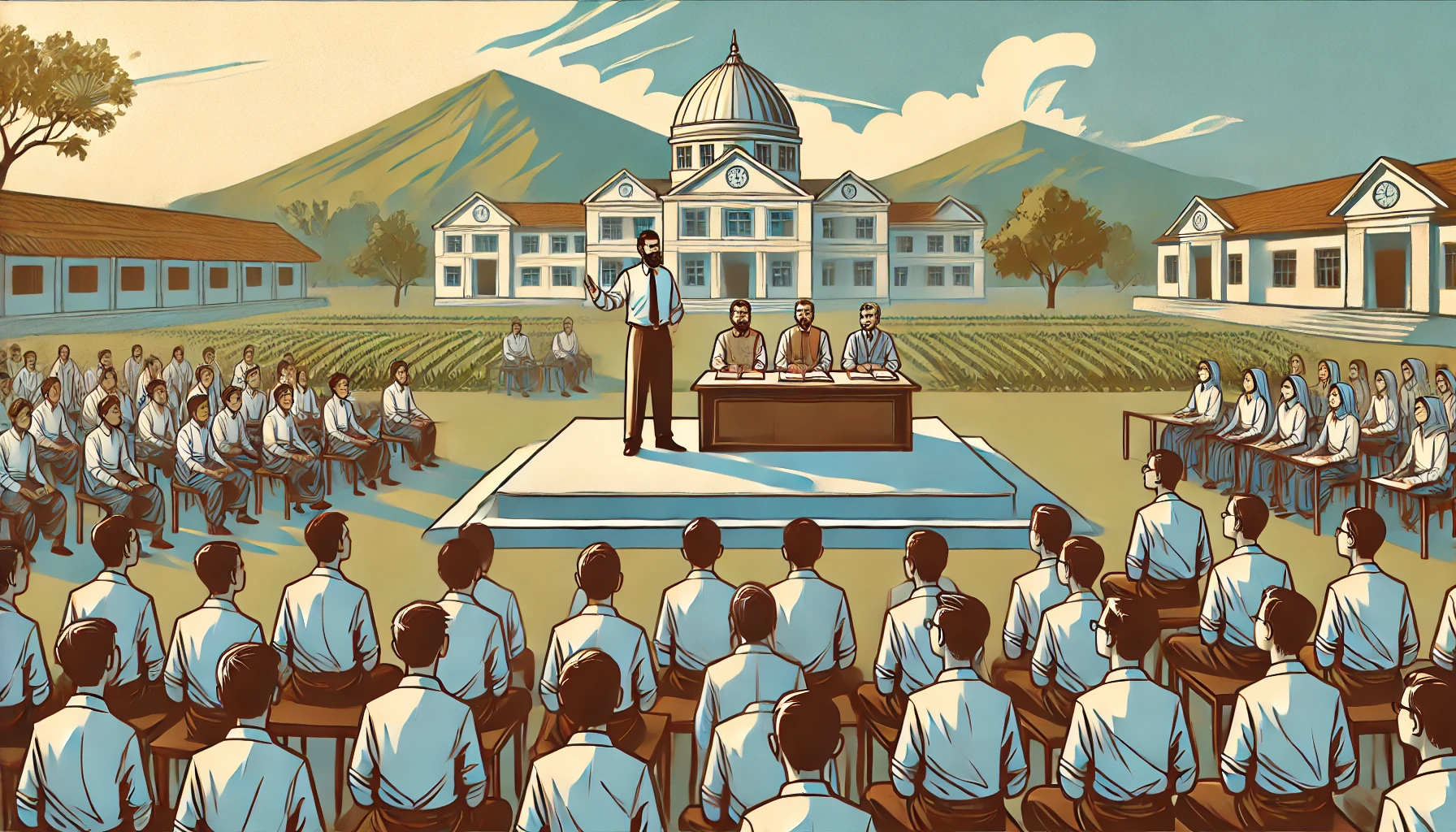
RSS Character Manufacturing Model: Global Export Possibility
Part 7A: Building Without Plumb and Line: Human Manufacturing Crisis Series
भारत/BG
Understanding How RSS Character Manufacturing Model Works
The RSS character manufacturing model: global export possibility isn’t theoretical speculation – it’s civilization’s practical necessity. We’ve documented across six articles how the human manufacturing crisis emerged when societies abandoned systematic character formation. We’ve examined how the guru became transactional teacher, how moral standards dissolved, how hierarchy collapsed into chaos, and how RSS preserved master craftsman principles while the West abandoned them.
The crisis is global. From American classrooms where teachers fear students, to European homes where parents negotiate with toddlers, to Asian economies producing brilliant test-takers who lack basic character – the dysfunction is universal. The West exported its broken education model worldwide through colonial systems and post-independence institutional capture, and now the whole world suffers from the same manufacturing defect.
But while the problem is global, the solution exists in a specific place: India. More specifically, in the RSS shakha model that has quietly perfected human manufacturing for a century while the rest of the world abandoned it. The question isn’t whether RSS’s approach works – we’ve established that definitively. The question is: can the model that manufactures disciplined swayamsevaks in Nagpur also work in New York, London, Tokyo, São Paulo?
The answer is yes – but with crucial adaptations. This article explores how the RSS character manufacturing model: global export possibility can address the human manufacturing crisis in four critical domains: schools, families, corporations, and nations. We examine the load-bearing walls (भार-वहन दीवारें) – the essential values of तप (discipline through pressure), दंड (authority to correct), and सेवा (service mentality) – that must be preserved in any adaptation.
Owing to the enormity of the contents we have split up this part into two blogs. While this part examines the first two domains – schools and families – where character manufacturing begins, the second will explore how properly manufactured individuals then organize into functional adult systems through corporate discipline and national policy. First, we rebuild the foundation. Then, we scale to civilization.
Schools: From Customer Service to Character Manufacturing Systems
Walk into any Western school and you’ll witness the human manufacturing crisis in its purest form. Teachers who can’t teach values because they’re legally prohibited. Administrators who manage compliance but can’t mold character. Counselors who therapy-speak problems but can’t forge discipline.
Research from the Thomas B. Fordham Institute documents how American schools have systematically dismantled disciplinary authority over the past three decades, with predictable results: schools that adopted restorative-justice models while diluting consequences have widely reported higher levels of disorder, fighting, and violent behavior, particularly affecting well-behaved students. The manufacturing defect spreads when you remove the tools required for character formation.
The transformation required isn’t incremental. It’s revolutionary. And it starts with one non-negotiable principle from the RSS character manufacturing model: global export possibility – restoring teacher authority.
Bringing Back Teacher Authority
Currently, teachers occupy an impossible position, as documented in educational reform analysis. They’re expected to educate but forbidden to discipline. Expected to shape minds but prohibited from shaping character. Expected to produce good citizens but restricted to transferring information.
This didn’t happen by accident. It was systematic dismantling of educational authority, replacing master craftsmen with service workers. The RSS character manufacturing model shows the alternative: the Mukhya Shikshak commands absolute respect. Not because he’s infallible, but because the role itself is sacred. Students don’t evaluate the teacher – they submit to the teaching. This isn’t oppression; it’s the basic requirement for transformation.
Practical implementation in schools globally:
First, legal protections for teachers exercising reasonable discipline. Not blank checks for abuse, but clear authority to maintain order through firm correction. Traditional Hindu educational systems always understood this balance – discipline without cruelty, firmness without violence. Countries like Singapore and Japan maintain such legal frameworks, which partly explains why their students consistently outperform Western counterparts not just academically but in character metrics.
According to PISA 2022 data, Singapore and Japan rank highest not only in academic performance but also in students’ respect for teachers and classroom discipline – metrics that Western nations have largely abandoned measuring because the results would be embarrassing.
Second, eliminate the customer-service model. Parents aren’t clients purchasing a service; they’re partners in the manufacturing process. When a teacher corrects their child, the default response should be “Thank you for caring enough to discipline” not “I’ll sue you for touching my child.”
This mindset shift mirrors what RSS shakhas have always maintained – parents entrust children to the organization understanding that character formation requires pressure, correction, and sometimes discomfort. The guru-shishya relationship supersedes consumer dynamics.
Third, restore hierarchy explicitly. The teacher is above the student. Period. Not democratically equal, not just “different perspectives” – hierarchically superior in the context of education. This isn’t controversial except to those who created the human manufacturing crisis by denying all hierarchy, as we documented in our authority collapse analysis.
Punishment as Educational Tool, Not Abuse
Here’s where the RSS character manufacturing model reveals its ideological clash with modern Western education most starkly. Modern pedagogy has categorized all punishment as abuse. Every correction becomes trauma. Every firm word becomes bullying.
RSS shakhas prove the alternative works through systematic imitation and obedience training. Trained swayamsevaks follow the Mukhya Shikshak’s orders precisely. Younger or newer swayamsevaks observe, imitate, and follow these seniors, training their minds and bodies to respond reflexively in the required manner without question. This repetition builds discipline into muscle memory and mental habit. Physical correction is rare but not prohibited. When used, it’s controlled, purposeful, and followed by explanation. The result? Disciplined individuals who later thank their trainers for the firmness that shaped them – a pattern completely absent in Western education where ex-students sue schools for alleged “trauma” from basic discipline.
Schools adopting RSS principles can implement:
Immediate correction for immediate offenses. When a student disrupts class, correction happens then, not after a meeting with counselors and parents three weeks later. The timing principle we explored in reward-punishment analysis applies universally: delayed punishment loses all effectiveness. This mirrors animal training principles – you don’t correct a dog’s behavior three weeks after the offense; the connection between action and consequence must be immediate.
Escalating responses matched to offense severity. Verbal correction first. Extra work (cleaning classrooms, organizing materials) for repeated issues. Physical correction (controlled, witnessed, documented) for serious violations. Suspension and expulsion reserved for extreme cases and they are not corrective tools. This graduated system exists in shakhas and produces measurable results without the chaos that American schools experience with their zero-tolerance policies that paradoxically increase violations.
Clear standards publicly known. No ambiguity. Students and parents know exactly what behaviors trigger what responses. The certainty itself becomes a deterrent. RSS shakhas operate on completely transparent rules – everyone knows the standards, everyone knows the consequences. Compare this to Western schools where disciplinary policies change based on political pressure rather than consistent principles.
Character Report Cards Alongside Academic
Currently, schools measure what doesn’t matter and ignore what does. Grade Point Average (GPA) tracks academic performance. Character goes unrecorded, unmeasured, unrewarded.
The RSS character manufacturing model suggests the alternative: systematic assessment of character alongside academics. Not touchy-feely “citizenship grades” that everyone passes, but rigorous evaluation of discipline, respect, service, and duty – the very metrics that traditional Hindu systems prioritized.
Implementation framework:
Monthly character assessments by teachers evaluating: punctuality, respect for authority, peer relationships, service contributions, handling of responsibility, response to correction. These aren’t subjective opinions but observable behaviors tracked systematically.
Semester character rankings publicly posted (yes, publicly – shame is a powerful motivator when properly deployed). Students below acceptable character standards face restrictions regardless of academic performance. Some private schools in India have begun implementing such systems with documented improvements in student behavior.
College admissions weighting character equally with academics. A 4.0 GPA with a 2.0 character score? Rejection. We don’t need more intelligent fools; we need capable humans. This mirrors the RSS approach where organizational responsibility comes only after demonstrated character, not mere capability.
Guru-Dakshina Mindset in Fee Payment
The commercialization of education – parents as clients, teachers as service providers, schools as businesses – lies at the heart of the human manufacturing crisis. When you’re selling a service, you can’t transform the customer. You can only satisfy them.
RSS operates on guru-dakshina principles: the offering comes from reverence, not entitlement. The student gives because the guru gave something invaluable – transformation. This principle, rooted in ancient Indian educational philosophy, creates fundamentally different dynamics than Western tuition payment. Once transformation is complete, the learner achieves a second birth – becoming द्विज (dwij, twice-born) through character formation, not merely credentialed through exam completion.
Schools globally can shift toward this model not by changing fee structures but by changing mindsets. When parents pay tuition, they should understand: “I’m entrusting my child to master craftsmen. I’m grateful they’re willing to undertake the difficult work of shaping my child’s character. I’ll support their authority, not undermine it.”
This mindset shift – from consumer purchasing services to disciple offering dakshina – transforms the entire educational relationship. And it’s critical for addressing the human manufacturing crisis that consumer-model education created.
Families: Restoring Manufacturing at the Source
Schools can only reinforce what families establish. The primary manufacturing unit is the home. And that’s where the human manufacturing crisis hits hardest – parents who’ve lost all authority, families without hierarchy, homes where children command and adults obey.
As we’ve explored throughout this series, traditional family structures understood what modern sociology denies: hierarchy enables healthy development. Children need parents above them, not beside them. The RSS character manufacturing model in family contexts means restoring this fundamental structure.
Reward-Punishment Balance Restored
The RSS model applies directly to families. Praise for discipline, not just achievement. Correction for mistakes, not humiliation but firm response. Responsibility given as reward, creating virtuous cycles where good behavior earns increased trust and authority.
Practical family application globally:
Daily routines mimicking shakha discipline. Fixed wake times. Family exercise. Shared meals without devices. Study periods. Service tasks. Not negotiable – expected. The consistency itself manufactures character. Research confirms what traditional cultures always knew: consistent family routines correlate strongly with children’s emotional regulation and academic performance.
RSS operates on guru-dakshina principles rooted in reverence, transformation, and above all, simple living. The offering comes from gratitude, not entitlement. The student gives because the guru gave something invaluable – transformation.
Immediate correction for immediate offenses. When your ten-year-old talks back, correction happens then, not after you’ve calmed down and drafted a therapeutic response. The misbehavior and the consequence must be connected in time for the lesson to imprint. This principle, fundamental to all effective training systems, gets completely inverted in modern parenting books that advise waiting until everyone is calm – which destroys the connection between action and consequence.
Public recognition for character achievements. Did your daughter help a struggling classmate? Praise her at dinner with siblings present. Did your son complete extra chores without being asked? Recognition amplifies the behavior. RSS shakhas practice this systematically – swayamsevaks receive public acknowledgment for character demonstrations, creating positive peer pressure.
सेवा भारती in Action: RSS Character Manufacturing Through Service
RSS swayamsevaks delivering food to Muslims during COVID lockdown. No cameras. No credit-taking. Just service.
Watch the beneficiary praise them: “They brought us food when we had nothing.”
Meanwhile, Muslim organizations publicly vow to eliminate RSS.
Character manufacturing produces servants. Ideology manufacturing produces slogans.
Guess which one feeds hungry people?
Physical Correction When Necessary
This is where the RSS character manufacturing model faces its strongest Western resistance. Modern parenting “experts” (none of whom have raised actually disciplined children) declare all physical correction as abuse. Meanwhile, traditional wisdom across cultures recognized controlled physical punishment as essential.
RSS shakhas prove the principle: physical correction is rare but not prohibited.
Guidelines for implementation that maintain RSS principles:
Never in anger. If you’re furious, wait until calm. The correction must be purposeful, not emotional venting. This distinguishes discipline from abuse – the former is calculated and constructive, the latter is reactive and destructive.
Proportionate to offense. Minor infractions get verbal correction. Major violations (violence toward siblings, severe disrespect to parents) warrant physical response. The escalation principle prevents both over-reaction and under-response.
Explained before and after. The child must understand why the correction is happening and what behavior would prevent recurrence. This educational component transforms punishment from mere pain into character lesson.
Controlled and limited. A firm swat, not a beating. Pain that teaches without injuring. The goal is to create strong enough memory that repetition becomes unnecessary. Studies from cultures that maintain controlled corporal punishment show no negative outcomes when applied within these strict parameters – contradicting Western research that conflates all physical correction with abuse.
Hierarchy Restoration: Parents > Children
The most fundamental shift required to address the human manufacturing crisis in families: explicit hierarchy. Parents are above children. Not “different but equal.” Not “just older with different perspectives.” Hierarchically superior with authority that isn’t contingent on children’s approval.
This core principle of the RSS character manufacturing model means:
Parents make decisions. Children obey. Discussion can happen after obedience, not instead of it. This inverts modern democratic parenting where children negotiate everything. Traditional Hindu family structures embodied this hierarchy, producing stable multigenerational households. Modern nuclear families rejecting hierarchy produce chaos.
Parents have privacy children don’t. The master bedroom isn’t a democracy. Parents’ conversations aren’t subject to children’s input. Boundaries teach children that not all spaces belong to them – essential preparation for adult life where most spaces don’t belong to them.
Parents’ needs sometimes supersede children’s wants. When the family needs the money for essentials, the teenager doesn’t get the latest iPhone no matter how much he “needs” it for social reasons. This teaches resource prioritization and delayed gratification.
Elder siblings have authority over younger ones. Not parental authority, but real authority nonetheless. This teaches leadership to elders and obedience to youngers – both essential for character formation. RSS shakhas implement this through their hierarchical system where senior swayamsevaks guide juniors.
Conclusion: Foundation Rebuilt
Schools and families form the manufacturing base – where raw human material receives its initial shaping. Restore teacher authority and parental hierarchy in these domains, and you create the foundation. But foundation alone doesn’t build civilization. Properly manufactured individuals must then organize into functional adult systems. Part 7B examines how the RSS character manufacturing system scales from youth formation to institutional governance – from workplace discipline to national policy.
Series Progress: The blog is followed by the next part of Part A7A that will conclude the series A: RSS Character Manufacturing System: From Workplace to Nation
Feature Image: Click here to view the image.
Watch the Videos
Glossary of Terms
- RSS Shakha: The basic training unit of the Rashtriya Swayamsevak Sangh where discipline, service, and character formation are systematically practiced.
- Character Manufacturing: The deliberate, structured process of shaping human behavior, discipline, and moral responsibility.
- Human Manufacturing Crisis: A civilizational breakdown caused by the abandonment of systematic character formation in modern societies.
- Guru–Shishya Relationship: A traditional Indian educational framework where authority, discipline, and character flow from teacher to student.
- Hierarchy: An ordered structure of authority essential for effective education, family stability, and institutional functioning.
- Load-Bearing Walls (भार-वहन दीवारें): Core values without which an entire civilizational or institutional structure collapses.
- Tap (तप): Discipline developed through sustained pressure, practice, and self-control.
- Dand (दंड): Legitimate authority to correct behavior for the purpose of discipline and character formation.
- Seva (सेवा): A service-oriented mindset emphasizing duty over entitlement.
- Grade Point Average (GPA): A numerical system used to measure academic performance, excluding character evaluation.
- Guru-Dakshina: An offering made out of reverence and gratitude for transformation received from a teacher.
- Dwij (Twice-Born): A person reborn through character formation, not merely certified through academic credentials.
#Character #Education #Discipline #Society #UncontrolledChild #ChildDiscipline #CharacterCrisis #SocialDecay #RSS #शाखा #अनुशासन #चरित्र #अधिकारपतन #मानवनिर्माण #अनुशासन #पदानुक्रम #HinduinfoPedia #AuthorityCollapse #HumanManufacturing #SocialDiscipline #HierarchyMatters #HinduinfoPedia #बिनासाहूलऔरडोरीकानिर्माण #BuildingWithoutPlumbandLine
Previous Blogs of The Series
- https://hinduinfopedia.org/manufacturing-defect-when-humans-stopped-making-humans/ https://hinduinfopedia.in/मानव निर्माण दोष
- https://hinduinfopedia.org/kbc-guru-to-guide-not-just-a-teacher/ https://hinduinfopedia.in/KBC गुरु से मार्गदर्शक
- https://hinduinfopedia.org/kbc-and-the-plumb-line-when-a-society-loses-its-moral-measure/ https://hinduinfopedia.in/KBC और साहूल
- https://hinduinfopedia.org/kbc-exposing-authority-collapse-in-human-manufacturing/ https://hinduinfopedia.in/?p=24463
- https://hinduinfopedia.org/building-without-master-craftsman-compare-with-rss-assembly/ https://hinduinfopedia.in/?p=24580
- https://hinduinfopedia.org/uncontrolled-child-development-the-kbc-quiz-show-warning/ https://hinduinfopedia.in/?p=24745
Related Reading
On Educational Reform:
- Gurukul: Truths of Hindu Wisdom
- Sixteen Sanskaras: Life’s Spiritual Journey
- Indian Education System and Its Legacy
On Civilizational Manufacturing:
On Global Patterns:
Follow us:
- English YouTube: https://www.youtube.com/@Hinduofficialstation
- Hindi YouTube: https://www.youtube.com/@HinduinfopediaIn
- X: https://x.com/HinduInfopedia
- Instagram: https://www.instagram.com/hinduinfopedia/
- Facebook: https://www.facebook.com/Hinduinfopediaofficial
- Threads: https://www.threads.com/@hinduinfopedia
Leave a Reply