

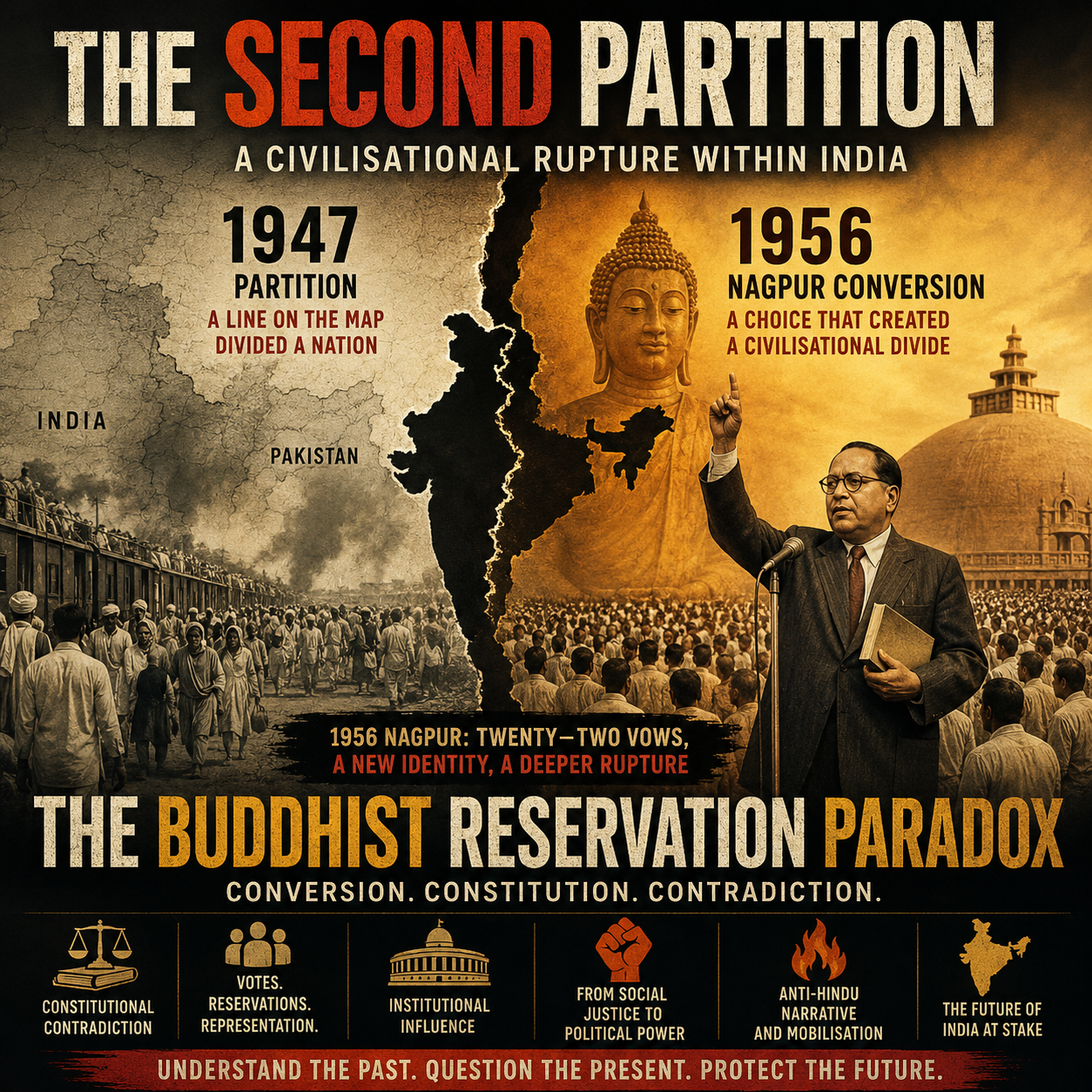
The Second Partition: Why the Buddhist Reservation Paradox Series (0)
Series Prologue — The Buddhist Reservation Paradox Part 0
भारत / GB
In 1947 India was divided by a border drawn in five weeks. In 1956 it was divided by something chosen — and the choice was made to wound.
This prologue sets the historical and moral frame for a series examining the Buddhist Reservation Paradox — the constitutional contradiction at the heart of independent India’s most consequential unresolved rupture. The blogs that follow are the argument. This blog is the reason the argument needs to be made.
Introduction: The Second Partition
The Second Partition: how Nagpur 1956 became India’s most consequential — and least examined — civilisational rupture. It has no commemorative date, no border commission report, no list of the displaced. It was not imposed by a colonial power drawing lines on a map. It was chosen — deliberately, strategically, and with precise political intent — by one of the most brilliant constitutional minds India has ever produced. And unlike the first Partition, which separated two nations with a border between them, the Second Partition operates entirely inside India’s constitutional framework — using the instruments designed to repair Indian society as the platform for a campaign to rupture it.
On October 14, 1956, in Nagpur, Dr. B.R. Ambedkar led 380,000 people in a mass conversion to Buddhism and administered twenty-two vows that explicitly rejected every Hindu deity, every Hindu ritual, and Hinduism itself as harmful to humanity. He died six weeks later. The movement he set in motion did not. Seven decades on, that movement has produced sitting legislators calling for the elimination of Sanatana Dharma from assembly floors. This series documents how we arrived there — and what the constitutional machinery enabling that journey looks like.
What Made Partition Irreversible — And Why the Second Partition Belongs in the Same Sentence
The Partition of 1947 displaced an estimated fifteen million people and produced one of the largest forced migrations in recorded history. The Radcliffe Line — drawn by a man who had never visited India, completed in five weeks — sorted a subcontinent into Muslim Pakistan and Hindu India with consequences that no subsequent diplomacy has fully resolved. What made Partition so structurally devastating was not only the immediate human cost. It was the irreversibility. Once the sorting happened, it could not be undone.
The Second Partition created permanent facts of a different kind. Not territorial — civilisational. Ambedkar did not draw a line on a map. He drew a line through Hindu society — a society that was itself, by 1956, already the wounded product of two centuries of systematic colonial dismemberment.
The rigidified, legally-codified, politically-weaponised caste order that Ambedkar experienced as a totalising oppressive system was not primarily the expression of Sanatana Dharma. Pre-colonial jati existed — regional, varied, and in many respects negotiable through occupation, wealth, and group mobility. What Ambedkar encountered as a fixed, all-India, bureaucratically enforced ladder was decisively British colonial administration’s architecture — the 1871 Census converting fluid identities into permanent legal categories, the Criminal Tribes Act branding entire jatis as hereditary criminals, the Communal Award making caste the currency of political power. He fought real oppression. Its decisive architect, in the form he experienced it, was British colonial governance — not Sanatana Dharma.
Partition was worse in its immediate human cost. The Second Partition is worse in one specific respect: it was designed to be invisible as a rupture while functioning as one. And where 1947 created two separate nations, the Second Partition operates inside India’s own constitutional framework — using the reservation system built on Hindu taxpayer money to campaign against the Hindu majority that funds it.
October 14, 1956: Insult Added to Injury on the Day of Dussehra
The conversion was announced for Vijayadasami — Dussehra — the Hindu festival celebrating Lord Ram’s victory over Ravana. This was not symbolism. It was a calculated wound. Ambedkar, who understood political theatre as precisely as he understood constitutional law, chose the holiest day of Hindu triumph to administer vows declaring Lord Ram — and every Hindu deity — unworthy of veneration, and Hinduism itself harmful to humanity. On the day Hindus celebrate their god’s victory, he administered vows rejecting that god entirely. Insult added to injury — deliberately, publicly, at scale.
The twenty-two vows are the foundational document of everything this series examines. Vow 1 rejects Brahma, Vishnu, and Maheshwara. Vow 2 rejects Rama and Krishna. Vow 5 — the most constitutionally consequential — declares the belief in Buddha as an avatar of Vishnu to be “sheer madness and false propaganda,” severing any theological bridge between Buddhism and the Hindu framework. Vow 19 states: “I renounce Hinduism which is harmful for humanity and impedes the advancement and development of humanity.” These are not theological refinements. They are a declaration of total civilisational exit — administered on the day Hindus celebrate. Gandhi sought reform from within. Ambedkar chose exit — and made the exit a public humiliation of the house he was leaving. The vows are still administered today. In 2024, a prominent Buddhist leader in Delhi instructed 100,000 Buddhists not to pray to Hindu gods. The insult of Dussehra 1956 is renewed at every such gathering. It was not a moment. It was a template.
The Caste Narrative Was a British Injection — Not a Hindu Truth
For seven decades the dominant framing of the 1956 conversion has rested on a premise that was not arrived at organically — it was constructed by the same colonial administration that built the rigid caste order it then described as ancient Hindu tradition. The narrative of Hinduism as the source of centuries of caste oppression is a British-engineered construct, delivered to Ambedkar as historical fact and accepted as such by a man of exceptional intellect who trusted the colonial archive more than it deserved.
The historical record is clear for those who examine it without the colonial lens. The Varna system as originally conceived was merit-based and fluid — determined by conduct and qualification, not birth. The Manusmriti that Ambedkar burned on Christmas Day 1927 was not the constitution of Hinduism. Unlike the Bible or the Quran, it carries no centralised doctrinal authority in Hindu practice — it is one text among hundreds, never universally applied. To burn it as Hinduism’s founding charter was to accept the coloniser’s misclassification as historical truth. Sanatana Dharma’s own tradition is one of spiritual equality — the oppressive caste architecture Ambedkar experienced was the coloniser’s construction, not dharma’s design. He fought the right injustice. He named the wrong perpetrator.
The Oppressed Who Set Out to Become the Oppressors
The movement did not stop at liberation. Its inheritors converted liberation into a programme with a specific numerical target — ten crore converts — a specific political goal — Buddhist-majority India — a foreign funding infrastructure, and an institutional strategy of occupying judiciary, legislature, bureaucracy, and academia to advance it. What began as a response to colonially-engineered oppression has become, in the hands of its most aggressive inheritors, an attempt at a new oppression: more sophisticated, constitutionally armoured, and funded by the very civilisation it targets.
The moral inversion is total. Those who experienced oppression — however misdirected their identification of its source — have organised not to end oppression but to redirect it. जिस थाली में खाते हैं उसी में छेद करते हैं. The oppressed trying to become the oppressors — using the plate of the wrongly accused to drill holes in that same plate.
What the Buddhist Reservation Paradox Has Unleashed — When Family Arguments Invite the Neighbours In
There is a principle of elementary social ethics that the Buddhist Reservation Paradox has violated at civilisational scale: a dispute within a family does not give the neighbours the right to join in the abuse. When Ambedkar attacked Hinduism — however misdirected that attack — it was a family argument. Painful, consequential, with some legitimate grievance about colonial-era conditions. Family arguments happen. They do not, under any ethical framework, constitute an invitation for outsiders to walk into the house and start calling the same names.
That is precisely what has happened. The Ambedkarite intellectual framework — Hinduism as oppressor, caste as Hindu crime, Sanatana Dharma as an instrument of subjugation — has been adopted wholesale by forces with no standing in the family at all. Christian conversion organisations use it as justification for missionary campaigns. Muslim political leadership deploys it to delegitimise Hindu social claims. And most visibly: in Tamil Nadu, a Minister who was later promoted to Deputy Chief Minister stood before a public gathering and declared that Sanatana Dharma should be eradicated the way one eradicates dengue and malaria — diseases, not a civilisation. In the new assembly, the demand has advanced from metaphor to explicit declaration: not the critique of Sanatana, not its reform — its elimination.
None of this would have the political oxygen it has today without the Buddhist Reservation Paradox providing the intellectual cover. The paradox normalised the premise that attacking Sanatana Dharma is a constitutional right — even a constitutional duty. From that normalisation, the neighbours concluded they were welcome. The door was left open from inside. Now they are calling the names in the legislative hall.
What the Series Will Establish
The blogs that follow build the constitutional and moral case in full. Prologue Part 2 examines the two intellectual errors at the root of the misdirected war: Ambedkar’s selective Manusmriti reading and his conflation of Jawaharlal Nehru with Hinduism. Blogs 1 through 7 document the paradox systematically — from its constitutional structure, through the conquest campaign and institutional capture, to the dharmic ethics of gratitude that the movement has abandoned.
One series. One paradox. One civilisation asking what happens when the instruments built to repair it are used to dismantle it instead — and when the resulting rupture gives the neighbours a reason to knock the walls down.
The series continues with: The Wrong Target — How Ambedkar Declared War on the Wrong Enemy (Prologue Part 2).
Feature Image: Click here to view the image.
Videos
Glossary of Terms
- Buddhist Reservation Paradox: The central concept of this series, describing the perceived constitutional contradiction in which individuals who renounce Hinduism through conversion to Buddhism continue to benefit from reservation provisions originally created to address historical discrimination within Hindu society.
- Second Partition: A term coined in this series to describe the civilisational rupture created by the 1956 mass conversion to Buddhism, contrasted with the territorial Partition of 1947. The phrase is used as an analytical metaphor rather than a legal or historical classification.
- Nagpur Conversion: The mass conversion ceremony held on October 14, 1956, in Nagpur, where Dr. B.R. Ambedkar and hundreds of thousands of followers embraced Buddhism and accepted the Twenty-Two Vows.
- Twenty-Two Vows: The set of vows administered by Dr. B.R. Ambedkar during the 1956 conversion ceremony, requiring converts to reject Hindu deities, rituals, and beliefs while embracing Buddhism.
- Vijayadasami (Dussehra): A major Hindu festival celebrating the victory of Lord Rama over Ravana and the triumph of dharma over adharma. Ambedkar deliberately chose this day for the Nagpur conversion ceremony.
- Civilisational Rupture: A key phrase used in this series to describe a deep cultural, religious, and social separation within a civilisation without the creation of territorial borders.
- Radcliffe Line: The boundary drawn in 1947 by Sir Cyril Radcliffe that divided British India into India and Pakistan during Partition.
- Communal Award: A British colonial policy introduced in 1932 that expanded separate electorates and reinforced social and political divisions among Indian communities.
- Criminal Tribes Act: A colonial law that classified entire communities as hereditary criminals, contributing to institutionalised discrimination based on birth.
- Sanatana Dharma: The traditional self-description of Hindu civilisation and its spiritual framework, often translated as the Eternal Dharma or Eternal Order.
- Varna System: The ancient social framework described in Hindu texts, traditionally linked to qualities and duties rather than hereditary caste identity.
- Manusmriti: An ancient Dharmashastra text frequently cited in debates on caste, law, and social organisation. It became a focal point of Ambedkar’s criticism of Hindu social structures.
- Ambedkarite Movement: The social, political, and ideological movement inspired by the teachings, writings, and activism of Dr. B.R. Ambedkar.
- Constitutional Machinery: A phrase used in this series to describe the legal, political, and institutional structures of the Indian Constitution through which social policies, including reservations, are implemented.
- Institutional Capture: A term used in political analysis to describe efforts by ideological movements to gain influence within key institutions such as the judiciary, legislature, bureaucracy, academia, and media.
#Ambedkar #Buddhism #Reservation #Dalit #Conversion #Hinduism #Constitution #Caste #India #Politics #SanatanaDharma #Nagpur #History #Buddhist #HinduinfoPedia
Related and Supporting Blogs for the Series
1. Ambedkar’s Buddhist Political Move: Divergence from Gandhi on Caste Issues
Meta Description: Explore the deep ideological rift between Dr. B.R. Ambedkar and Mahatma Gandhi over caste reform. This article analyzes Ambedkar’s sudden, strategic political turn toward Buddhism as a radical rejection of incremental Hindu social integration.
2. Ambedkar’s Buddhist Conversion: Challenging Caste with New Faith
Meta Description: Discover how Dr. B.R. Ambedkar’s historic conversion to Buddhism served as a monumental political act to dismantle caste hierarchies. Examine his path to seeking absolute equality and social justice outside traditional Hindu systems.
3. Manusmriti Critique of Ambedkar and Its Modern Relevance
Meta Description: An in-depth analysis of Dr. B.R. Ambedkar’s powerful critique of the Manusmriti’s social hierarchies. Read how modern legal systems have made these ancient codes obsolete, paving the way for an egalitarian, democratic society.
4. Ambedkar’s Criticism and the Manusmriti: Insights and Impact
Meta Description: Examine Dr. B.R. Ambedkar’s rigorous scholarly challenge against the Manusmriti’s institutionalized inequalities. Learn how his criticisms reshaped India’s legal reforms, transforming traditional varna systems into modern frameworks of justice and human rights.
5. Ambedkar’s Criticism of Manusmriti: A Modern Review
Meta Description: A contemporary review of Dr. B.R. Ambedkar’s evaluation of the Manusmriti. This piece reflects on his enduring legacy, the historical context of Hindu scriptures, and India’s ongoing evolution toward complete social and legal equity.
6. Buddhist Reservation Paradox: Why Buddhists Get SC Benefits
Meta Description: Unpack the complex constitutional debate surrounding the Buddhist Reservation Paradox. This article explores how Buddhist converts retain Scheduled Caste benefits despite explicitly rejecting the Hindu social framework that initially necessitated those legal protections.
7. Manusmriti Gender Equality Analysis
Meta Description: Delve into a balanced textual analysis of gender dynamics within the Manusmriti. This post examines how ancient social roles, duties, and verses align or conflict with modern standards of gender equality and personal freedom.
8. Manusmriti Women’s Rights Insights: Examining Various Perspectives
Meta Description: Explore the multi-layered perspectives on women’s rights in the Manusmriti. From historical restrictions to protective guidelines, this blog bridges ancient text interpretations with contemporary feminist and socio-legal frameworks in India.
9. Manusmriti Ritual Purity Insights: Bridging Ancient Wisdom with Modern Living
Meta Description: Understand the concept of ritual purity as outlined in the Manusmriti. This article analyzes its ancient socio-religious intentions and evaluates how these traditional hygiene and spiritual practices apply to modern everyday living.
10. Manusmriti Legal System Insights: Ancient to Modern Justice
Meta Description: Trace the evolution of justice from the ancient legal tenets of the Manusmriti to modern Indian jurisprudence. This blog analyzes historical varna-based court dynamics against today’s principles of absolute equality before the law.
11. Manusmriti Varna Determination: Ancient Insights
Meta Description: How was social standing decided in ancient India? This blog dives into the Manusmriti’s guidelines on varna determination, analyzing whether the system was originally based on rigid birthright or individual merit and occupation.
12. Manusmriti Social Structure Analysis: Ancient vs. Modern
Meta Description: A comparative study contrasting the rigid social stratifications found in the Manusmriti with modern democratic values. Learn how centuries of colonial policies and shifting interpretations transformed the ancient varna system into a caste framework.
13. Caste Systems and Definition of Brahmin Analyzed
Meta Description: Deconstruct the historical and textual definition of a Brahmin within the Hindu caste system. This analysis explores the evolution of the priesthood, societal duties, and the shift from character-based roles to birth-based privileges.
14. Vedic Varna System: Unveiling Its Impact on Architecture
Meta Description: Unveil the fascinating connection between ancient social structures and spatial design. This article reveals how the Vedic varna system historically influenced town planning, residential layouts, and traditional Vastu Shastra architectural principles.
The Blogs of the Series
https://hinduinfopedia.org/the-second-partition-why-the-buddhist-reservation-paradox-series-0/
Leave a Reply